

You have been dizzy for weeks. Your scans are clear. So you did what most people do at 11pm with a sore, stiff neck and a floaty head: you started shopping for a gadget. A TENS neck massager. A traction device. Something, anything, to make the wooziness stop.
Here is the honest comparison you were looking for, TENS (like the TENStim) versus cervical traction, judged not on which relieves neck pain, but on the only thing that matters for giddiness: which one actually fixes the balance signal. The short version may surprise you: for dizziness, neither gadget is the real answer.
Read this first: get cleared before using any device
Do not treat dizziness with a neck gadget until a doctor has checked you. Dizziness can come from the inner ear, the brain, the heart or the blood vessels, not just the neck, and some causes are emergencies. Call 995 or go to A&E now for sudden severe dizziness, slurred speech, a drooping face, one-sided weakness or numbness, sudden trouble seeing or walking, fainting, chest pain, a “worst-ever” headache, or sudden severe neck pain after a fall or knock. Forceful home traction on a neck near the vertebral arteries carries real risk, and it can trigger dizziness. This article is educational, and it assumes a doctor has ruled the serious causes out.
The short version
- Dizziness is a signal problem, not a pain problem. Your neck helps tell your brain where your head is. Neck-related giddiness happens when it sends the wrong reading, not because a muscle hurts.
- TENS (like the TENStim) is a pain tool. It masks pain signals. It does not reach the joints and position sensors that cause the dizziness, so it treats the wrong thing.
- Traction is closer to the point. It physically unloads the upper neck, where the balance sensors are densest, so mechanically it targets the right area.
- But home traction is a guess. Pull at the wrong angle and you can make dizziness worse. A gadget does not measure your neck.
- Neither device fixes the cause. Both are downstream of the real question: what does your neck’s structure actually look like? That takes a measurement, not a purchase.
Related reading
First, the Right Question
Every generic comparison of these devices asks the same thing: which one relieves neck pain better? For giddiness, that is the wrong question, and it is why people keep buying the wrong tool.
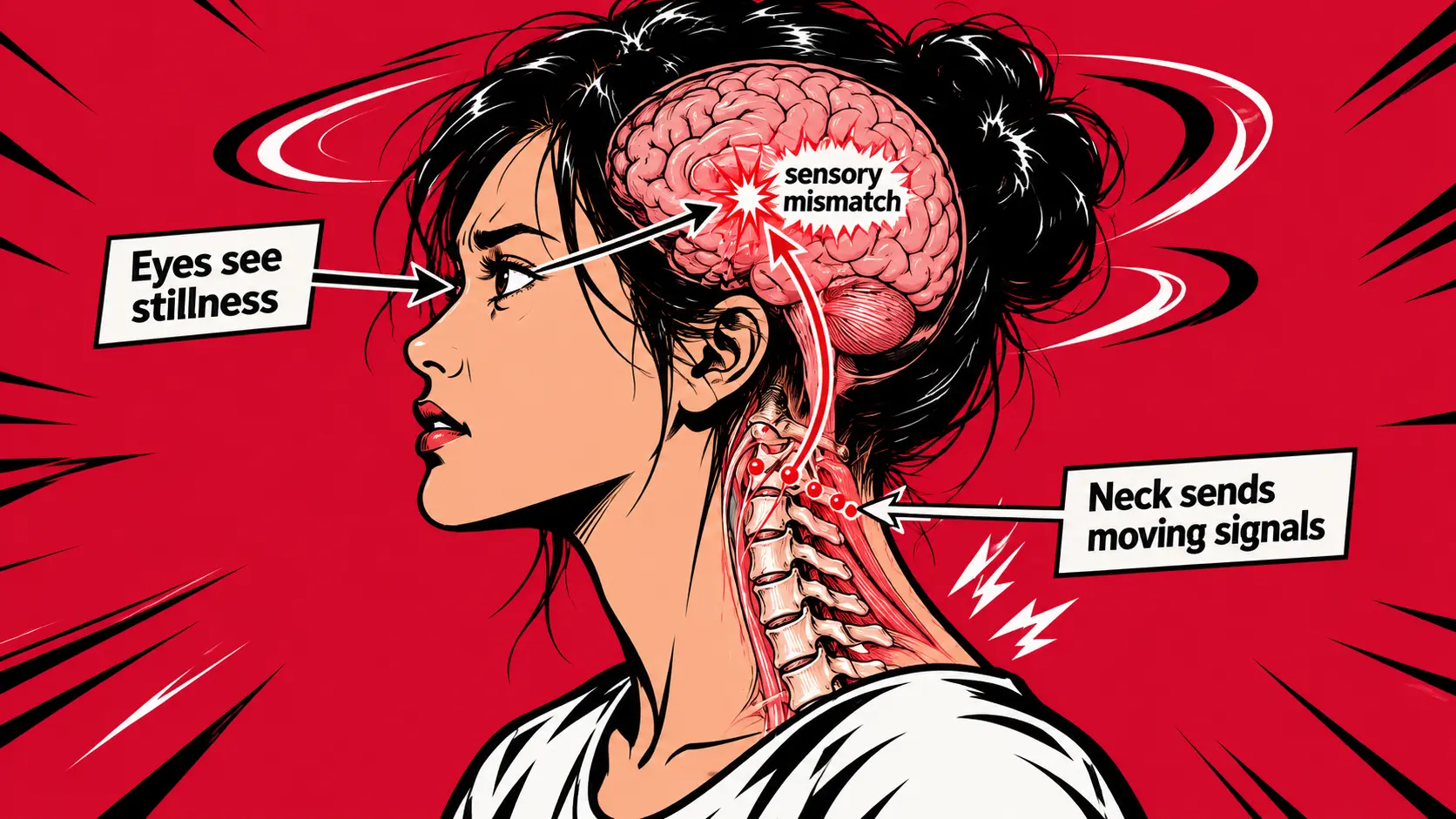
Neck-related dizziness (its clinical name is cervicogenic dizziness) is not really a pain problem. Your neck is one of three systems your brain uses to know where your head is in space, alongside your eyes and your inner ear. The joints and small muscles at the top of your neck are packed with position sensors. When those sensors are irritated and send confused signals, your brain gets one story from your neck and a different one from your eyes and ears. That mismatch is what you feel as floating, swaying or wooziness. So the real test for any tool is not “does it dull pain?” but “does it fix the faulty signal?” Judge TENS and traction by that, and they look very different.
How TENS Devices Like the TENStim Work
If you have been shopping for home remedies, you have probably found TENS neck massagers, with the TENStim one of the better-known names. These are all TENS devices, transcutaneous electrical nerve stimulation, and they work the same way: pads deliver small electrical pulses into the skin and surface muscles.
For an ordinary stiff, sore neck after a long day at a screen, a TENS device can feel genuinely good. The pulses tap into what pain scientists call the “gate control” system: they crowd the nerve pathways with harmless buzzing sensations, which helps drown out pain traffic before it reaches the brain, and they relax tense surface muscle. As a home tool for muscle tension and pain, that is a fair use.
The honest limit
TENS is a pain-modulation technology. It quiets pain signals at the surface. It does not physically decompress a compressed joint, and it does not reset the position sensors that feed your balance. So even for neck pain the evidence is only weak and inconsistent (Cochrane), and for dizziness there is no good evidence at all, because it is aimed at the wrong system. Blasting electrical buzzing into an already-confused balance system adds noise; it does not restore the signal.
What Cervical Traction Does Differently
Cervical traction is a completely different kind of intervention. Instead of electrical signals, it applies a gentle mechanical pull that separates the neck joints slightly and takes load off them. And crucially, it acts where the problem lives.
The top of your neck is one of the body’s densest balance-sensor zones.
The small suboccipital muscles at the base of your skull carry one of the highest muscle-spindle (position-sensor) densities anywhere in the body, up to roughly 240 per gram in one of them, far more than big muscles like the thigh (Kulkarni 2001). Together with the richly-innervated joints of the top three neck segments, this region is effectively a balance antenna. When those joints are stiff and irritated, the antenna sends a distorted signal. Because traction physically unloads exactly this area, it targets the source of the faulty balance data, not just the ache. That is a real mechanical advantage over electrical stimulation for dizziness.
The research backs the direction. Reviews of hands-on neck treatment, which includes traction and mobilisation, find it can reduce dizziness, improve neck movement, and improve head-repositioning accuracy in people with cervicogenic dizziness, though the studies are still modest in quality (De Vestel 2022). One of the better trials found hands-on neck treatment beat a placebo on how often dizziness struck and how much it disrupted daily life over 12 months (Reid 2015). So traction-type treatment is genuinely more on-target than TENS for giddiness.
TENS vs Traction: The Comparison
Judged on dizziness, not just pain relief.
| What matters | TENS (e.g. TENStim) | Cervical traction |
|---|---|---|
| What it does | Sends electrical pulses to mask pain signals | Applies a mechanical pull to unload the joints |
| Where it acts | Surface skin and muscle | Deep joints and position sensors of the upper neck |
| Effect on pain | May soothe tension; evidence weak and inconsistent | Can ease pain by decompressing the joints |
| Effect on dizziness | Wrong target; no good evidence for giddiness | On-target; can reduce dizziness in the right cases |
| Risk for a dizzy neck | Low; skin tingling | Real: wrong angle or force can worsen dizziness |
| Does it measure your neck? | No | No |
Read the last two rows carefully. Traction wins the dizziness question, but it carries a real risk if applied blindly, and neither device measures the one thing that determines whether it will help: the actual shape and alignment of your neck.
Why Neither Gadget Is the Answer
Here is the trap almost everyone falls into. You feel dizzy, so you buy a device, and you hope. But hope is not a plan, and a gadget cannot see inside your neck.
TENS treats the wrong problem, it works on pain, not balance. And while traction works on the right area, a home traction unit or an over-the-door pulley applies a generic, straight-line pull to every neck the same way. If your neck’s natural curve has flattened or reversed, pulling it in the wrong direction can irritate the very sensors you are trying to calm, which is exactly why blind traction can make dizziness worse. Generic pulling, at an angle nobody measured, is a shot in the dark.
The same device that rescues one person floors the next, and that is the whole problem.
Browse the neck-dizziness forums and two patterns repeat. On traction, some people describe the giddiness easing quickly with gentle, guided neck traction, and almost in the same breath, others describe overdoing it and feeling worse, stiff and light-headed, “like I might faint the next day.” On TENS, most credit it for easing neck tension, while a sensitive few say it left them more dizzy, even close to fainting. The lesson buried in these stories is not “traction good, TENS bad.” It is that the outcome swings on dose, angle, and how each person’s neck is actually built, none of which a gadget can assess. That unpredictability is exactly what a measurement removes.
These are anecdotes from the internet, not clinic outcomes or advice. Everyone’s neck is different, individual results vary widely, and no one should self-traction a dizzy neck without being assessed first.
The reason these gadgets so often disappoint is not that traction is useless. It is that using traction correctly depends on knowing the shape of your neck first, and no device on a shopping site can tell you that. That is the missing step.
What Actually Resets the Signal
If the problem is a distorted balance signal from a mis-shaped, irritated upper neck, the fix is to correct the structure, done in the right place, at the right angle, based on a measurement rather than a guess. That is what a structural assessment is for.
Clinical view · 29 years, 3,000+ cases
People arrive at the clinic with a drawer of gadgets, a TENS unit, a traction strap, and the same story: it helped the ache for an hour and did nothing for the dizziness. That makes sense to me. You cannot buzz a balance signal back into place, and you cannot safely pull a neck you have never measured. The first move is always the same, see the structure on a standing X-ray, then correct it precisely, rather than guessing at home.
At Dr Neck Pain, traction is not a device you take home, it is one controlled phase of a measured protocol. The R3NEW X™ approach starts by measuring your neck’s curve and upper-neck alignment on a standing X-ray, the picture a shopping-site gadget can never give you, and then works in three phases: Release (the AxisFlex Protocol™ frees the deep, overworked upper-neck muscles), Reset (the AxisFlow Adjust™ frees the stiff joints sending the confused signals), and Recalibrate (NeuroPosture Calibration™ retrains your nervous system to trust the neck again). Applied at the right segment and angle, that is traction’s benefit done properly, plus the two steps a device cannot do.
Before you spend on a gadget
- A doctor comes first. Have the ear, brain, heart and other causes ruled out before treating a dizzy neck with anything.
- TENS is fine for ordinary pain and tension, just not a dizziness fix.
- Do not self-traction a dizzy neck. The wrong angle can make it worse; this belongs in trained hands after a measurement.
- Cost and regulation: chiropractic is not MOH-registered in Singapore, is not a substitute for medical care, and is not Medisave-claimable.
Tried the gadgets, still floaty? If the buzzing and the pulling have not touched your dizziness, the missing step is measurement. Once your doctor has ruled out the serious causes, a standing X-ray assessment can show whether your neck is the reason, and you can see how other Singapore patients progressed first.
Book a dizziness assessment →Frequently Asked Questions
Can a TENS unit like the TENStim help with dizziness?
Not really, it is built for pain, not balance. TENS devices send electrical pulses that mask pain signals at the surface. Neck-related dizziness comes from irritated joints and position sensors in the upper neck sending faulty balance data, which TENS does not reach or reset. It can soothe a sore, tense neck, but there is no good evidence it relieves cervicogenic dizziness. See a doctor first to rule out inner-ear and other causes.
Is cervical traction better than TENS for neck dizziness?
For dizziness specifically, yes, traction is more on-target, but that does not make a home traction device the answer. Traction physically unloads the upper neck where the balance sensors are densest, so it addresses the right area, and hands-on neck treatment that includes traction can reduce dizziness in the right cases. TENS only masks pain. The catch: home traction applies a generic pull to a neck nobody has measured, and the wrong angle can worsen dizziness. The mechanism matters, but so does doing it correctly.
Is it safe to use a neck traction device at home if I feel dizzy?
Not without an assessment first. Cervical traction on a dizzy neck can make the dizziness worse if the angle or force is wrong, and forceful traction near the neck’s arteries carries real risk. Dizziness should always be checked by a doctor first to rule out inner-ear, brain, heart and vascular causes. If the neck is then found to be the driver, traction-type treatment belongs in trained hands, guided by a measurement of your neck, not applied blindly at home.
Why do gadgets help my neck pain but not my dizziness?
Because pain and dizziness are different problems. A stiff, sore neck responds to things that relax muscle and quiet pain, which is what a TENS unit does. Dizziness comes from the neck sending your brain the wrong position data, a signal problem, not a pain problem. Relaxing a surface muscle does not correct a distorted balance signal from irritated upper-neck joints. That is why the ache eases but the floaty feeling stays.
What actually fixes cervicogenic dizziness then?
Correcting the neck itself, once serious causes are ruled out. The evidence points to hands-on neck treatment and targeted rehabilitation rather than gadgets. Because the problem is a mis-shaped, irritated upper neck sending faulty balance signals, the useful first step is to measure the neck’s curve and alignment on a standing X-ray, then correct the structure precisely, at the right segment and angle. A device bought online cannot measure your neck, which is the step that decides what will actually help.
Stop buying gadgets. Measure the neck.
If TENS and traction devices have not touched your giddiness, the missing piece is a picture of your neck under gravity. Once your doctor has cleared the serious causes, a standing X-ray assessment shows whether your neck is the reason, and what can be done about it.
References
- Kroeling P, Gross A, Graham N, et al. Electrotherapy for neck pain. Cochrane Database Syst Rev. 2013;(8):CD004251. PMID 23979926. PubMed
- De Vestel C, Vereeck L, Reid SA, Van Rompaey V, Lemmens J, De Hertogh W. Systematic review and meta-analysis of the therapeutic management of patients with cervicogenic dizziness. J Man Manip Ther. 2022;30(5):273-283. PMID 35383538. PubMed
- Reid SA, Callister R, Snodgrass SJ, Katekar MG, Rivett DA. Manual therapy for cervicogenic dizziness: long-term outcomes of a randomised trial. Man Ther. 2015;20(1):148-156. PMID 25220110. PubMed
- Li Y, Yang L, Dai C, Peng B. Proprioceptive cervicogenic dizziness: a narrative review of pathogenesis, diagnosis, and treatment. J Clin Med. 2022;11(21):6293. PMID 36362521. PubMed
- Kulkarni V, Chandy MJ, Babu KS. Quantitative study of muscle spindles in suboccipital muscles of human foetuses. Neurol India. 2001;49(4):355-359. PMID 11799407. PubMed
- Bhattacharyya N, Gubbels SP, Schwartz SR, et al. Clinical practice guideline: benign paroxysmal positional vertigo (update). Otolaryngol Head Neck Surg. 2017;156(3 Suppl):S1-S47. PMID 28248609. PubMed
- Biller J, Sacco RL, Albuquerque FC, et al. Cervical arterial dissections and association with cervical manipulative therapy: a statement for healthcare professionals from the American Heart Association/American Stroke Association. Stroke. 2014;45(10):3155-3174. PMID 25104849. PubMed
This article is educational information only and is not medical advice, diagnosis, or a treatment recommendation for your individual situation, nor a review of any specific product. Product names are used only to describe device categories. Cervicogenic (neck-related) dizziness is a diagnosis of exclusion: other causes should be assessed and ruled out by a doctor first. Do not self-treat dizziness with a TENS or traction device before medical assessment. Chiropractic care is not MOH-registered in Singapore and is not a substitute for medical or surgical care. If you have sudden or severe dizziness, slurred speech, a drooping face, one-sided weakness, sudden trouble seeing or walking, fainting, chest pain, a severe headache, or sudden severe neck pain after an injury, call 995 or go to A&E immediately.