Data vs Guesswork: How a Clinic Assesses
Here is a line worth drawing before you hand over a credit card. Ask how the clinic will know what is actually wrong, and how it will know whether you are getting better.
For simple, recent neck pain, a careful history and a hands-on examination are appropriate, and most straightforward necks do not need imaging at all. Guidelines are clear on that, and a clinic that scans every stiff neck is overdoing it. But there is a specific situation where feel is not enough: when the proposed treatment is structural correction of the neck’s curve. You cannot plan, or verify, a change to a structure you have only estimated by pressing on someone’s shoulders.
The principle
You cannot correct what you have not measured.
A structural approach rests on the actual shape of your cervical spine, the degree of curve, how far the head sits forward, whether it is changing. That is measured on a standing (weight-bearing) X-ray, under load, not inferred from how the muscles feel that day. The same principle sets the honesty test for progress: a clinic doing structural work should be able to show you objective before-and-after measurement, not just ask whether you feel better this week. Feeling better is the goal; measurement is how you know the structure, not just the mood, has moved.
So the calibrated standard is not “every good clinic X-rays everyone.” It is: a clinic offering structural correction should measure the structure it proposes to correct, and track it. If a provider wants to aggressively and repeatedly manipulate a long-standing neck problem without ever looking at it, that is guesswork dressed up as treatment.
Red Flags in a Clinic, Not Just Your Body
You know the red flags for your neck. These are the red flags for the clinic, the signs, regardless of tier, that you are being sold a package rather than a plan:
- No objective progress measurement. For structural work especially, if there is no before-and-after imaging or measurement, there is no way to prove you are improving beyond how you feel on the day.
- Endless packages with no exit criteria. A credible plan has a defined course and a clear answer to “how will we know when I am done?” Open-ended visits with no endpoint are a business model, not a treatment.
- Pressure to commit before assessment. Being asked to buy a large package before anyone has properly examined you is backwards. Assessment first, plan second, commitment third.
- No red-flag screening. Any competent first visit screens for the serious signs, nerve, cord, and vascular, before hands go anywhere near your neck.
- Treating the back when the pain is in the neck. A generic, whole-spine routine applied to a specific cervical problem is a sign the assessment was not specific either.
A clinic confident in its method welcomes these questions. One that deflects them is telling you something.
When Structural Correction Is the Right Call
Putting the framework together, structural correction earns serious consideration when several of these are true:
- Your pain keeps returningafter a genuine, consistent trial of Tier 2 rehabilitation, not just one or two missed sessions.
- There is a measured structural changea documented loss of cervical curve or a fixed forward-head posture, seen on imaging rather than guessed.
- You have a radiating-nerve patternone-sided arm pain, tingling in specific fingers, or grip weakness that fits a pinched nerve root, after serious causes are excluded.
- Chronic cervicogenic headachesthat track with neck position and have not settled with rehab and posture work.
If several of those describe you, this is the clinic in this guide built specifically for that case, and exactly how its assessment works.
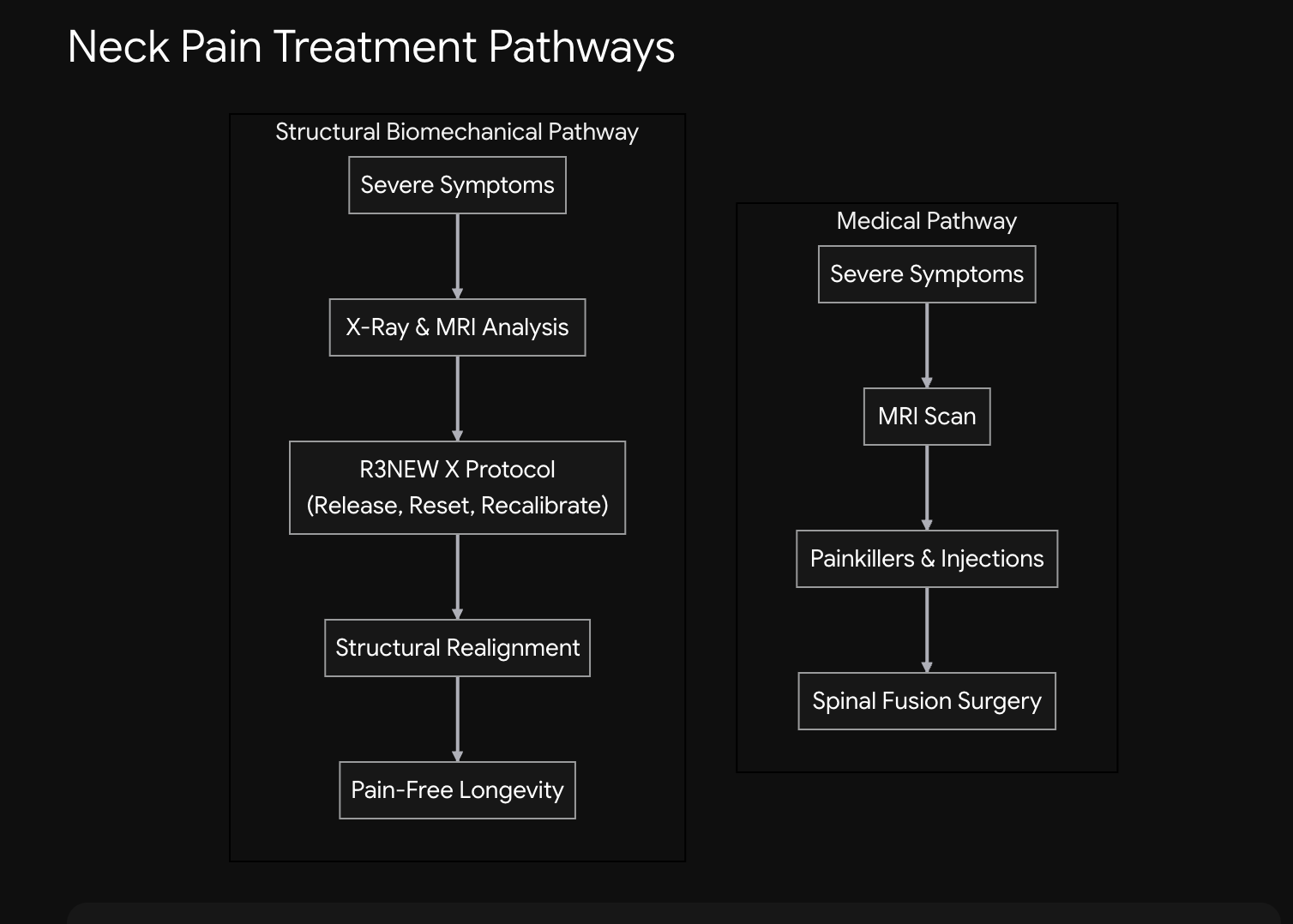
The structural-correction pathway, in practice
How Dr Neck Pain runs it
29Years’ experience
3,000+Cases treated
42Countries seen
- FocusNon-surgical cervical correction for chronic, structural, and radiating-nerve cases
- MethodR3NEW X™ protocol (Release, Reset, Recalibrate), planned and tracked with X-ray
- Led byDr Will Kalla, hands-on for every assessment
- PaymentPrivate or corporate health benefits (non-MOH; not Medisave)
The premise is measurement over guesswork: establish the actual state of the cervical curve on standing X-ray, work to change it through a structured course, and verify the change on repeat imaging rather than by feel alone. It is built for the Tier 3 subset above, not a first stop for an ordinary stiff neck.
How assessment works here
Because the approach is structural, an assessment with Dr Kalla is based on a standing X-ray of your neck, not on how it looks or feels: bring your own films if they are under six months old, or you will be referred for one first. Radiating arm pain and tingling are assessed here; signs of possible nerve or spinal-cord damage, like losing the ability to tell a key from a coin by touch, are referred to a spine surgeon. Chiropractic is non-MOH and not Medisave-claimable. Seek urgent medical care for weakness, spreading numbness, unsteadiness, or pain after an injury.
Book a standing-X-ray assessment →
The Five Pathways, and Who Fits Each
Applying the framework to the real market, here are five distinct provider types in Singapore, named openly, mapped to the symptom pattern each fits best. Inclusion is not endorsement, and these differ in regulatory status: Dr Neck Pain provides non-MOH-registered structural correction, while the surgical, interventional, and diagnostic providers operate within MOH’s licensed framework. Confirm each provider’s registration and current services directly before booking.
| Pathway | Core focus | MOH / Medisave | Best for |
|---|
| Dr Neck Pain | Non-surgical structural correction (R3NEW X™) | Non-MOH; private / corporate | Chronic tech-neck, measured curve loss, radiculopathy after failed rehab |
| Dr Loo Wee Lim (Synergy Ortho) | Surgical spine & decompression | MOH-licensed; Medisave-claimable | Confirmed structural damage, myelopathy, progressive weakness |
| Total Pain Specialist Clinic (Dr Nivan) | Interventional pain (injections, nerve blocks) | MOH-licensed; Medisave-claimable | Severe nerve or facet pain needing relief before surgery |
| The Pain Relief Clinic (Dr Terence Tan) | Rapid diagnostics & triage | MOH-registered; Medisave for scans | Fast cervical MRI and medical triage when the cause is unclear |
| Singapore Paincare Centre (Dr Bernard Lee) | Minimally invasive pain procedures | MOH-licensed; Medisave-claimable | Complex, multi-site chronic pain after multiple opinions |
Read across the table with the tiers in mind: the four MOH-framework providers cover relief, diagnostics, injections and surgery; Dr Neck Pain covers the structural-correction niche. Desk-driven pain often spans the neck and shoulders and upper back together, so match the pathway to the dominant pattern. The right first call is the one that matches your pattern, which is exactly the point of judging by method.
Why Chiropractic Sits Outside the MOH Framework
One point of transparency that affects both trust and cost. Chiropractic, including structural correction, sits outside the Ministry of Health’s licensing framework for medical clinics. Chiropractors use the title “Dr” from a Doctor of Chiropractic degree, which is a Traditional and Complementary Medicine qualification, not a medical degree like MBBS or MD. It is a distinct pathway, not a substitute for MOH-registered medical or surgical care, and a clinic worth trusting states that plainly rather than blurring it.
Costs, Medisave & Insurance in 2026
How you pay depends entirely on which category the care falls into. Two 2026 changes matter for anyone weighing higher-ticket options.
- Outpatient scan limit doubledFrom 1 January 2026, the Medisave withdrawal limit for outpatient diagnostic scans (MRI, CT, ultrasound) rose from S$300 to S$600 per person per year, a shared annual cap, for scans a doctor orders for a medical condition.
- New IP riders changedFrom 1 April 2026, newly bought Integrated Shield Plan riders can no longer cover the minimum deductible (S$1,500 to S$3,500 by ward class), and the annual co-payment cap rose from S$3,000 to a minimum of S$6,000. Riders bought before 27 November 2025 are not immediately affected. Budget for the deductible plus a larger co-payment share if surgery is on the table.
- Functional and structural care is usually corporate, not MedisaveRoutine physiotherapy, chiropractic and structural correction are generally not Medisave-claimable; corporate extended health benefits are the layer that most often applies.
| Service | Typical price range | Medisave? | Cash / corporate? |
|---|
| Massage / TCM session | S$40–S$120 | No | Cash; some corporate |
| Physiotherapy session | S$80–S$180 | Generally no | Yes / corporate |
| Structural correction programme | S$1,500–S$5,000+ | No (non-MOH) | Yes / corporate |
| Private cervical MRI | S$900–S$1,400 | Up to S$600/yr outpatient (2026) | Often |
| Nerve block / epidural (day surgery) | S$2,000–S$6,000+ | Yes, within caps | Sometimes |
| Cervical decompression / fusion | S$20,000–S$60,000+ | Yes, within caps | IP after deductible |
Figures are indicative only and vary by procedure, indication, institution, ward class, insurer and policy. Request a written estimate and claim confirmation before proceeding, and verify current Medisave and insurance rules with official MOH and CPF sources.
What a Good First Visit Looks Like
Whichever pathway you choose, a credible first appointment follows the same shape, only the tools differ:
- History and red-flag screeningHow it started, where it radiates, and a check for the serious nerve, cord and vascular signs, before any treatment.
- Physical and neurological examinationMovement, strength, reflexes and sensation, often including the same key-and-coin discrimination check.
- Measurement matched to the methodFor a structural approach, a standing X-ray of the curve; for others, imaging only where the findings call for it.
- A clear plan, endpoint and estimateThe proposed pathway, how long it should take, how progress will be measured, and a written cost and claim breakdown, before you commit.
Frequently Asked Questions
What is the best neck pain clinic in Singapore?
There is no single best clinic; there is a best method for your specific problem. Everyday tension responds to relief-based care (massage, TCM). Recent, muscular or trigger-related pain does well with physiotherapy or general manual therapy, the evidence-backed first line for most people. Chronic pain that keeps returning after real rehab, a measured loss of the neck’s curve, or a radiating-nerve pattern is where structural correction is worth considering. Match the method to your cause rather than picking a name off a ranking.
Should I see a physiotherapist or a chiropractor for neck pain?
For most neck pain, start with physiotherapy or general manual therapy. It is effective first-line care and often all that is needed. Consider a structural-correction chiropractor when symptoms keep returning after a genuine trial of rehab, or when imaging shows a loss of the cervical curve. For red-flag signs, hand clumsiness, balance changes, weakness in both limbs, see a doctor first, not either.
Do I really need an X-ray for neck pain?
Not for most simple neck pain. A careful history and examination are enough for recent, uncomplicated cases, and guidelines do not support scanning every stiff neck. Imaging becomes relevant when there are warning signs, when pain persists despite proper care, or when the treatment itself is structural correction, because you cannot plan or track a change to the cervical curve without measuring it on a standing X-ray.
How do I know if a neck clinic is any good?
Judge it by method and honesty, not marketing. Good signs: it screens for red flags before treating, assesses your neck specifically rather than running a generic whole-spine routine, measures progress objectively (imaging for structural work), and gives a plan with a clear endpoint and written costs. Warning signs: pressure to buy a large package before assessment, open-ended visits with no exit criteria, and no way to show whether you are actually improving.
Can I use Medisave or insurance for a chiropractor in Singapore?
Medisave cannot be used for chiropractic or routine outpatient physiotherapy. It applies to approved scans (up to S$600/year for outpatient scans from 2026), day surgery and inpatient procedures. Many corporate extended health benefit plans, however, do cover chiropractic and physiotherapy through direct billing or reimbursement, which is usually the relevant funding layer for functional and structural care.
When is neck pain an emergency?
Seek urgent medical care if neck pain comes with any of these:
- Loss of fine touch, such as not being able to tell a key from a coin by feel
- New hand clumsiness or dropping objects
- Weakness or numbness in both arms or both legs
- Balance problems or difficulty walking
- New bladder or bowel changes, or severe pain after an injury
Judge us by the same standard.
If rehab has not held and you want to know whether your cervical curve is the reason, a standing-X-ray assessment measures it, and shows whether structural correction actually fits your case.
WhatsApp us to book an assessment
Related reading
This article is educational information only and is not medical advice, diagnosis, or a treatment recommendation for your individual situation. Clinic details, credentials, pricing, and Medisave or insurance rules can change; verify current information directly with each provider and with official MOH and CPF sources before deciding. Inclusion of any provider is not an endorsement. Chiropractic care is not MOH-registered in Singapore and is not a substitute for medical or surgical care. If you have red-flag symptoms, seek urgent medical assessment.