


Stuck at a desk with a stiff neck? One camp promises instant relief, the other promises it won't come back. With forward head posture affecting over 80% of office workers, which approach actually solves office syndrome for good?
Key takeaways
- Chiropractic care and spinal manipulation tend to bring faster short-term relief for office-related neck stiffness, while physiotherapy-style exercise builds the lasting durability that keeps pain from returning.
- Forward head posture is reported in about 82–83% of office and remote workers using non-ergonomic setups.
- Spending more than 4 hours a day at a computer is linked to a 25% higher risk of neck, arm, and shoulder complaints, as shown by occupational health research.
- Dr Neck Pain's R3NEW X™ Protocol combines manual correction with a structured rehabilitation pathway, using X-ray verification to track whether the neck's structure is actually changing.
- Understanding which approach suits which stage of pain helps office workers avoid bouncing between treatments without lasting results.
Related reading
The Shortest Version (TL;DR)
If you want the bottom line on treating desk-related neck pain: standard chiropractic adjustments are great for fast, short-term relief, while physiotherapy exercises build muscle endurance for long computer hours.
However, if your pain keeps returning, neither approach will permanently solve the problem if you have an underlying structural issue, such as a loss of your natural cervical curve.
For chronic office syndrome, the most effective plan goes beyond temporary relief:
- Phase 1 (Symptom Relief): Unlock stiff joints and reduce acute soreness so you can get through the workday.
- Phase 2 (Structural Correction): This is where standard care stops. Dr Neck Pain's specialised protocols actually move and realign the bones to restore your neck's natural curve, fixing the root mechanical problem.
- Phase 3 (Lasting Durability): Lock in that newly corrected alignment with targeted rehab and posture habits so the pain stays away for good.
Who this guide is for
This guide is for people searching for answers to neck pain office job, neck pain office worker, neck pain office work, neck pain desk job, or neck pain desk work. It is especially relevant if your neck feels fine in the morning but gets tight, heavy, sore, or stiff as the workday goes on.
- Desk workers and remote workers in Singapore with neck pain that builds through the day
- People whose neck pain comes and goes depending on screen time, stress, sleep, or long meetings
- People who have tried massage, quick adjustments, or stretches but found the relief did not last
- Anyone considering Dr Neck Pain's R3NEW X™ Protocol and wondering how it compares with standard chiropractic or physiotherapy

Office workers with neck pain often feel stuck between two camps: the chiropractor promising quick relief and the physiotherapist promising a longer-term fix. Both can play a role. The useful question is not "which profession is best?" but "what does my neck need at this stage?"
Chiro wins speed, physio wins durability
Chiro vs. Physio: The Speed vs. Durability Trade-Off
The honest answer to "which fixes neck pain faster" depends entirely on how you define a fix. Each profession solves a different half of the puzzle:
- Chiropractic Care (The Speed): If a restricted joint or severe stiffness is the main culprit, spinal manipulation is incredibly effective for rapid relief. Many patients experience a sharp drop in pain intensity within their very first few visits.
- Physiotherapy (The Durability): Built around exercise and movement retraining, this approach takes slightly longer to feel but produces steadier, long-lasting improvements. It rebuilds the muscular endurance needed to correct the bad habits that caused the problem to begin with.
For office workers battling persistent neck and shoulder pain, choosing between the two often feels like a frustrating trade-off. However, you shouldn't have to choose between feeling better today and staying better tomorrow. Dr Neck Pain uses a structured, phase-based approach that combines the rapid relief of structural adjustments with the lasting durability of active rehabilitation.
How Standard Care Compares to Dr Neck Pain's Structural Correction
| Goal | Standard Chiropractic / Manual Care | Standard Physiotherapy / Exercise Rehab | Dr Neck Pain (Structural Correction) |
|---|---|---|---|
| Main strength | Faster relief of pain, stiffness, restricted movement. | Longer-term strength, function, fewer repeat flare-ups. | Fixes the root mechanical issue (like loss of cervical curve) for permanent, lasting relief. |
| Often suits | Recent flare-ups, stiff joints, or "I need to get through work this week." | Chronic or recurring pain, weak postural endurance, desk-related flare-ups. | Chronic office syndrome, cases where standard treatments failed, underlying structural misalignments. |
| Typical focus | Joint motion, muscle guarding, early symptom relief. | Deep neck strength, shoulder-blade control, movement habits. | X-ray verified alignment, actually moving bones back into place, combined with targeted rehab. |
While standard treatments focus on managing symptoms week-to-week, true recovery requires fixing the underlying structure. This is especially true for desk workers suffering from the modern epidemic of "Office Syndrome."
Why Office Syndrome Causes So Much Neck Pain
"Neck pain office syndrome" is not a vague complaint. It describes a very real, measurable cluster of musculoskeletal problems caused by long hours at a desk. Also commonly referred to as computer neck syndrome, tech neck, or desk-worker neck pain, this condition includes neck stiffness, heavy shoulders, tension headaches, and upper-back pain that worsens as the workday progresses.

Can sitting cause neck pain? The 4-Hour Rule
Yes. Sitting itself isn't automatically harmful, but duration matters just as much as posture. Occupational health studies show that spending more than four hours a day on a computer is linked to a 25% higher risk of arm, neck, and shoulder complaints.
When you combine static sitting with a poor laptop setup and high stress, your neck endures hours of low-grade, repetitive strain with zero recovery time. That is exactly why neck pain due to work is so prevalent among modern professionals.
Forward Head Posture: The 82% Epidemic
When you lean toward a screen or look down at a phone, your head drifts forward off your center of gravity. Research shows that 82–83% of office and remote workers using non-ergonomic setups develop forward head posture.
This structural shift forces the muscles at the back of your neck to work overtime just to hold up the weight of your head. Day after day, this shifts an unnatural load onto joints that were never designed to hold it, leading to the familiar late-afternoon fatigue and sore upper traps.
Why does my neck hurt when sitting at my desk?
The problem is rarely one single "bad posture" moment. It is the cumulative effect of your daily habits. A monitor that is too low, reaching forward for a mouse, slumping in your chair, and skipping movement breaks all add up. Over time, this constant low-level physical stress overloads your cervical spine.
Where is office-related neck pain located?
Desk-related pain typically follows a specific, recognizable pattern. It is most commonly felt in these three areas:
- Base of the skull / Back of the neck: Often linked to prolonged forward head posture, frequently triggering tension-type headaches.
- Top of the shoulders: A clear sign of overworked upper trapezius and levator scapulae muscles.
- Between the shoulder blades: Reflects upper-back stiffness and rhomboid fatigue from prolonged typing and mouse use.
What does neck pain when tilting your head back mean?
If you feel a pinching or blocked ache when looking up, your cervical facet joints (the small joints at the back of the spine) may be compressed, irritated, or stiff. This one-sided ache often feels worse if you try to tilt and turn your head at the same time.
Clinical Safety Note
Do not force repeated, painful neck extension. Start with gentle mid-range movements and improve your upper-back mobility. If the pain travels below the elbow, causes numbness, tingling, or hand clumsiness, get assessed by a clinical professional immediately. This may indicate nerve involvement rather than simple office-related muscle tension.
How to relieve neck pain from sitting at a desk
If you are searching for how to relieve neck pain from sitting at a desk, start with three simple changes: improve the screen setup, interrupt long sitting periods, and build the muscles that support your neck and shoulder blades.
- Raise your screen: keep the top of the monitor at or just below eye level, and place it roughly an arm's length away. Even better if you can adjust the monitor so the middle is at eye level.
- Bring keyboard and mouse closer: keep elbows near your sides so you are not reaching forward all day.
- Take micro-breaks: stand and move for 30–60 seconds every 30–45 minutes.
- Do a short daily reset: gentle chin tucks, upper-back movement, and shoulder-blade strength work can help your neck tolerate desk work better.
Tip from Dr Will
Reaching 40? I realised I was jutting my head forward to read the screen, and I fixed it by zooming Excel spreadsheets and webpages to 125%. My vision was getting worse and I eventually needed glasses, so enlarging the text keeps you from creeping toward the screen.
How to fix neck pain from looking down
If you want to know how to fix neck pain from looking down, the first step is reducing the total time your neck stays bent forward. Raise your phone or tablet closer to eye height where possible, use a laptop stand and separate keyboard for work, and take frequent short breaks rather than waiting until the pain is severe.
Then build capacity: gentle deep-neck-flexor exercises, upper-back mobility, and shoulder-blade strengthening help your body hold a more comfortable position with less effort. The goal is not to sit perfectly still all day; it is to change position regularly and make your neck stronger for real life.
How to relieve neck pain from computer use
How to relieve neck pain from computer use usually comes down to your screen height, keyboard/mouse position, movement breaks, and a small daily exercise routine. If you only stretch but return to the same low-screen, no-break setup for eight hours, the tightness will usually return.
Speed vs durability in neck pain recovery
Once the cause is clear, the next question is which treatment approach tackles it best, and when.
Manual care can help with early pain and restricted movement
Clinical research on mechanical neck pain links spinal manipulation to faster pain reduction. Hands-on care can reduce muscle guarding and make movement feel easier in the short term, which matters when you have a recent flare-up and need to keep working, sleeping, or driving comfortably.
Exercise-based rehab helps make relief stick
Studies on multimodal physiotherapy show that combining manual therapy with targeted exercise, such as deep neck flexor and scapular strengthening, produces stronger long-term results. This kind of rehab builds the endurance of the muscles that support your neck all day. This matters when you have neck pain from office work patterns that keep returning: the aim is not only to feel better today, but to help your neck cope with tomorrow's long meeting, commute, and screen time too.
A structural correction path for lasting change
Rather than treating speed and durability as separate paths, some structural correction approaches aim to build both into a single plan. At Dr Neck Pain, the R3NEW X™ Protocol is designed for people with persistent, recurring symptoms and measurable postural or cervical alignment concerns. The goal is to physically reposition misaligned vertebrae, not just temporarily loosen tight muscles.
Release, Reset, Recalibrate: the three-phase model during each treatment
- Release: Loosen tight connective tissue, ligaments, and muscles.
- Reset: Spinal manipulation or adjustment acts a bit like an EMP pulse, causing a powerful surge of sensory data that alters how the brain and spinal cord process joint positioning and muscle tone.
- Recalibrate: With active NeuroMuscular Rehabilitation (NMR), we recalibrate your brain’s “body schema”, the unconscious, dynamic internal map your brain uses to track your body’s position in space and coordinate movement, also known as the “postural reference frame”.
Most people complete a planned course of care over a few months, with treatment focused on restoring your neck’s structure and function to support healing and relieve symptoms. Your own plan should depend on examination findings, goals, and how your neck responds.
X-ray verification instead of guesswork
Dr Neck Pain uses standing digital X-rays where clinically appropriate to assess cervical alignment and track structural changes over time. Imaging is not necessary for every case of neck pain, but it can be useful in selected chronic or complex cases where a structural assessment will change the care plan.
How to decide: chiro, physio, or a combined plan?
- Consider chiropractic or other hands-on care first if: your pain is recent, mainly stiffness-driven, or you feel a clear movement restriction and want short-term relief.
- Consider physiotherapy or exercise-focused rehab first if: your pain has lasted more than 6–12 weeks, keeps returning, or you notice poor endurance and posture-related flare-ups.
- Choose a combined plan if: you want short-term relief that lasts, delivering structural changes to your neck and learning correct ergonomics.
Not sure which camp you fall into? A short assessment can tell you whether hands-on care, rehab, or a combined plan fits your pattern best.
Book a consultation →Myth vs fact: chiro, physio, and neck pain
"A neck adjustment will definitely cause a stroke."
"Physio is a proven medical treatment, while chiro is just a temporary trick."
"Physio is always better for chronic pain, while chiro is only for acute pain."
The 15-Minute Desk Neck Reset
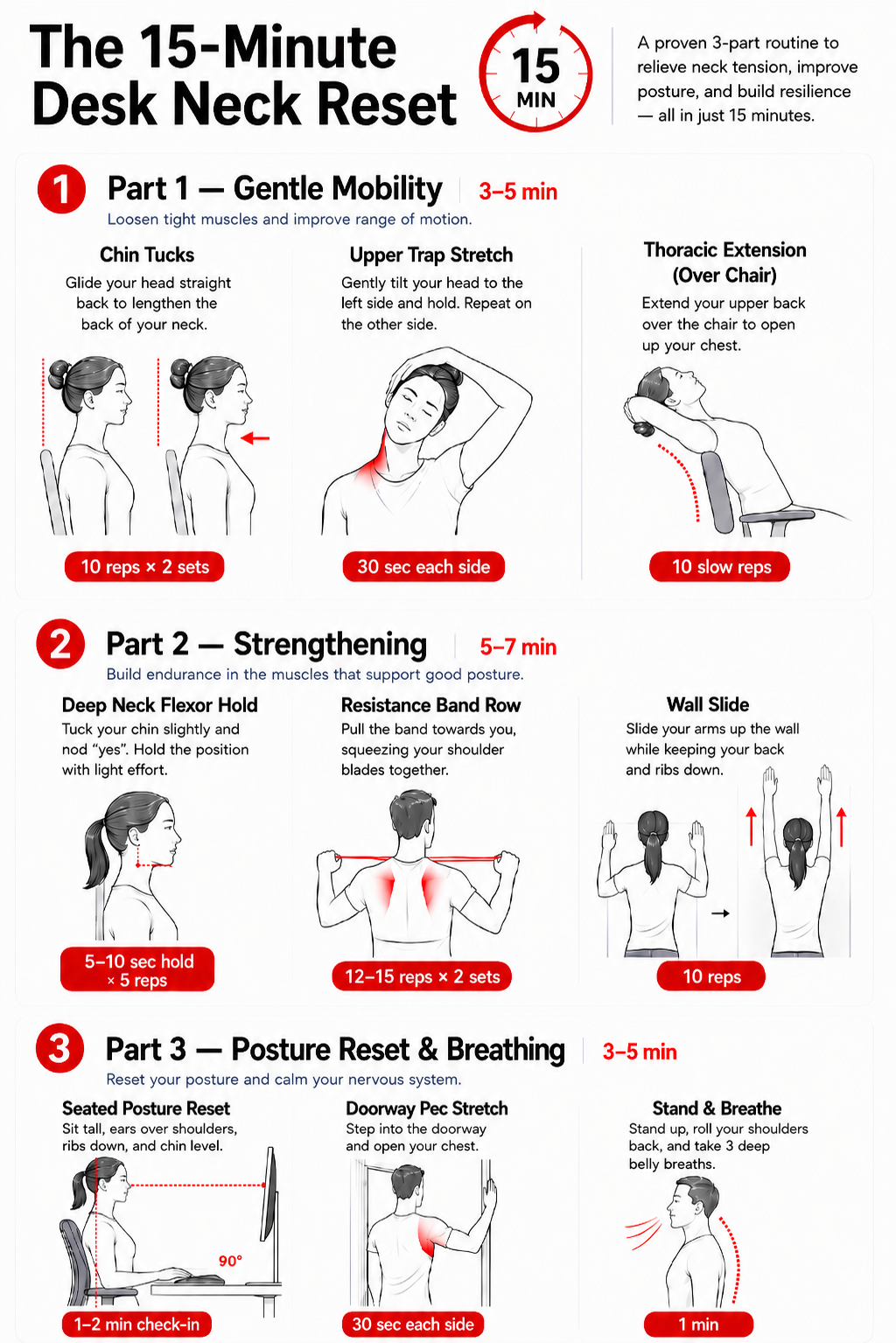
Do this whether you choose chiro, physio, or a combined plan. Do this routine at your desk or at home once or twice a day. This self-care piece can help relieve pain between appointments.
Here is the step-by-step breakdown of the routine above:
Part 1: gentle mobility (3–5 minutes)
- Chin tucks: 10 slow repetitions, holding each for 3 seconds. Make a small controlled nod; do not force the neck backward.
- Upper-trap stretch: gently tilt your ear toward your shoulder, holding 20–30 seconds per side for 2 rounds.
- Thoracic extensions over a chair: lean your upper back over the chair back with hands behind your head; do 8–10 gentle repetitions.
Part 2: strengthening (5–7 minutes)
- Deep neck flexor holds: do a small chin tuck while lying down or against a wall; hold 5–10 seconds for 8–10 repetitions.
- Band rows: 2 sets of 12–15, squeezing shoulder blades gently down and back without shrugging.
- Wall slides or Y/T/W movements: 1–2 sets of 8–10 slow, controlled repetitions.
Part 3: posture reset and breathing (3–5 minutes)
- Seated reset: sit tall, relax the shoulders, make a gentle chin tuck, and take 5–8 slow lower-rib breaths; repeat 3–4 times.
- Doorway pec stretch: hold 20–30 seconds for 2 rounds.
- Micro-break plan: stand and move for 30–60 seconds every 30–45 minutes of desk work.
Safety note
Keep movements comfortable. Stop and seek advice if exercise causes sharp pain, dizziness, numbness, or symptoms spreading into the arm or hand.
Want the printable routine?
Get the free 15-Minute Desk Neck Reset PDF with step-by-step instructions you can follow at your desk or at home.
Send me the free PDFFrequently asked questions about office syndrome neck pain
Are "office neck pain", "desk-job neck pain", and "office syndrome" the same thing?
Yes, these terms all refer to the exact same cluster of musculoskeletal issues caused by prolonged computer use. While the names vary by region, the root causes are identical: forward head posture, static sitting, and poor ergonomic setups leading to muscle fatigue and cervical joint stiffness.
What does neck pain when tilting the head back mean?
Neck pain when tilting your head back typically indicates cervical facet joint irritation or restricted spinal mobility. Looking upward narrows and compresses the small joints at the back of your neck. If this motion causes a sharp, pinching sensation, it strongly suggests a mechanical joint dysfunction that may require manual correction.
How to relieve neck pain from sitting at a desk?
To relieve neck pain from sitting at a desk, you must address both workstation ergonomics and spinal mobility. Follow these four immediate steps:
- Raise your monitor so the top third is at eye level.
- Pull your keyboard closer to avoid forward-reaching.
- Stand up and move for 60 seconds every 45 minutes.
- Perform daily chin tucks and scapular retractions to reset your posture.
How to fix neck pain from looking down?
Fixing neck pain from looking down requires reducing the sustained gravitational load on your cervical spine. Elevate your devices using a laptop stand, hold your phone at eye level, and strengthen your deep neck flexors. Restoring the natural cervical curve helps distribute the weight of your head evenly, preventing chronic strain.
What is computer neck syndrome?
Computer neck syndrome, commonly known as tech neck, is a repetitive strain injury caused by keeping your head in a forward, downward-looking position for extended periods. It results in structural strain on the cervical spine, leading to chronic stiffness, tension headaches, and upper shoulder pain.
Can sitting cause neck pain?
Yes, prolonged sitting directly causes neck pain by forcing the upper back to slouch and the heavy head to drift forward. This "tech neck" posture overworks the upper trapezius and levator scapulae muscles, leading to chronic tension, stiffness, and eventually joint irritation.
Why does my neck hurt when sitting at my desk?
Your neck hurts at your desk because static, low-grade strain fatigues your stabilizing muscles over time. Even with a perfect ergonomic setup, holding one single position for hours reduces blood flow and oxygen to the soft tissues, triggering muscle guarding, stiffness, and pain by the late afternoon.
Where is desk-related neck pain usually located?
Desk-related neck pain is most commonly located in four specific areas:
- The base of the skull (suboccipital tension and headaches)
- The back of the neck (cervical spine stiffness)
- The top of the shoulders (upper trapezius strain)
- Between the shoulder blades (rhomboid fatigue)
Should I worry if my neck pain lasts for more than a week?
Neck pain lasting more than a week is not automatically dangerous, but it is a clear sign that self-care and stretching are insufficient. If the pain persists, disrupts your sleep, or consistently worsens during work hours, you should book a clinical assessment to prevent a temporary flare-up from becoming a chronic structural issue.
Why does my neck pain come and go?
Neck pain comes and goes because your muscles are constantly fighting an underlying structural misalignment. If your cervical spine has lost its natural healthy curve, the surrounding muscles are forced to work overtime just to hold your head up. During weeks with long screen hours, tight deadlines, or poor sleep, these compensating muscles eventually fatigue and spasm, triggering a flare-up. Sustained relief requires going beyond temporary muscle release and actually correcting the spinal structure so those muscles are no longer overworked.
What is the ICD-10 code for office syndrome?
There is no specific ICD-10 code for "office syndrome." Instead, clinics diagnose and code the specific resulting clinical condition. The most common codes used for desk-worker neck pain are M54.2 (Cervicalgia) for localized neck pain, and M79.1 (Myalgia) for chronic muscle tension.
What to do next
- Start with the basics: improve monitor height, take micro-breaks, and follow the Desk Neck Reset daily for 2–4 weeks.
- Match care to the pattern: recent stiffness may respond well to hands-on care; recurring desk-related pain usually needs a stronger rehabilitation and self-management component too.
- Get assessed if needed: if your symptoms are persistent, recurring, or affecting work and sleep, book a targeted assessment. If you are in Singapore and want an X-ray-guided structural approach, ask whether the R3NEW X™ Protocol is appropriate for your case.
Quick pain relief feels good, but one good adjustment rarely solves neck pain that flares up after a stressful work week. For anyone tired of managing the same neck and shoulder pain on repeat, the aim is not endless appointments. It is a clear plan that helps your neck move better now and cope better with normal workdays over time.
Ready for a clear plan?
Book a consultation to discuss your symptoms and the right next step for your neck.
Book a consultation →