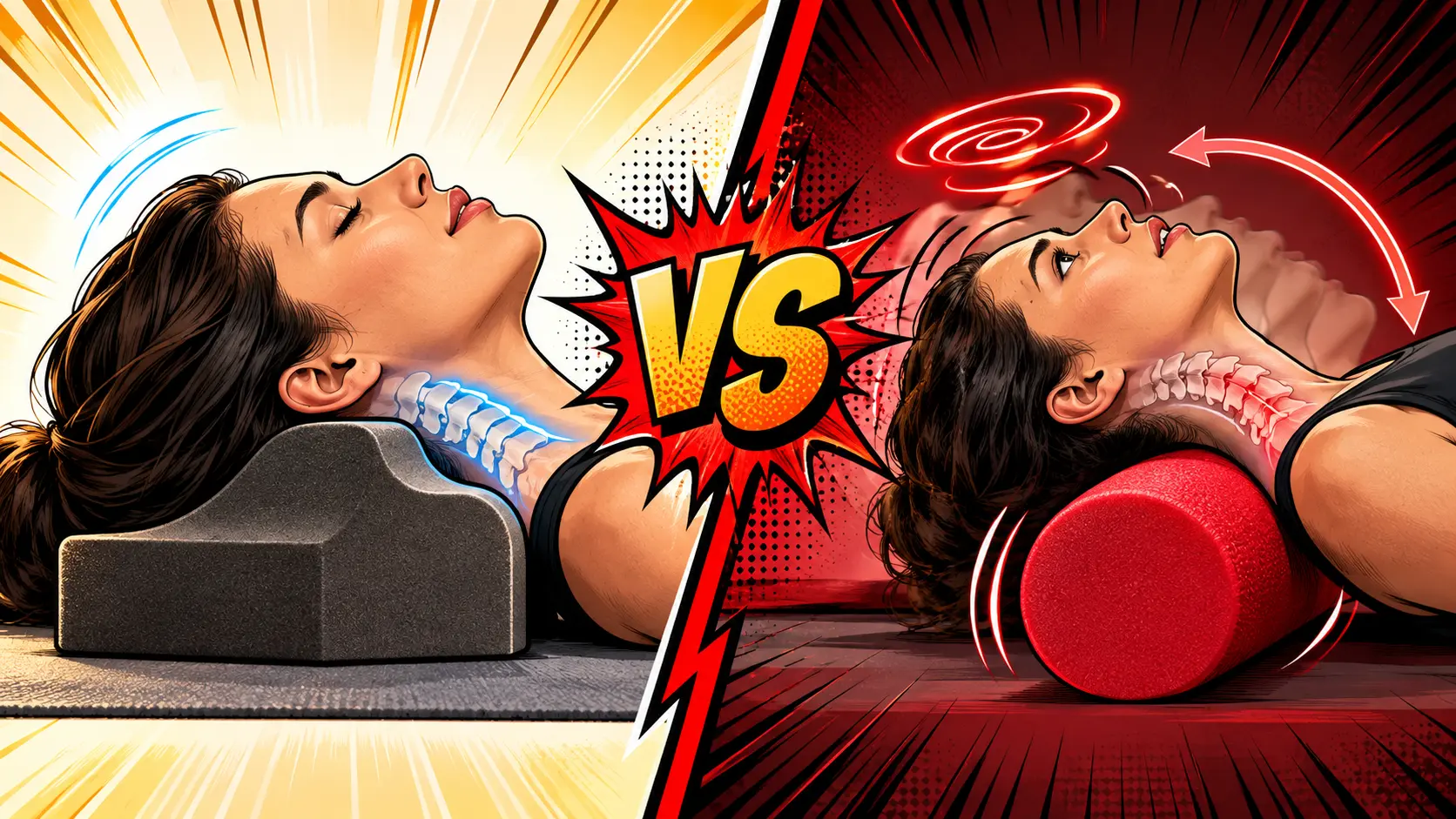
Cervical D-Roll vs. Standard Foam Roller for Neck Dizziness Relief
It is late, your neck is aching, the room feels vaguely unsteady, and you have two things in a shopping cart: a firm half-moon cervical roll that promises to restore your neck curve, and a standard foam roller from the gym aisle.
Here is the honest answer before you spend anything. These are not two versions of the same thing, and only one of them has a clinical trial behind it for dizziness, though not in the way a product page would have you believe.
Last updated: September 2026 · Reviewed by Dr Will Kalla, Dr Neck Pain
Read this first: some dizziness is an emergency
Call 995 or go to A&E now if your dizziness comes with a new severe headache or neck pain, slurred speech, a drooping face, double vision, weakness or numbness on one side, inability to stand or walk unaided, or fainting, especially after a head or neck injury. Do not experiment with a roller or a pillow to see whether the symptoms settle.
The short version
No trial has compared the two. The foam roller has no dizziness evidence at all.
They are not rivals. A D-roll is passive support you rest on. A foam roller is a pressure and movement tool for large muscle areas.
Keep the foam roller off your neck. Upper back, yes. Directly under the cervical vertebrae of someone who is already dizzy, no.
The Denneroll cervical orthotic does have a trial, a 1-year RCT in cervicogenic dizziness. But it was prescribed after X-ray to people with a measured flat curve, as part of a supervised programme.
The bigger question is what is causing the dizziness. Even the label “neck dizziness” is contested, and the most common causes of dizziness plus neck pain are not the neck.
People arrive at the clinic with these in their bags. A D-roll bought after a late-night search, a foam roller borrowed from the spare room, sometimes both, usually with the same question: which one should I be using? Dr Will’s answer is that it is the wrong question first time round, and the rest of this article is why.
Start here: most comparisons treat these as two options for the same job. They are not.
Cervical D-roll (Denneroll)
You lie still on it
What it does: holds the neck in gentle extension while you rest, to load the curve in the opposite direction to a desk posture.
Head movement: almost none, which is why it provokes less.
Honest role: an orthotic when prescribed and fitted after imaging; a comfort trial when bought off a shelf.
VS
Standard foam roller
You move over it
What it does: applies body-weight pressure to large areas while you roll along it.
Head movement: plenty, plus changes in head position relative to gravity.
Honest role: an upper-back mobility and muscle tool.
That difference in head movement is the whole safety story. Rolling under a dizzy person’s neck combines pressure, positional change and end-range extension, three things that can provoke symptoms, before anyone has established what is causing them.
What the Evidence Actually Says
We looked for a direct comparison. There isn’t one, and there probably never will be, because these tools are not doing the same job. What does exist is one relevant trial on the orthotic side, nothing on the roller side, and a lot of adjacent evidence worth reading honestly.
Claim
What the research shows
Confidence
A Denneroll orthotic helps dizziness
One 1-year randomised trial in 72 people with cervicogenic dizziness. Added to a multimodal programme, it made no difference at 10 weeks, but at one year the orthotic group was better on every measure while the comparison group slid back.
One trial, with caveats
A generic cervical pillow or roll helps dizziness
No trial identified. Cervical pillow research covers neck pain and sleep, not dizziness: a 2025 review found five eligible studies (239 people), inconsistent results, and no design clearly superior.
No direct evidence
A foam roller relieves dizziness
No trial identified. A 2025 trial in 58 adults with chronic neck pain found foam rolling improved pain and movement, but no better than Swedish massage, and dizziness was not studied.
No direct evidence
Foam rolling is harmless because it’s foam
A 2025 survey of rehabilitation professionals reported headaches, bruising and tissue irritation as observed or plausible effects. Foam is the material, not the force: body weight on a small contact area is a lot of focal pressure.
Not risk-free
Hands-on treatment of the upper neck helps selected people
A 2022 review found moderate-quality evidence that clinician-delivered manual therapy can reduce cervicogenic dizziness, and a 2025 meta-analysis found benefit specifically from upper-neck-focused work, though certainty was rated low to very low.
Some support
Active retraining helps
A 2023 trial of a home programme of neck and eye-movement exercises improved dizziness handicap scores substantially against control. This is the direction the research is moving: active retraining, not passive props.
Some support
The trap in that table
Notice the gap between rows four and one. Because clinician-delivered upper-neck treatment has some evidence, it is tempting to assume a foam cylinder under the same area does the same thing. It does not follow. Targeted, dosed, assessed treatment is a different intervention from body weight on a tube, and no study bridges that gap.
What the Denneroll Trial Actually Found
Because this is the one piece of real evidence in the whole comparison, it is worth knowing exactly what it did and did not show.
Seventy-two adults with long-standing cervicogenic dizziness, all with a measured flat neck curve and forward head posture on X-ray, were randomised. Everyone received the same multimodal rehabilitation. Only one group also used the Denneroll cervical extension orthotic.
The result that matters
At 10 weeks, no difference. At one year, the two groups had pulled apart.
Both groups improved in the short term, which most treatments can manage. The difference appeared later: the orthotic group held their gains and kept improving in dizziness, neck pain, disability and head-repositioning accuracy, while the comparison group drifted back toward where they started once treatment stopped. That is an unusual shape for a trial result, and it is the strongest argument in this article for taking structure seriously.
Now the caveats, because they matter
Everyone in it was screened on X-ray. Participants were selected for a measured flat curve and forward head posture. This was not a trial of “buy a roll if your neck aches.”
It was an add-on, not a stand-alone. The orthotic was layered on top of a fully supervised programme, and prescribed, fitted and dosed by clinicians.
One research group. The work comes from a team closely associated with the method and the device, and independent groups have not widely replicated it. That is a real limitation, not a technicality.
Diagnosis was the contested kind. Everything in the next section about the term “cervicogenic dizziness” applies to this trial too.
So the fair reading is not “Denneroll beats foam roller.” It is: when a flat curve was confirmed by measurement first, correcting it produced results that lasted after care ended. The measurement is doing as much work in that sentence as the device is.
That is the part a shopping page cannot sell you, and it is exactly what a structural assessment is for. A standing X-ray answers the two questions that decide whether any support is worth using: is your curve actually flattened, and in which direction does it need loading. Without those answers, you are buying a shape and hoping it matches a neck nobody has looked at.
The Label Itself Is Contested
This is the part most product pages leave out, and it matters more than the choice of roller.
Worth knowing
The body that classifies vestibular disorders does not accept “cervical dizziness” as an established diagnosis.
In 2022, the Bárány Society, which writes the international classification for dizziness and balance disorders, concluded that the evidence linking neck problems to a spinning sensation is lacking, and declined to publish diagnostic criteria for clinical use. It noted that when head and neck movement triggers spinning, the cause is usually a vestibular one, most commonly vestibular migraine or BPPV. A 2025 multidisciplinary perspective is more receptive to altered neck position sense as a mechanism, but still calls the entity debated and stresses excluding other causes first.
A large 2024 cohort puts a number on it. Among 3,638 people aged 60 and over with cervical spondylosis, matched against 3,638 with lumbar spondylosis, the one-year incidence of dizziness was 10.2% versus 8.6%. Real, but a difference of only 1.6 percentage points. The authors' conclusion was blunt: dizziness attributable to the neck is uncommon even among people whose necks are visibly degenerating on a scan.
So what does that mean for you and a shopping cart? It means a tight neck and a dizzy head occurring together is not proof that one caused the other, and that a device chosen on that assumption may target the wrong system entirely. It also means the honest first step is not a purchase.
How to Trial Either One Safely
If you have been assessed, your symptoms are familiar and mild, and you still want to try, these are risk-management principles rather than a treatment protocol.
If it was prescribed, follow that dosing insteadA Denneroll fitted after imaging comes with a position, a duration and a progression. This list is for people self-experimenting, not a reason to override a clinician who measured you.
Start reversibleA folded towel lets you adjust height a centimetre at a time. A large firm contour does not. Several people find a fixed roll is too tall and holds the neck in extension.
Trial it awake, not overnightFive to ten minutes lying down is easy to stop. Eight hours asleep on an unfamiliar shape is not.
Change one thing at a timeNew pillow, new exercises and a new massage routine in the same week means you learn nothing about which one helped or hurt.
Keep the foam roller below the neckUpper back and shoulder blades are fair game. Don't roll directly under the cervical vertebrae, and don't let your head drop back into end-range extension over the end of the roller.
Check the delayed response, not just the momentNote how you feel immediately, later that day and the next morning. A technique can feel loosening at the time and produce a flare hours later.
Stop rulesIncreasing spinning, a new or severe headache, nausea, visual symptoms, tingling or radiating arm pain, or any of the red flags at the top of this page. Get up from the floor slowly: dizziness plus standing is how people fall.
If Not a Prop, Then What?
Telling you not to buy something leaves an obvious gap. Here is the order that actually makes sense, and it is the same order Dr Will works in.
Get the serious and common causes excludedYour doctor first. Inner ear, migraine, heart, blood pressure and medication all cause dizziness far more often than the neck does. Nothing below matters until you've done this.
Get the neck measured standing, not guessedA standing X-ray shows the curve under the load of your own head. This is the step the Denneroll trial did before anyone was given a device, and the step almost every consumer purchase skips.
Then decide what, if anything, your neck needsIf the curve is normal, you have saved yourself the money and can stop wondering. If it is flattened, the measurement tells you what to correct and in which direction, and gives you something to re-measure against later.
If you are guessing with a prop, stop. Once your doctor has ruled out the serious causes, a standing X-ray assessment shows what your neck is actually doing under gravity, before you spend anything on a shape that may not fit it.
Recurring themes, paraphrased from neck and dizziness communities on Reddit
H
Height and firmness decide everything
The same product is described as transformative by one person and as the thing that triggered a flare by another. Too tall, too firm, or too prominent under the neck comes up repeatedly, and several prefer a rolled towel precisely because they can fine-tune it.
T
Upper back good, neck bad
Where people report foam rolling helping, they are usually describing the thoracic spine, ribs and shoulder blades. The warning stories tend to involve direct neck rolling or vibrating rollers, sometimes with dizziness that lasted well beyond the session.
D
The delayed flare
Felt loose→Fine that evening→Woke up worse→Lesson: dose it
The most consistent practical lesson in these threads is that more is not better, and that the verdict on a technique comes the next morning rather than in the moment.
These are anecdotal reports summarised from online patient communities, not clinical outcomes or medical advice. Diagnoses are usually unverified and most people change several things at once, so these stories show usability problems, not effectiveness.
Self-Check: Which Pattern Is Yours?
Before you choose a device, it is worth sorting which pattern your symptoms fit. This is not a diagnosis, only an exam can give you that.
Self-guided symptom check
Is a neck support even the right thing to be shopping for?
4 short questions · about 1 minute · educational only
Where Measurement Fits
Here is the thread running through everything above. The one device with a trial behind it was used on people whose curve had been measured first, and the trial selected them on that basis. Buy the same shape off a shelf without that step, and you keep the object but throw away the reason it worked. A roll manufactured to an average contour doesn't know what your neck currently looks like, which decides whether support helps, does nothing, or holds you in a position that makes you feel worse.
WKDr Will Kalla Clinical view · 29 years, 3,000+ cases
Dr Will’s view is that the order has been reversed. People buy the support first and hope it fits, but the measurement tells you what shape the neck is in and whether extension is even the right direction to load it. He points to the Denneroll trial for exactly that reason: the people in it were measured before anything was prescribed. He is also direct about the limits. Where a proper work-up points to the ear or to migraine, that is not a neck case, and no amount of structural work changes it. The measurement is as useful for ruling his own approach out as for ruling it in.
Where the pattern does point to the neck, and the serious causes have been excluded, that is where the R3NEW X™ protocol starts: a standing X-ray of how your neck carries your head, then correction guided by that measurement rather than by a shape off a shelf. You can read more about Dr Will’s background and structural approach to neck care, or see how the clinic handles cervicogenic dizziness.
One caution that cuts both ways
Feeling better after any treatment, ours included, does not by itself prove the neck caused the dizziness. Symptoms fluctuate, and pain relief alone can make anyone feel steadier. That is why measurement and exclusion matter more than how a first session feels.
The practical details
Where: the clinic is in Singapore, at North Bridge Centre in Bugis (420 North Bridge Road #02-20).
Referral: none needed for an initial structural assessment. Your doctor’s work-up for the dizziness itself still comes first.
X-rays: bring your own films if they are less than a year old (digital copies can be sent ahead, though measurements are taken on the physical films), or the clinic can help arrange them.
Cost: billed privately and worth checking against corporate extended health benefits, which often cover chiropractic. Chiropractic is not MOH-registered in Singapore and is not Medisave-claimable.
Stop guessing. Measure it first. That is the one step the trial did and the shopping cart cannot: 29 years and 3,000+ cases of doing it in that order. If your unsteadiness tracks with your neck and the serious causes have been ruled out, a standing X-ray assessment shows what your neck is actually doing under gravity. You can also see how other Singapore patients progressed first.
Is a cervical D-roll or a foam roller better for neck dizziness?
They do different jobs, and only one has evidence for dizziness. A Denneroll cervical orthotic was tested in a 1-year randomised trial in cervicogenic dizziness, added to a supervised programme in people with an X-ray-confirmed flat curve. No evidence supports a foam roller for this, and it belongs on the upper back, not under the neck. No study has compared the two directly.
Can a foam roller make dizziness worse?
It can. Rolling under the neck combines focal pressure, head movement and end-range extension, and people commonly report flares, sometimes hours later. A 2025 professional survey also listed headaches, bruising and tissue irritation among effects seen with foam rolling generally.
Does a cervical roll restore the curve in my neck?
For a generic roll, that claim goes beyond the evidence. For a fitted Denneroll, the picture is different. Cervical pillow research measures neck pain, disability and sleep, not curve correction. The Denneroll trial did report maintained improvements in curve and head posture at one year, but participants were selected by X-ray and the orthotic was prescribed within a supervised programme. Without that measurement, you cannot know whether your curve needs loading in that direction at all.
How long should I lie on a cervical roll?
Start with five to ten minutes while awake, not a full night. Use something adjustable like a folded towel first so you can change the height, and stop if dizziness, headache, nausea or arm symptoms increase. Check how you feel the next morning, not just at the time.
My neck is stiff and I'm dizzy. Doesn't that prove it's cervicogenic dizziness?
No, and this is the most common mistake. The Bárány Society, which writes the international classification of balance disorders, found the evidence for a neck-to-vertigo mechanism lacking and notes that vestibular migraine is the commonest cause of neck pain with dizziness. A 2024 cohort also found dizziness only 1.6 percentage points more common in people with cervical spondylosis than in matched controls. Neck dizziness is considered only after other causes are excluded.
What does have evidence for neck-related dizziness?
Measured, supervised care rather than a device alone. A 2022 review found moderate-quality evidence for clinician-delivered manual therapy in selected patients, a 2025 meta-analysis found benefit from upper-neck-focused work at low certainty, a 2023 trial of home neck and eye-movement exercises improved dizziness handicap scores, and the Denneroll trial found lasting gains when a measured flat curve was corrected. None of them supports buying a shape and hoping.
Where is the clinic, and do I need a referral?
Dr Neck Pain is in Bugis, at North Bridge Centre (420 North Bridge Road #02-20), and no referral is needed for an initial structural assessment. A doctor’s work-up for the dizziness itself should still come first. Bring any X-ray films less than a year old, or the clinic can help arrange them. Assessments are billed privately and may be claimable through corporate extended health benefits; chiropractic is not MOH-registered in Singapore and is not Medisave-claimable.
References
The Bárány Society position on ‘Cervical Dizziness’. J Vestib Res. 2022;32(6):487-499. PMID 36404562. PubMed
Risk of cervical dizziness in patients with cervical spondylosis. JAMA Otolaryngol Head Neck Surg. 2024. Cohort of 3,638 matched pairs. Record
De Vestel C, Vereeck L, Reid SA, Van Rompaey V, Lemmens J, De Hertogh W. Systematic review and meta-analysis of the therapeutic management of patients with cervicogenic dizziness. J Man Manip Ther. 2022;30(5):273-283. PMID 35383538. PubMed
Carrasco-Uribarren A, et al. Manual therapy for cervicogenic dizziness: systematic review and meta-analysis. 2025. PMC
Home exercise programme for cervicogenic dizziness: randomised controlled trial. Front Neurol. 2023. Frontiers
De Hertogh W, Micarelli A, Reid S, et al. Dizziness and neck pain: a perspective on cervicogenic dizziness. Front Neurol. 2025;16:1545241. PMID 40166638. PMC
Bhattacharyya N, Gubbels SP, Schwartz SR, et al. Clinical practice guideline: benign paroxysmal positional vertigo (update). Otolaryngol Head Neck Surg. 2017;156(3 Suppl):S1-S47. PMID 28248609. PubMed
Moustafa IM, Diab AA, Harrison DE. The effect of normalising the sagittal cervical configuration on dizziness, neck pain, and cervicocephalic kinesthetic sensibility: a 1-year randomised controlled study. Eur J Phys Rehabil Med. 2017;53(1):57-71. (The trial used the Denneroll cervical extension orthotic; PEDro rated 8/10.) PMID 27575013. PubMed
This article is educational information only and is not medical advice, diagnosis, or a treatment recommendation for your individual situation, nor a review of any specific product. Brand names are used only to identify the devices discussed. Foam rollers have not been shown in clinical trials to treat dizziness; the single Denneroll trial described here studied a clinician-prescribed orthotic in X-ray-selected patients as part of a supervised programme, and its findings should not be read as applying to any roll bought off a shelf. Dizziness should be assessed by a doctor, and neck-related dizziness is considered only after other causes have been excluded. Chiropractic care is not MOH-registered in Singapore and is not a substitute for medical or surgical care. If you have a new severe headache or neck pain, slurred speech, a drooping face, double vision, one-sided weakness or numbness, trouble walking, or fainting, call 995 or go to A&E immediately.