

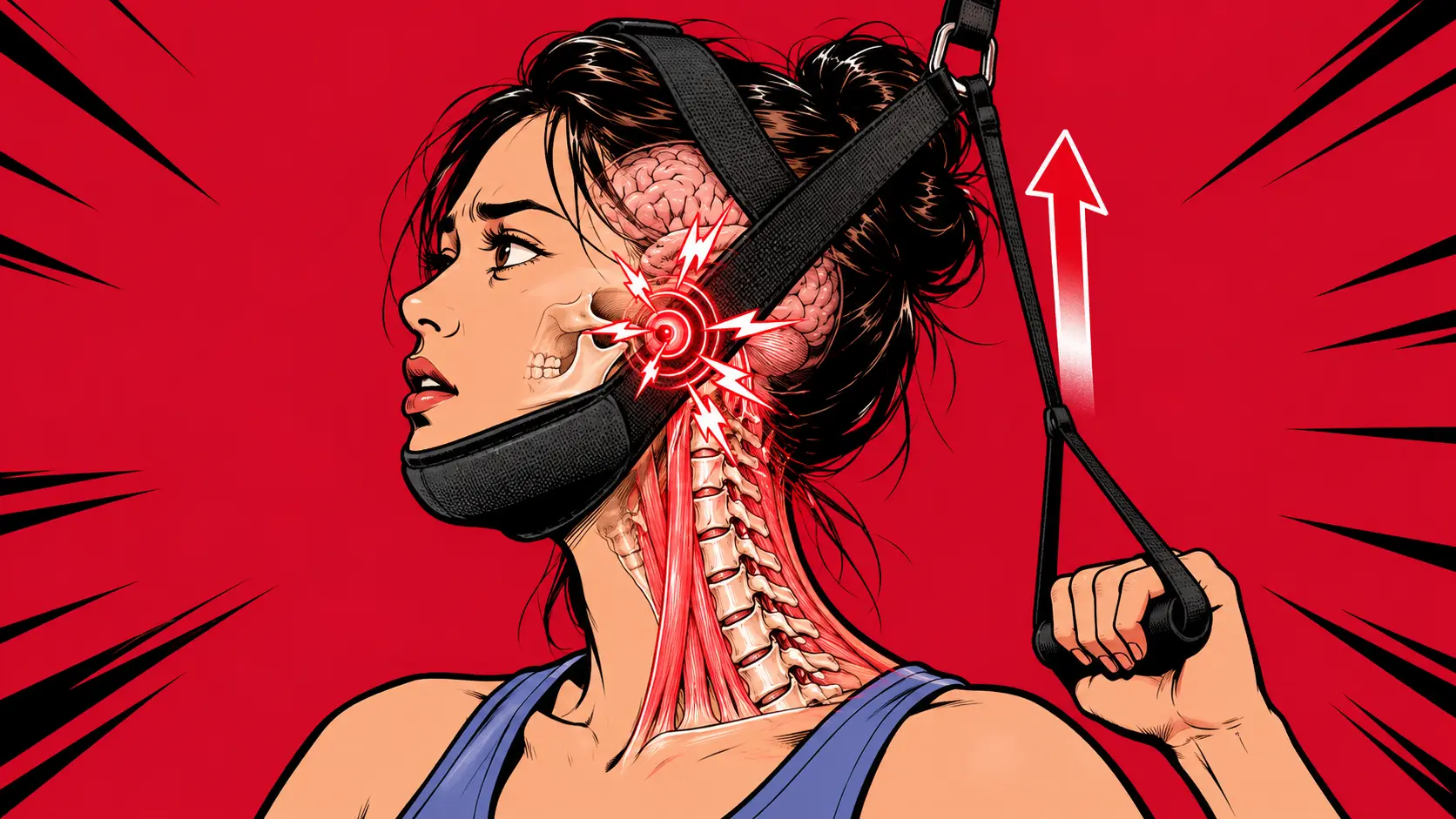
Over-the-door traction pulls through a strap under your chin. Saunders traction doesn’t touch your jaw at all. For a stiff neck, that difference is minor. For neck-related dizziness, it’s the whole story.
Key takeaways
- Over-the-door traction routes pulling force through a chin halter, which transfers real pressure onto your jaw joint (TMJ), not just your neck.
- Saunders-style traction pulls from the occiput (the base of your skull) while you lie down, so the jaw stays passive and the neck muscles can fully relax.
- No trial has directly compared the two devices for neck-related dizziness specifically, so “Saunders is proven better for dizziness” overstates the evidence.
- Cervicogenic dizziness is a diagnosis of exclusion: vestibular, cardiovascular, medication, and neurological causes need ruling out first, whichever device you’re considering.
- If traction ever triggers or worsens dizziness, nausea, new arm symptoms, or visual changes, stop immediately, it’s not something to push through.
- The device you buy matters less than whether anyone has confirmed what’s actually driving your dizziness before you start pulling on your neck.
Related reading
Why the $20 fix can be the wrong tool for a dizzy neck
If you’ve been googling “cervical traction for dizziness” at midnight, chances are you’ve landed on a $20–$40 over-the-door kit: a chin strap, a pulley, a water bag. It’s cheap, it ships tomorrow, and for an ordinary stiff neck it can genuinely help some people loosen up.
Dizziness changes the calculation. When the symptom you’re trying to treat involves your balance system, an uncontrolled, seated, chin-loaded device is a blunt instrument for a problem that needs precision. That’s not a reason to panic, it’s a reason to understand exactly what each device is doing to your body before you decide.
Important
This article compares two traction devices, not treatments for dizziness. Whether traction is appropriate for you at all is a separate, earlier question, covered in what the research shows below.
The chin halter problem no one tells you about
Most over-the-door units use a canvas or plastic harness that sits under your chin and around the back of your skull. A pulley (or a bag of water) then pulls that harness upward. The problem is where that force actually goes.
The mechanics
Engineering literature on cervical traction headgear has documented this for decades: chin-strap harnesses transfer significant pressure directly onto the temporomandibular joint (TMJ), the hinge just in front of your ear that lets you chew and talk. Because that pressure is painful, your own pain tolerance becomes the limiting factor on how much force you can actually apply, typically capping out at around 20 pounds, which may be too little to meaningfully affect the neck in the first place.
Jaw problems and neck-related dizziness frequently travel together.
Research on temporomandibular disorders has found aural symptoms, dizziness, tinnitus, and ear fullness, in the large majority of patients with jaw joint problems, likely because the TMJ, the neck, and the ear share overlapping nerve pathways. That’s an association documented in the literature, not proof that one directly causes the other in every case, but it’s exactly why loading the jaw is the last thing you want to do when dizziness is already on the table.
A supine, occiput-pull design sidesteps this entirely. Rather than pulling on the chin, a unit like the Saunders Clinical Traction device anchors force at the occiput (the ridge at the base of your skull) and the forehead, with the jaw taking no load. The pulling axis lines up with the spine instead of being offset through the jaw, which patent literature on cervical traction design has specifically flagged as the more anatomically sound approach.
Here’s how the mechanics break down when you compare the two designs side by side:
✗ Chin-strap (over-the-door)
- Force passes through the TMJ before it reaches the neck
- Pain tolerance at the jaw limits usable force, often under 20 lb
- Seated harness position varies with chair height and pulley alignment
✓ Occiput-pull (Saunders-style)
- Jaw is not loaded at all, force is delivered at the base of the skull
- A gauge lets you (or your clinician) set an exact, repeatable poundage
- Supine position keeps the head and neck consistently aligned
Why lying down beats sitting up
Sit upright for over-the-door traction and your neck and back muscles have a job to do that has nothing to do with treatment: they have to keep your torso from slumping against gravity. You’re asking a device to gently lengthen your cervical spine while your own muscles are actively bracing against it.
Lie flat for supine traction and that job disappears. Gravity is neutralised, the cervical muscles can properly disengage, and the pulling force reaches the joints and discs it’s meant to reach instead of fighting active muscle guarding. Clinical guidance on cervical traction technique generally favours the supine position for this reason.
Practical read: if a stiff, guarded neck is part of what’s feeding your symptoms, position isn’t a minor detail, it changes whether the traction can do its job at all.
Angle and force: control versus guesswork
Your cervical spine has a natural forward curve. Different structures respond to different angles of flexion (commonly somewhere in the 15–25 degree range, depending on what’s being targeted), and pulling straight up, which is what a door-mounted pulley does by default, isn’t automatically the right angle for every neck or every condition.
| Variable | Over-the-door | Saunders / clinical unit |
|---|---|---|
| Angle of pull | Usually fixed, straight up | Adjustable, set to the degree of flexion needed |
| Force | Set by a hanging weight or water bag, hard to fine-tune | Set on a gauge, repeatable session to session |
| Consistency | Varies with chair, harness fit, and pulley height | Fixed lying-down setup, less to get wrong |
None of this means a home Saunders unit turns into a clinic visit. It means the margin for accidental over-force or a poorly chosen angle is smaller with a controllable device, which matters more when you’re treating something as sensitive as your balance system than when you’re treating an ordinary stiff neck.
What the research actually shows (and what it doesn’t)
Here’s the honest part, and it cuts against the easy version of this story: no published trial has directly compared Saunders traction against over-the-door traction for neck-related dizziness. Anyone telling you one is “proven” more effective than the other for dizziness specifically is going beyond what the evidence says.
| Intervention | What the evidence shows | Status |
|---|---|---|
| Manual therapy ± exercise | A 2022 review of 13 trials (898 patients) found manual therapy may reduce dizziness, neck symptoms, and balance problems; adding exercise looked promising but certainty was rated very low. | Some support |
| Traction combined with manual therapy (clinic) | A 40-patient trial found large short-term gains in dizziness and neck pain, but the protocol bundled traction with manual therapy, so the improvement can’t be credited to traction alone. | Short-term only |
| Saunders traction, used alone | No dedicated trial isolates a home Saunders device as a standalone treatment for dizziness. | Not proven alone |
| Over-the-door traction, used alone | Same gap in the evidence, plus the added setup variability of a seated, chin-loaded device. | Riskier setup |
A separate 2025 meta-analysis of six trials (about 272 patients) found upper-cervical manual therapy improved dizziness-related disability and dizziness intensity by a meaningful margin on average, but again rated the certainty of that evidence as low to very low. A 2026 review of physiotherapy for neck pain with dizziness or tinnitus found 77% of the 13 included studies were at high risk of bias. None of this is a reason to dismiss the field, small and imperfect evidence still points somewhere useful, but it is a reason to be precise about what’s actually established.
The honest summary
The strongest evidence supports assessment-led, multimodal care (manual therapy, targeted exercise, and traction when appropriate, delivered together and supervised). The weakest evidence supports buying either traction device and using it alone, unsupervised, on a dizziness you haven’t had properly assessed.
Saunders vs. over-the-door, side by side
| Feature | Saunders / clinical traction | Over-the-door traction |
|---|---|---|
| Position | Lying down, head supported | Seated, harness on a door pulley |
| Contact point | Occiput and forehead, jaw free | Chin and occiput together |
| Force control | Precise, gauge-based | Often a hanging weight or water bag |
| Muscle relaxation | Full, gravity neutralised | Partial, torso muscles stay active |
| Evidence for dizziness | No direct trial isolates it | No direct trial isolates it |
| Main practical risk | Can feel “medical,” creating false confidence if used unsupervised | Excessive or uneven force, jaw loading, inconsistent setup |
| Best use | Trialled in-clinic first, then continued at home under instruction | Only after a clinician has demonstrated correct setup and dosage, if at all |
The same device that helps one person can flare up the next, and that’s exactly the point.
Threads on Reddit’s cervicogenic-dizziness communities show roughly the same split the clinical evidence hints at. People who describe real improvement tend to be using gentle, time-limited, lying-down traction (Saunders-style or similar) alongside a physio-led programme, deep neck-flexor strengthening, posture correction, suboccipital release, not the device by itself. People who describe things going wrong tend to cluster around over-the-door or inflatable setups, strong force applied early, or traction tried on a neck with suspected instability that was never properly assessed; a few describe over-inflated collars feeling like pressure on the throat before any relief arrived. One physical therapist active in these threads said they’d only had consistent success with lying-down Saunders-style units sourced through clinics, and hadn’t heard good things about over-the-door or inflatable devices.
These are anecdotal reports from online communities, not clinic outcomes or medical advice. Individual results vary widely, and no one should self-traction a dizzy or unstable neck without being assessed first.
Red flags: when to stop immediately
Whichever device you’re considering, some symptoms mean you stop the moment they appear and don’t restart on your own.
Safety note
Stop traction immediately and seek urgent medical care if you notice sudden severe headache, double vision or vision loss, slurred speech, facial drooping, new one-sided weakness or numbness, difficulty walking normally, fainting or near-fainting, difficulty swallowing, or persistent vomiting. Do not use a home traction device to “test” whether these symptoms are coming from your neck.
- Dizziness or nausea worsens during or after useStop the session. A bad reaction to traction is not proof the neck is the cause, and shouldn’t be used to self-diagnose.
- New arm or hand symptoms appearShooting pain, tingling, weakness, or an electric-shock sensation down one arm means stop and get assessed before continuing.
- You feel the need to increase the force because it “isn’t working”More force is not the fix for an ineffective session. Reassess with a clinician instead of escalating on your own.
- You have osteoporosis, a recent neck injury, inflammatory arthritis, or previous neck surgeryThese conditions can change whether traction is appropriate at all. Get clearance first.
Why even the best device isn’t a protocol
If the comparison above has you leaning toward a Saunders unit instead of an over-the-door kit, that’s the safer hardware call. But hardware isn’t the whole answer, a traction device is a tool, not a treatment plan.
Pulling on the neck is one piece of a larger mechanical picture. Skip the steps around it, and even a well-controlled pull tends to give temporary relief before the same forces that caused the problem, an unmeasured curve, guarded muscle, posture that never changed, put it right back.
After 29 years and 3,000+ cases, Dr Will’s view is that traction only earns its place as one step inside a sequence, not a stand-alone fix.
- Measure
A Saunders unit can’t see your bones. Assessment starts with a standing, weight-bearing X-ray, because Dr Will’s stand is that pulling a flattened or reversed curve at a generic angle isn’t automatically safe, the direction of pull needs to match the direction of the problem, not the other way round.
- Release · AxisFlex™
In Dr Will’s clinical experience, pulling directly on a neck that’s locked in guarded spasm tends to trigger a defensive muscle reflex rather than a clean stretch. The AxisFlex Protocol™ releases the deep suboccipital muscles first, before any decompression is applied.
- Recalibrate · NeuroPosture™
Fifteen minutes of traction changes little if the posture that caused the problem snaps straight back once gravity takes over. NeuroPosture Calibration™ retrains that pattern, so the correction has a chance to stick.
A device pulls. A protocol measures first, prepares the tissue, then works on making the change hold, in that order.
The question that actually matters
Clinical note
After 3,000 patient cases, here’s what I tell people who ask me whether to buy a Saunders unit or an over-the-door kit for their dizziness: that’s not actually the first decision.
The device only matters once you know what you’re treating. Cervicogenic dizziness is a diagnosis reached by ruling other things out, not by trying a traction device and seeing what happens. A standing X-ray tells you whether your cervical curve is still within a normal range or has started to flatten, information that changes everything about whether traction, and which kind, makes sense for you at all.
Choosing structural correction over a stiff-neck home device isn’t about one being “better,” it’s about answering the right question first. If your neck-related dizziness hasn’t been properly assessed, buying the more controllable device only makes an unsupervised guess a little safer, it doesn’t make it an informed decision. You only get one cervical spine. Measuring it before you pull on it, rather than after, is the actual upgrade.
Not sure what’s driving your dizziness? A structural assessment can tell you before you spend on either device.
Book your structural X-ray assessment →Frequently asked questions
Is over-the-door traction dangerous?
Not inherently, but it carries more setup risk than a supine device. The chin strap loads your jaw joint, and force from a hanging weight or water bag is harder to control precisely than a gauge-based unit. It’s the added variability, not the price tag, that’s the concern.
Can traction cure cervicogenic dizziness?
No study supports calling traction a cure for cervicogenic dizziness. The best current evidence points to assessment-led, multimodal care (manual therapy, targeted exercise, and traction where appropriate) as the approach with the most support, not any single device used alone.
Is Saunders traction automatically safe if I have TMJ problems?
It’s designed to avoid loading the jaw, but “designed to” isn’t the same as “risk-free.” Anyone with a diagnosed TMJ disorder, or dizziness that might be connected to one, should get that assessed before starting any traction device, supine or seated.
How much force or weight should I use at home?
This isn’t something to set by guesswork, and we won’t give a generic number here. Appropriate force depends on your neck, your diagnosis, and the device, and should be set (or at least confirmed) by a clinician who has actually assessed you.
Should I try traction at all if I’m already dizzy?
Not on your own, and not until the cause of the dizziness has been considered. Cervicogenic dizziness is only one possible explanation among several (inner-ear, cardiovascular, medication-related, neurological), and self-directed traction on an unassessed dizziness is exactly the scenario clinical safety guidance warns against.
How is Dr Neck Pain’s approach different from just buying a home traction device?
It starts with measuring your cervical spine, not guessing at it. A standing X-ray shows whether your curve is within a normal range or has flattened, which is the information that should decide whether traction fits your case, and if so, how it’s dosed, before anyone reaches for a device at home.
References
- Cao Y, et al. Manual therapy for cervicogenic dizziness: a systematic review and meta-analysis. 2022. 13 RCTs, 898 patients. PubMed
- Reid SA, et al. Manual therapy and traction for cervicogenic dizziness: randomized controlled trial. 2021. PubMed
- Home exercise programme for cervicogenic dizziness: randomized controlled trial. Frontiers in Neurology. 2023. Frontiers
- Carrasco-Uribarren A, et al. Manual therapy for cervical dizziness: systematic review and meta-analysis. 2025. PMC
- Physiotherapy for neck pain with cervicogenic dizziness or tinnitus: systematic review. 2026. PubMed
- Cervicogenic dizziness: diagnosis of exclusion and clinical overview. PMC
- Cervical traction: technique, indications, and contraindications. StatPearls. NCBI Bookshelf
- Inchingolo AM, et al. Correlation between temporomandibular disorders and tinnitus. Applied Sciences. 2023;13(15):8997. MDPI
- Karacay BC, Korkmaz MD. Factors associated with dizziness, tinnitus, and ear fullness in temporomandibular disorders. J Oral Facial Pain Headache. 2023;37(1). PMC
- Headgear for cervical traction system (chin-strap TMJ loading). US Patent 5,109,835. Google Patents
- Cervical traction device (occiput vs. chin pulling axis). US Patent 4,508,109. Google Patents
- Signs requiring urgent evaluation with cervical traction. NHS patient guide, Royal Berkshire NHS Foundation Trust. PDF
This article is educational information only and is not medical advice, diagnosis, or a treatment recommendation. It should not be used to self-diagnose the cause of dizziness or to self-prescribe traction force or duration. Clinic details, credentials, and pricing can change; verify current information directly. If you have any red-flag symptoms listed above, seek urgent medical assessment rather than using a home traction device.