
“It felt amazing, then the room spun”
Many describe long sessions on tight shoulders that crept up toward the base of the skull. Some felt dizzy straight away; others woke the next morning in the worst vertigo of their lives, lasting days to weeks.
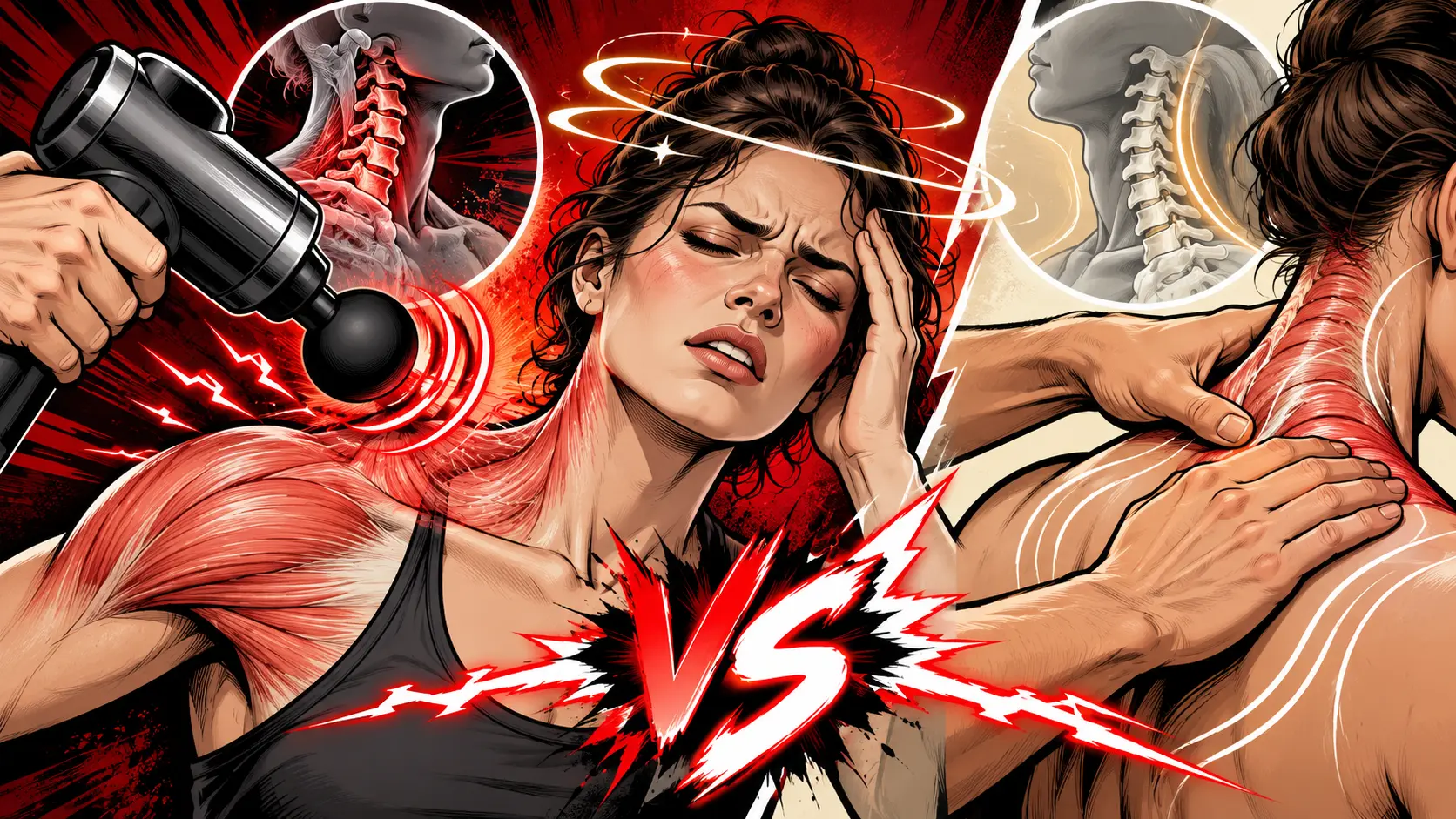
Your neck was tight after a long week at the desk. You grabbed the massage gun, worked it up into the base of your skull, and it felt great. Then, a few hours later or the next morning, the room started to tilt.
If you are reading this worried you have done damage, take a breath. Most people in this situation have not caused anything permanent. But some symptoms do need a doctor today, and there is a better way to deal with the tension that sent you reaching for the gun in the first place.
Last updated: September 2026 · Reviewed by Dr Will Kalla, Dr Neck Pain
Read this first: when to go to A&E
Call 995 or go to A&E now if, in the hours or days after using a massage gun or any massage on your neck, you develop a new severe headache or neck pain unlike your usual stiffness, dizziness with vomiting or trouble walking, double vision, slurred speech, a drooping face, or weakness or numbness on one side. Tell the doctor you used a massage gun on your neck. These can be signs of a torn neck artery, which is rare but an emergency.
The short version
Related reading
Massage guns are everywhere, in gym bags, office drawers and gift guides, and they genuinely work well on big, thick muscles like the thighs and calves. So when the base of your skull feels like a clenched fist after a day at the screen, it seems obvious to point one at your neck.
The problem is that your neck is not a thigh. Within a few centimetres of that tight spot sit the arteries that feed the back of your brain, the nerves to your arms, the balance organ in your inner ear, and some of the densest clusters of position sensors in your body. That is a lot of delicate anatomy to put under a motorised hammer.
This is not internet rumour. Doctors have started publishing cases. They are case reports, which means they describe what happened to individual patients rather than proving cause and effect, but the pattern is consistent enough that clinicians now advise keeping massage guns off the neck.
Two patients, two massage guns, one pattern
Two middle-aged patients developed benign paroxysmal positional vertigo (BPPV) after using handheld massage guns around the neck and upper shoulders. The authors proposed that vibration travelling through the skull shook loose tiny calcium crystals in the inner ear.
Outcome: short bursts of spinning when lying down or rolling over. Treatable with repositioning manoeuvres.
A 27-year-old with headache, neck pain and dizziness
She was found to have a vertebral artery dissection, a tear in one of the arteries supplying the back of the brain, after repeated massage gun use on her neck. The authors noted causation is hard to prove, but advised doctors to ask about massage guns.
Outcome: a tear in an artery feeding the brainstem. She recovered fully on aspirin, because it was caught.
Two hours on one side of the neck
A 25-year-old reportedly used a massage gun on the back and side of her neck for about two hours, then developed sudden dizziness and slurred speech. She had a vertebral artery tear and a stroke in the brainstem.
Outcome: the stroke the earlier case avoided. Same mechanism, worse ending.
Keep this in proportion. Vertebral artery tears are rare, estimated at roughly 3 in 100,000 people a year, and most people who use a massage gun on their neck will never have one. But the consequences can be serious, and the benefit of pounding the neck in the first place is small. That is a poor trade.
Most people bought the thing for their traps, and that is a perfectly reasonable use. The line that matters is not “shoulders bad,” it is knowing where the trap stops and the neck begins.
Find the landmark first
Tip your chin to your chest and feel down the back of your neck. The bump that sticks out most at the bottom, where the neck meets the shoulders, is your C7 vertebra. Everything above that bump is off limits. The meaty slope out towards your shoulder is not.
Above the C7 bump, and the throat
The back of the neck over the spine, the soft dip at the base of the skull, behind the ears, the jaw, and the front and sides of the throat. This is where the arteries, the balance organ and the position sensors sit.
The trap slope and shoulder tops
The muscle bulk between your neck and the point of your shoulder is fair game. Stay roughly a hand’s width out from the spine; keep below the C7 bump; lower setting; 30 to 60 seconds a spot; let it float rather than pressing it into bone. Ease off if you feel light-headed.
Big muscles
Shoulder blades, mid and lower back, thighs, calves and glutes. Thick muscle, no delicate structures underneath, exactly what the tool was designed for.
One exception worth taking seriously
If you already get dizzy, or you have had BPPV or vertigo before, treat the trap slope as off limits too until someone has worked out what is driving it. Not because shoulder work is dangerous in itself, but because you lose your early warning: when you feel floaty most days anyway, a new symptom is easy to dismiss as just another bad day.
The zones above assume an otherwise healthy neck. Some conditions change the answer, and a few are worth checking with your doctor or pharmacist before you use a percussive device anywhere near the upper body.
Not a complete list
These are the cautions commonly listed for vibration and percussive therapy, not trial evidence. If you are on medication or being treated for something, a two-minute check with your doctor or pharmacist settles it far better than an article can.
Here is the honest tension in all of this. The muscles that tend to be the real culprits in a stiff, dizzy neck are the ones you cannot safely reach with a gun: the scalenes on the side of the neck, the sternocleidomastoid running from behind the ear to the collarbone, and the suboccipitals in the dip at the base of the skull.
Work on those muscles genuinely can help, which is why good therapists spend time there. The problem is the delivery method, not the target.
If the scalene area is a recurring problem for you, and especially if it comes with arm symptoms, that pattern is worth having assessed rather than self-treated. It overlaps with thoracic outlet syndrome, where those same muscles compress the nerves and vessels heading into the arm.
| What matters | Massage gun on the neck | Gentle manual massage |
|---|---|---|
| Type of force | Rapid, repeated mechanical strikes | Steady, adjustable pressure |
| Feedback | None; the motor keeps going | A trained therapist feels the tissue respond |
| Stops when something is wrong? | Only when you notice | Adjusts or stops at the first sign of dizziness |
| Neck safety | Case reports of vertigo and artery tears; clinicians advise against | Generally the lower-risk option when gentle and skilled |
| What it treats | Muscle tension | Muscle tension |
Look at that last row. Manual massage wins on safety, but both are aimed at the same thing: the tight muscle. Neither asks why the muscle keeps getting tight.
What people report online
Recurring themes, paraphrased from massage and cervical vertigo communities on Reddit
“It felt amazing, then the room spun”
Many describe long sessions on tight shoulders that crept up toward the base of the skull. Some felt dizzy straight away; others woke the next morning in the worst vertigo of their lives, lasting days to weeks.
The A&E visit that ended in “it’s nothing”
Several went to A&E fearing a stroke. Scans came back clear and they were told it was neck strain or shaken ear crystals, which was a relief, but many were still dizzy weeks later with little guidance on what to do next.
What they say finally helped
The common thread is putting the device down and finding a clinician who understands neck-related dizziness, rather than more self-treatment.
These are anecdotal reports summarised from online patient communities, not clinical outcomes or medical advice. Individual experiences vary widely.
This is not a diagnosis, only an exam can give you that, but it can help you work out the right next step.
Self-guided symptom check
Dizzy after using a massage gun: what should you do next?
4 short questions · about 1 minute · educational only
Whether it is a massage gun or a skilled pair of hands, the target is the same: the tight muscle. And if you have been chasing the same knot at the base of your skull for months, you already know the pattern. It loosens, then it comes straight back.
The tight muscle
Massage guns and manual massage both work here. Relief is real, but it fades, because nothing about the load on the muscle has changed.
The symptom
Why the muscle is working so hard
A head that sits forward, or a neck that has lost its natural curve, keeps the muscles at the back of the neck switched on all day just to hold you upright.
The structure, measured on a standing X-ray
Dr Will’s view is that chronic neck tension is usually a message, not the problem. The muscles tighten because they are guarding a neck that is no longer sitting well under the weight of the head. Pound them, rub them or stretch them, and they relax for a while, then tighten again, because the reason they are working has not changed. His approach is to measure the structure first, then decide what the muscles actually need.
If the tension keeps returning, the next step is not a stronger device, it is a different question: what shape is your neck in while it holds your head up? Over 29 years and 3,000+ cases, Dr Will Kalla built the R3NEW X™ protocol around that question. You can read more about Dr Will’s background and structural approach to neck care.
Hands, not hammers, and guided by a standing X-ray, in three phases.
Frees the deep, overworked suboccipital muscles at the base of the skull, the same spot people aim the massage gun at, but with controlled hands-on technique.
Resets the specific stiff upper-neck segments your X-ray identifies, at the neurological level, rather than working on the whole neck blindly.
Retrains your nervous system to hold the corrected position against gravity, so the muscles no longer need to guard all day.
Measured first, tracked on X-ray throughout, with a defined endpoint rather than open-ended sessions.
Before you book, worth being clear
Put the massage gun down. If your neck tension keeps coming back, a standing X-ray assessment shows how your neck is holding up under gravity, and why the muscles won’t let go. You can also see how other Singapore patients progressed first.
Book your structural X-ray assessment →Yes, it has been reported. A 2024 report in JAMA Otolaryngology described two patients who developed BPPV, a type of vertigo caused by loose crystals in the inner ear, after using massage guns around the neck. It is usually treatable with repositioning manoeuvres.
It is rare, but there are case reports. Doctors have described vertebral artery tears, which can lead to stroke, after repeated or prolonged massage gun use on the neck. Causation is hard to prove from single cases, but it is why clinicians advise keeping massage guns off the neck entirely.
Anywhere above the C7 bump: tip your chin down and feel for the vertebra that sticks out where your neck meets your shoulders. Above that, meaning the back of the neck, the base of the skull, behind the ears and jaw, plus the front and sides of the throat, is off limits. The trap slope below that bump, out towards the shoulder, is fine with a lower setting and short bursts.
Generally yes, when it is gentle and done by a trained therapist. A therapist can feel how the tissue responds and stop if you become dizzy, while a motor keeps striking. Both, however, only treat the muscle tension itself, not the reason it keeps coming back.
Most people have not. The most common cause, inner-ear vertigo, is usually very treatable. But if you have a new severe headache or neck pain, vomiting, trouble walking, double vision, slurred speech, or one-sided weakness, go to A&E now. Otherwise, stop using the gun on your neck and see a doctor.
Because massage treats the muscle, not what is loading it. In Dr Will’s view, muscles at the back of the neck often stay tight because they are holding up a head that sits forward or a neck that has lost its curve. A standing X-ray shows whether that is part of your picture.
This article is educational information only and is not medical advice, diagnosis, or a treatment recommendation for your individual situation, nor a review of any specific product. Brand names such as Theragun are used only to describe the category of handheld percussive massage devices; the published cases did not necessarily involve any particular brand. New dizziness after neck massage should be assessed by a doctor. Chiropractic care is not MOH-registered in Singapore and is not a substitute for medical or surgical care. If you have a sudden severe headache or neck pain, dizziness with vomiting or trouble walking, double vision, slurred speech, a drooping face, or one-sided weakness or numbness, call 995 or go to A&E immediately.

Chat with us today to begin your journey to a pain-free life.
Our Clinic
420 North Bridge Road,
02-20 North Bridge Centre,
Singapore 188727
Opening Hours
Monday - Friday: 9:30 AM - 7 PM
Saturday: 9:30 AM - 1 PM
Sunday: Closed