

Four published studies have tested whether restoring the curve in the neck changes dizziness. Here is what they found, how strong that evidence is, and what it still cannot tell you.
- Dizziness can come from the neck. It is called cervicogenic dizziness, and it usually feels like floating or unsteadiness rather than the room spinning.
- There is no single test that confirms it. It is a diagnosis of exclusion, which means ear and neurological causes are ruled out first.
- The research linking neck alignment to dizziness is real but small: one randomised trial of 72 patients and three single-patient case reports.
- Structural change and symptom change are two separate measurements. An X-ray can show your curve has changed. It cannot show that your dizziness has gone.
The short answer
For some people, yes. Where dizziness is coming from the neck, the published research suggests that restoring cervical lordosis, the natural curve in the neck, can reduce dizziness, and that the improvement can hold at one year. The evidence base is small: one randomised controlled trial with 72 patients, plus three case reports describing one patient each. That is enough to take the approach seriously. It is not enough to promise anyone an outcome, and any clinic that promises you one is going beyond what the research supports.
What cervicogenic dizziness is, and why it is hard to name
Cervicogenic dizziness is dizziness that comes from the neck. Patients rarely describe a spinning room. They describe floating, swaying, walking on a boat, or a head that feels disconnected from the body. It often gets worse after long desk hours, when turning the head quickly, or when holding one position for too long.
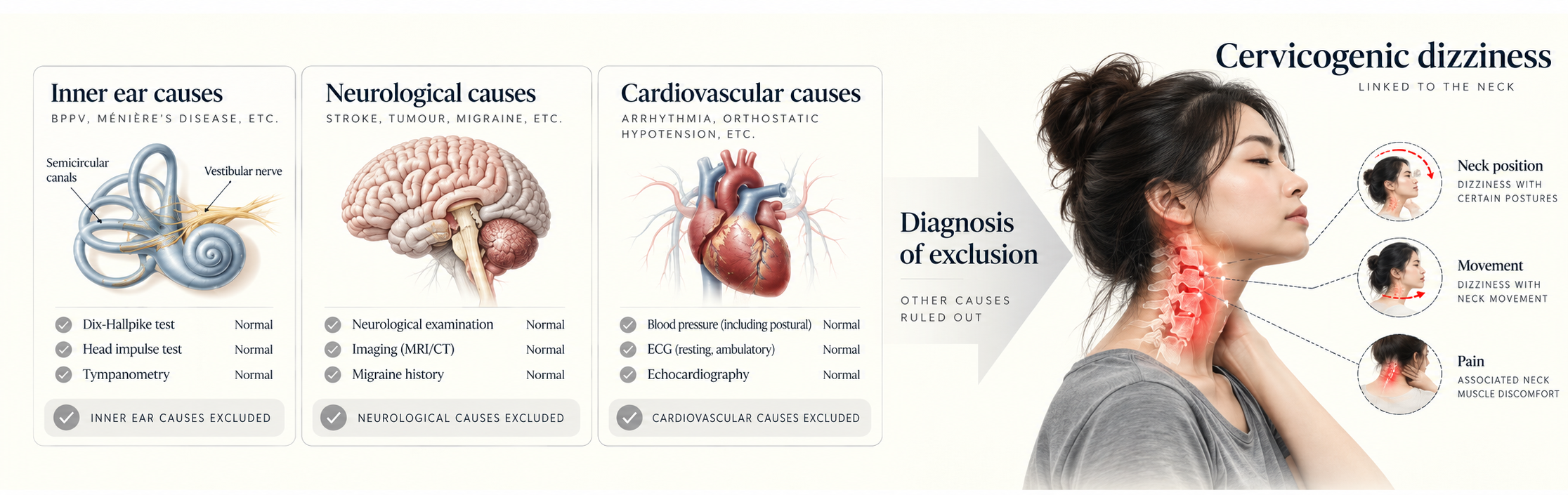
Here is the difficult part, and most clinics skip it. There is no single test that confirms cervicogenic dizziness. It is what doctors call a diagnosis of exclusion. The inner ear causes, including BPPV and vestibular neuritis, are ruled out. Neurological and cardiovascular causes are ruled out. If those tests come back clear, and the dizziness tracks with neck position, movement or pain, then a cervical cause becomes the likely explanation.
That is why so many people arrive at a structural clinic after months of normal scans. They have been told nothing is wrong, which is not the same as being told what is wrong.
The idea being tested: structure and function
The upper neck is dense with position sensors called proprioceptors. They tell your brain where your head is in space. Your eyes and your inner ear do the same job. When all three agree, you feel steady.
The theory behind structural treatment is that when the cervical curve is lost or reversed, those joints and sensors send signals that disagree with the eyes and the inner ear. Your brain gets two versions of reality, and the mismatch is what you feel as floating or unsteadiness. Restore the alignment and the signals can line up again.
Clinical note
“Structure dictates function. We restore your cervical structure towards normal lordosis, which improves function. Once function is normal, your neck can heal, and your dizziness can go away.”
That word “can” is doing real work. Some patients respond well. Some respond slowly. Some do not respond, and those people need a different answer, not a longer programme.
What the research actually shows
Four published studies have looked at cervical alignment and dizziness. Here they are, with how strong each one is.
| Study | Design and patients | What the study found | How strong |
|---|---|---|---|
| Moustafa, Diab & Harrison, 2017 |
Randomised controlled trial |
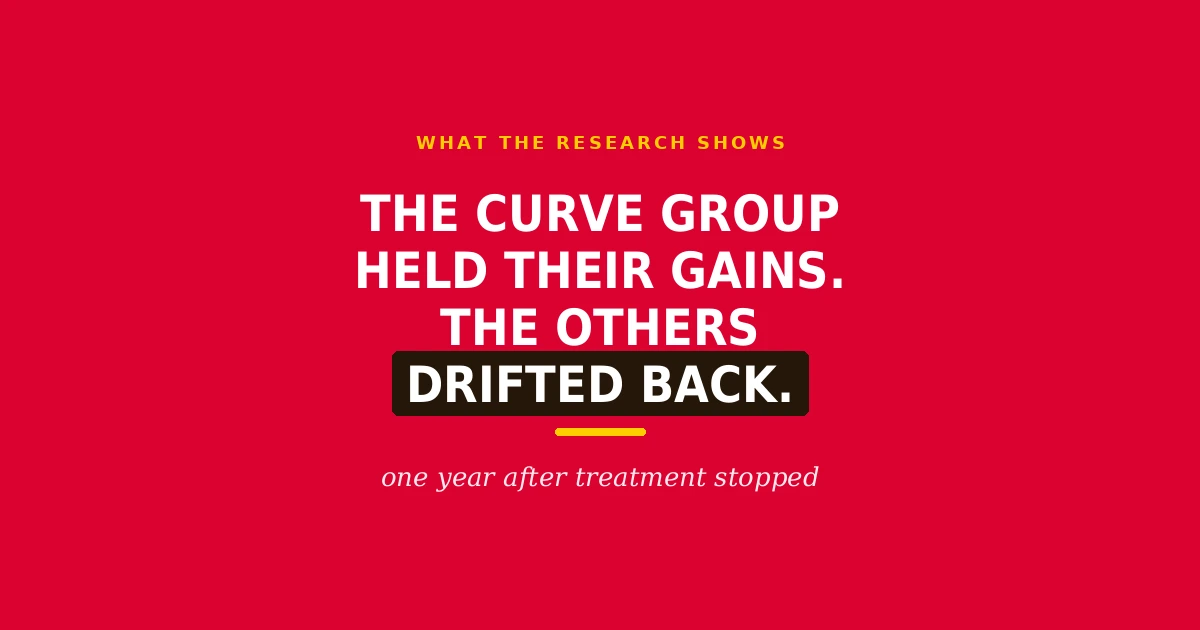
Both groups had the same rehabilitation. Only one group also received cervical traction to restore the curve. Both improved at 10 weeks. At one year the traction group held and improved further, reported as close to a 30-point gain on the Dizziness Handicap Inventory, while the other group drifted back towards where they started. | Strongest here |
| Gerstin, Oakley & Harrison, 2020 |
Case report |
Cervical lordosis increased by 20 degrees over 115 sessions in 12 months, and the Dizziness Handicap Inventory score fell by 44 points. | One patient |
| Fortner, Oakley & Harrison, 2018 |
Case report |
Dizziness after an injury, and neck pain, resolved as forward head posture reduced and the curve increased. | One patient |
| Rivera Ortiz and colleagues, 2026 |
Case report |
Dizziness and fainting triggered by tilting the head back. After 68 treatments over 5.5 months the curve moved from 9.4 degrees kyphotic to 16.4 degrees lordotic. At one year the fainting had fully resolved and about 90% of the dizziness symptoms had resolved. | One patient |
In the trial, both groups felt better at ten weeks. The difference only showed up a year later.
Short-term relief is easy to produce and easy to sell. Whether it holds after treatment stops is the question worth asking, and it is the question most clinics never answer because they never follow up.
How to read this evidence
A case report describes one patient. It tells you something happened. It cannot tell you how often it happens, whether the treatment caused it, or whether you would respond the same way. Case reports are how medicine notices a pattern worth testing. They are not proof.
A randomised controlled trial compares groups. That is what makes the 2017 study the most useful item here: 72 patients, two groups, the same rehabilitation for both, one extra ingredient for one group, and a year of follow-up.
One trial is still one trial. A single study, however well designed, is a strong signal rather than a settled answer. Cervicogenic dizziness remains an area where specialists disagree, including about how often the neck is genuinely the cause.
Worth knowing
Dr Deed Harrison is a co-author on all four studies and leads the research foundation behind the Chiropractic BioPhysics method they examine. We think you should know that when you read them. It does not make the findings wrong, and the 2017 trial was published in a peer-reviewed rehabilitation medicine journal. It does mean the field needs work from independent teams before anyone calls this settled.
What the research does not prove
What it supports
- Neck alignment can be a factor in dizziness for some patients.
- Restoring cervical lordosis was associated with lower dizziness scores in the trial.
- Improvements held at one year in the group that had structural work.
What it does not support
- That every case of dizziness comes from the neck. Most do not.
- That a changed X-ray guarantees your symptoms will change.
- That results are permanent for everyone, or that nobody needs further care.
- That structural treatment should replace a medical assessment.
When to see a doctor first, or instead
Dizziness has many causes, and some need urgent medical attention. See a doctor before booking anything structural if any of these apply.
- Sudden, severe or new dizziness
Especially with slurred speech, weakness on one side, double vision, a severe headache, or trouble walking. Seek urgent medical care.
- Fainting, chest pain or palpitations
These point towards a heart or blood pressure cause, which needs a doctor first.
- The room genuinely spins
True spinning vertigo, particularly when rolling over in bed, is more typical of an inner ear cause such as BPPV. An ENT or GP assessment comes first.
- Hearing loss, ringing or ear fullness
Symptoms in the ear belong to an ENT specialist.
Please read
Chiropractic and structural correction are not MOH-registered services in Singapore, and they are not a substitute for medical or surgical care. Care is paid privately or through corporate benefits, not Medisave. This article is general information, not a diagnosis.
What we see in our own clinic
We are a structural clinic, so treat this as our experience rather than research. We publish it because it is more useful to you than an adjective.
Timeline. Some patients reach their structural targets in about four weeks. Most take three to four months.
What we measure, and separately. Your X-rays show whether the curve has changed. That is structure. How you feel is tracked on its own: we ask you at your visits, and you fill in a written symptom form, so there is a record of your own answers over time rather than a memory of them. The two do not always move together, and we tell you both, including when they disagree.
Afterwards. The aim is not to keep you coming back. It is to correct the mechanical cause, confirm the change on your post-correction X-rays, and graduate you from care. We have followed up with 20 former patients between six and fifteen years after they finished, and they are doing well without further treatment. That is not everyone we have treated and it is not a study. It is the group we were able to track, and that is what they told us.
Not sure whether your neck is the cause?
The Initial Consultation and X-ray Assessment is $168, and it answers that question either way. If the imaging does not show a mechanical problem we can correct, we will tell you on the day and point you towards who can help.
Book your assessment →North Bridge Centre · Mon to Fri 9.30am to 7pm · Sat 9.30am to 1pm
Questions to ask any clinic before you start
Ask these of us and of anyone else you are considering. A clinic that answers them clearly is a clinic worth your money.
- How many visits are you proposing, and why that number?
The answer should come from your examination, not from a standard package.
- What is the all-in price, including assessment and imaging?
Ours are published on the neck pain treatment pricing page.
- When will you reassess whether this is working?
There should be a specific point at which someone tells you honestly if it is not.
- If there is a guarantee, exactly what does it refund?
Read this one carefully. A guarantee tied to an imaging measurement is not a guarantee about your symptoms. Ours refunds on the structural improvement only, measured on before and after X-rays, and not on your symptoms. We would rather you knew that before you paid than after.
- What happens if I do not respond?
“We would refer you on” is a good answer. “Everyone responds” is not.
Self-check: could your dizziness be coming from your neck?
Self-check
Is your dizziness likely coming from your neck?
Two short lists. Tick anything that applies to you. Your result updates as you go.
Signs that point towards the neck
Signs to see a doctor first
Your result will appear here as soon as you tick something.
See a doctor first
At least one of the things you ticked needs a medical assessment before anything structural. Some causes of dizziness are urgent, and a neck problem can sit alongside one of them without being the cause.
If it came on suddenly or severely, or with weakness, slurred speech, double vision or fainting, treat it as urgent and seek medical care now.
Possible, but not clear yet
One or two of these on their own do not point strongly to the neck. Plenty of other causes produce the same feeling, and the neck pattern usually shows up as a cluster rather than a single sign.
If you have not had your ears and a neurological check looked at yet, start there. If those come back clear and the dizziness still tracks with your neck, an examination with imaging is the next step.
A cervical cause is worth investigating
The pattern you have ticked is the one seen in cervicogenic dizziness: unsteadiness rather than spinning, worse with desk hours or head position, and neck symptoms alongside it. That is not a diagnosis, and it does not rule other causes out.
The next step is an examination with imaging, which either shows a mechanical problem we can work on or does not. Either answer is useful.
This checklist is general information, not a diagnosis. If you are unsure, see a doctor.
Frequently asked questions
Can a chiropractor help with dizziness?
Where the dizziness is coming from the neck, published research suggests structural treatment can help. The strongest study is a randomised trial of 72 patients in which the group that received cervical traction to restore the curve was still improved at one year, while the comparison group drifted back. Where the cause is the inner ear, the brain or the heart, a chiropractor is not the right first stop.
Is cervicogenic dizziness permanent?
Not necessarily, but nobody can honestly promise you it will never return. In the studies above, improvements held for a year, and in one case report for 18 months. Our own follow-ups with former patients, six to fifteen years after they finished, found them doing well without further treatment. That is encouraging. It is not a guarantee, and anyone offering you one is overstating what is known.
How long does treatment take?
Some patients reach their structural targets in about four weeks, and most take three to four months. The published cases took longer: 68 visits over 5.5 months in one, and 115 sessions over 12 months in another. Your examination and X-rays determine your own plan, and we reassess along the way rather than asking you to wait and hope.
Does an X-ray show cervicogenic dizziness?
No. An X-ray shows alignment, not symptoms. It can show that your cervical curve is reduced, reversed or that your head sits forward of your shoulders, which tells us whether there is a mechanical problem we can work on. It cannot confirm that this is what is making you dizzy, and it cannot prove your dizziness has stopped. That is why we track your symptoms separately.
What does treatment for cervicogenic dizziness cost in Singapore?
At our clinic the Initial Consultation and X-ray Assessment is $168, and treatment is charged either per session or as a package. Every price is published on our pricing page, including what each package includes. Which one suits you depends on what the X-rays show, not on the symptom you arrived with. Care is private or corporate insurance, not Medisave.
Can the dizziness come back after treatment?
It can. The trial above found that the group without structural correction drifted back towards their starting point once care stopped, which is the honest reason to care about what happens at one year rather than at ten weeks. Posture habits, new injuries and long desk hours can all reintroduce the problem. We would rather tell you that than promise it is gone forever.
When should I see a doctor instead?
See a doctor first if your dizziness is sudden or severe, or comes with fainting, chest pain, weakness on one side, slurred speech, double vision, a severe headache, hearing loss or ringing. Also see a doctor first if the room genuinely spins when you roll over in bed, which is more typical of an inner ear cause. Structural treatment is for mechanical neck problems, not for these.
Find out whether your neck is the cause
An Initial Consultation and X-ray Assessment is $168 and gives you an answer either way. If the imaging does not show something we can correct, we will tell you on the day and point you towards who can help.
Book your assessmentReferences
- Moustafa IM, Diab AA, Harrison DE. The effect of normalizing the sagittal cervical configuration on dizziness, neck pain, and cervicocephalic kinesthetic sensibility: a 1-year randomized controlled study. Eur J Phys Rehabil Med. 2017;53(1):57–71. PubMed
- Gerstin G, Oakley PA, Harrison DE. The treatment of dizziness by improving cervical lordosis: a Chiropractic BioPhysics case report. J Phys Ther Sci. 2020;32(12):864–868. doi:10.1589/jpts.32.864
- Fortner MO, Oakley PA, Harrison DE. Alleviation of posttraumatic dizziness by restoration of the cervical lordosis: a CBP case study with a one year follow-up. J Phys Ther Sci. 2018;30(5):730–733. doi:10.1589/jpts.30.730
- Rivera Ortiz V, Haas JW, Oakley PA, Norton TC, Harrison DE. Resolution of cervicogenic dizziness, syncope, and neck pain following restoration of cervical lordosis using Chiropractic BioPhysics orthopedic rehabilitation: a case report with one-year follow-up. Cureus. 2026. doi:10.7759/cureus.114624
This article is general health information and not medical advice, diagnosis or treatment. Dizziness has many causes and some are serious. Please see a doctor for a diagnosis. Chiropractic and structural correction are not MOH-registered services in Singapore and are not a substitute for medical or surgical care.