McKenzie Method vs Mulligan Technique for Cervicogenic Dizziness
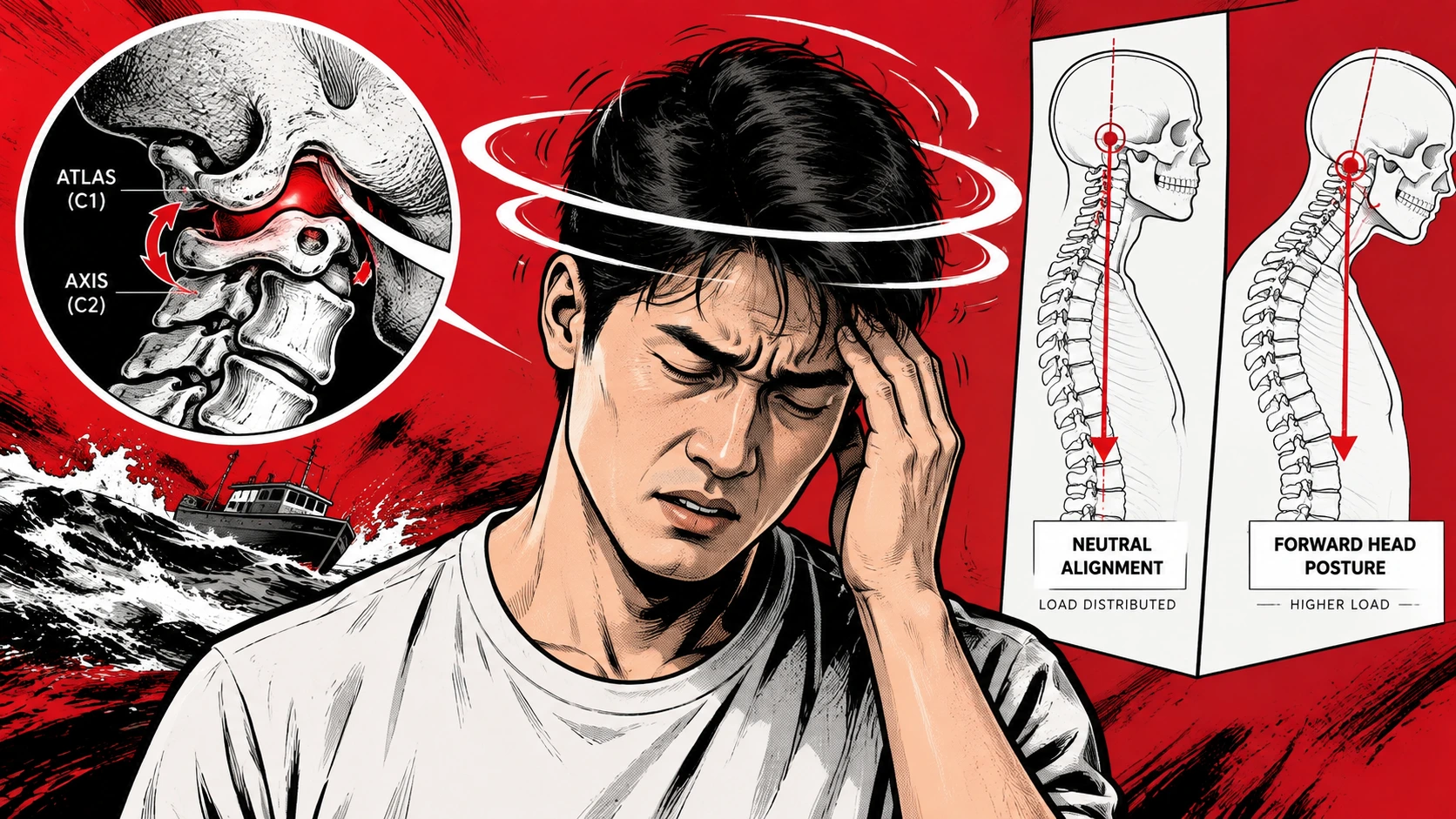
You have been doing your physio homework. The chin tucks. The towel glides. The repeated neck retractions every few hours. It helps for a while, then you sit back down at your desk and the floaty, “standing on a boat” giddiness creeps back in.
Now you are searching McKenzie vs Mulligan, trying to work out whether you picked the wrong method. Here is what each one actually does, what the clinical trials really show, and the one thing neither method was designed to measure.
Last updated: September 2026 · Reviewed by Dr Will Kalla, Dr Neck Pain
Read this first: some dizziness is an emergency
Call 995 or go to A&E now if your dizziness comes with slurred speech, a drooping face, weakness or numbness on one side, sudden trouble seeing or walking, a “worst-ever” headache, fainting, chest pain, or sudden severe neck pain after a fall or knock. New hand clumsiness or numbness spreading into both arms also needs a doctor promptly. This article is about ongoing, non-spinning giddiness after a doctor has ruled the serious causes out.
The short version
Both are respected, evidence-based physiotherapy methods. McKenzie uses repeated movements you do yourself; Mulligan uses a sustained joint glide while you move.
Mulligan has the stronger direct evidence for dizziness. Randomised trials found SNAGs reduced dizziness and improved neck movement compared with placebo.
McKenzie’s evidence is mainly for neck pain and neck-related headache. Dizziness has rarely been measured as a main outcome.
The trials also show where they stop. Movement improved, but neck position sense and balance did not clearly normalise, and some gains faded by 12 months.
Neither method measures your spine under gravity. If the curve of your neck has flattened or reversed, that is a structural question, and it needs a standing X-ray to answer.
If you have had neck-related dizziness in Singapore for a while, your path probably looked familiar: a GP or polyclinic visit, a referral to hospital physiotherapy, and a home programme built around McKenzie retractions or Mulligan self-glides. That is a sensible, evidence-based route, and for many people it is enough.
But if you are reading this, it probably was not enough for you. First, some validation: this is not “just neck tension.” Researchers describe cervicogenic dizziness as present in roughly 5 to 6% of people seen in ENT practices and in up to 40% of people with neck pain, and patients with it score on the Dizziness Handicap Inventory (a standard disability questionnaire) at levels comparable to other forms of chronic dizziness. It is real, it is common, and it is genuinely disabling.
McKenzie vs Mulligan in Plain English
Both methods are widely taught and globally respected. They simply work in different ways.
The McKenzie Method (MDT)
You move, repeatedly
How it works: you repeat end-range neck movements, like retractions (chin tucks), to find a “directional preference” that eases your symptoms.
Who drives it: mostly you, with frequent home exercises through the day.
Strongest evidence: neck pain and neck-related headache.
VS
The Mulligan Concept (SNAGs)
A glide while you move
How it works: a therapist holds a sustained glide on an upper-neck joint (often C1 or C2) while you turn or tilt your head, pain-free.
Who drives it: the therapist first, then you, with a towel “self-SNAG” at home.
Strongest evidence: cervicogenic dizziness itself, in randomised trials.
What the Clinical Trials Actually Show
The best evidence for Mulligan in dizziness comes from a research group in Australia. An early double-blind trial of 34 people found SNAGs reduced dizziness, disability and neck pain compared with a placebo laser. A larger trial of 86 people with long-standing cervicogenic dizziness then compared SNAGs, Maitland-style mobilisations and placebo, and followed them for a full year. Here is how that scorecard reads.
The scorecard
Mulligan SNAGs vs placebo, 86 patients, followed for 12 months
✓
Dizziness intensity dropped more than placebo, and the gain held at 12 weeks.
✓
Neck movement improved in all six directions, more broadly than with mobilisations.
✓
How often dizziness struck and dizziness handicap were still better than placebo at 12 months.
✗
Neck position sense (how accurately you can return your head to centre) did not clearly improve.
✗
Balance, standing and moving, did not clearly improve either.
✗
By 12 months, dizziness intensity and neck pain no longer differed from placebo.
Read it honestly: SNAGs genuinely help. They loosen movement and ease symptoms. But the balance-related measures, the ones closest to the “floaty” feeling, did not clearly normalise.
And McKenzie?
The McKenzie evidence here is thinner, not because it does not work, but because dizziness has rarely been measured as the main outcome. A 2023 case series of 15 people with neck-related headache, some of whom also had dizziness, found meaningful improvements in headache disability, neck disability and pain using directional-preference exercises. Dizziness itself was not reported as a separate outcome.
Where you treat seems to matter
A 2025 review added a useful detail: manual therapy focused on the upper neck improved dizziness compared with control, while more general, whole-neck approaches did not show a significant change. The certainty of that evidence is very low, but it points in one direction: precision about which segment is involved may matter more than the name of the technique.
What People Report Online
Read past the trials into dizziness communities online and a very specific pattern emerges around standard neck exercises.
What people report online
Recurring themes, paraphrased from cervicogenic dizziness communities on Reddit
B
The “boat” sensation
People consistently clarify that the room does not spin. They describe rocking or floating, like standing on a boat, which flares with long sitting, driving or screen time and eases when they lie down and take the load off the neck.
P
The exercise plateau, and the flare-ups
Many describe physio, chin tucks and band work as a real turning point early on, then a frustrating plateau. Many also warn that over-doing neck stretches or exercises triggered dizziness flare-ups, leaving them nervous to move at all.
L
The diagnostic loop
GP→ENT→Clear ear tests→“It’s just anxiety”→Finally, the neck
Posters describe months or years between specialists. Because the ear tests come back clear, they are often told it is anxiety, and only connect the dots once they notice the dizziness tracks with neck tension and posture.
These are anecdotal reports summarised from online patient communities, not clinical outcomes or medical advice. Individual experiences vary widely.
The Blind Spot Both Methods Share
Notice what the upright-versus-lying-down pattern is telling you. The dizziness is worse when the neck is holding your head up against gravity, and better when it is not. That is a clue about load, not just movement.
Layer 1
Mechanics: how the neck moves
What McKenzie and Mulligan work on. Think of oiling the hinges of a door that keeps sticking: movement frees up and symptoms ease.
Measured by feel and by how you respond
Layer 2
Structure: how it holds your head under gravity
The shape of the curve in your neck while you stand. If the door frame itself is out of line, oiled hinges keep drifting back to sticking.
Measured on a standing X-ray
This is not physio versus chiropractic. Physiotherapy works on muscle and movement; structural correction works on how the spine is shaped under load. They are different layers, and plenty of people need attention on both.
WKDr Will Kalla Clinical view · 29 years, 3,000+ cases
Dr Will regularly sees people who have spent months faithfully doing chin tucks and towel glides. His view is that these are good methods, but they are guided by feel. If the upper neck has lost its curve, mobilising it improves how it moves, yet the same load returns the moment you sit back down. That is why he measures the structure under gravity first, before deciding what the neck needs.
There is research pointing in this direction too. In a one-year trial of 72 adults with neck-related dizziness, a flattened neck curve and forward head posture, adding curve-correcting traction to a standard programme made no difference at 10 weeks. At the one-year follow-up, the curve group was better on every measure, including dizziness. The study did not prove the curve change itself caused the improvement, but it is exactly the long-term pattern the exercise-only trials did not show.
Side-by-Side Comparison
Approach
What it works on
Evidence for dizziness
What it does not measure
McKenzie (MDT)
Repeated movements to find a direction that eases symptoms
Indirect: good for neck pain and headache; dizziness rarely a main outcome
The shape of your spine under gravity
Mulligan (SNAGs)
Upper-neck joint glides while you move
Direct RCTs: less dizziness and better movement; balance and position sense not clearly improved
The shape of your spine under gravity
R3NEW X™ structural correction
The alignment of the upper neck and its curve, measured first
No trial of the protocol itself; the curve-correction principle has one 1-year RCT behind it
Measures it: standing X-ray before and during care
Self-Check: Have Your Exercises Plateaued?
This is not a diagnosis, only an exam can give you that, but it can help you see whether your pattern points toward continuing your current plan or measuring the structure.
Self-guided symptom check
Have your neck exercises plateaued, or is there more to find?
4 short questions · about 1 minute · educational only
Where Structural Correction Fits
If your exercises helped but never fully settled the dizziness, the next step is not a different exercise, it is a different question: what shape is your neck in while it holds your head up? Over 29 years and 3,000+ cases, Dr Will Kalla built the R3NEW X™ protocol around that question, for people who have done the physio and plateaued. You can read more about Dr Will’s background and structural approach to neck care.
The R3NEW X™ protocol
It starts where exercises can’t reach: a standing X-ray, then a three-phase correction in this order.
Release · AxisFlex Protocol™
Frees the deep, overworked suboccipital muscles at the base of the skull, so the upper neck is ready to change rather than guarding against it.
Reset · AxisFlow Adjust™
Resets the specific stiff upper-neck segments your X-ray identifies, at the neurological level, rather than a general whole-neck routine.
Recalibrate · NeuroPosture Calibration™
Retrains your nervous system to hold the corrected position against gravity, so the change has a chance to last when you sit back down.
Measured first, tracked on X-ray throughout, with a defined endpoint rather than open-ended sessions.
A doctor’s check comes first. This is the step after the ear, brain, heart and other causes are excluded, never a replacement for that work-up.
This isn’t instead of physio. Many people benefit from both layers; the X-ray helps decide what your neck actually needs.
Cost and regulation: chiropractic is not MOH-registered in Singapore, is not a substitute for medical care, and is not Medisave-claimable.
You’ve done the stretches and the towel glides. If the giddiness keeps coming back, a standing X-ray assessment shows how your neck is holding up under gravity, the picture exercises alone can’t give you. You can also see how other Singapore patients progressed first.
Is McKenzie or Mulligan better for cervicogenic dizziness?
For dizziness specifically, Mulligan SNAGs have the stronger direct evidence. Randomised trials found they reduced dizziness and improved neck movement compared with placebo. McKenzie has good evidence for neck pain and neck-related headache, but dizziness has rarely been measured as its main outcome. Many physiotherapists combine elements of both.
Why do my neck exercises help for a while, then the dizziness comes back?
Exercises improve how the neck moves, but they don’t change what it is doing under load. In the major Mulligan trial, movement improved in every direction, yet balance and neck position sense did not clearly normalise. If your dizziness is worse upright and better lying down, the structure holding your head up may be part of the picture.
Can doing too many neck exercises make dizziness worse?
It can, and many people report flare-ups from over-doing them. Mulligan techniques are meant to be pain-free and dizziness-free. If an exercise triggers dizziness, stop and tell your physiotherapist rather than pushing through.
Should I stop my physiotherapy if I see a chiropractor?
No, not by default. Physiotherapy works on muscle and movement; structural correction works on how the spine is shaped under load. They are different layers, and many people benefit from both. Discuss any change to your plan with the clinicians involved.
What does a standing X-ray show that my physio assessment didn’t?
The curve and alignment of your neck while it holds your head up against gravity. A hands-on assessment tells a clinician how the neck moves and feels. A standing X-ray shows its actual shape under load, which is what decides whether structural correction is relevant to your case.
References
Reid SA, Rivett DA, Katekar MG, Callister R. Sustained natural apophyseal glides (SNAGs) are an effective treatment for cervicogenic dizziness. Man Ther. 2008;13(4):357-366. DOI
Reid SA, Callister R, Katekar MG, Rivett DA. Effects of cervical spine manual therapy on range of motion, head repositioning, and balance in participants with cervicogenic dizziness: a randomized controlled trial. Arch Phys Med Rehabil. 2014;95(9):1603-1612. PMID 24792139. PubMed
Reid SA, Rivett DA, Katekar MG, Callister R. Comparison of Mulligan sustained natural apophyseal glides and Maitland mobilizations for treatment of cervicogenic dizziness: a randomized controlled trial. Phys Ther. 2014;94(4):466-476. PMID 24336477. PubMed
Reid SA, Callister R, Snodgrass SJ, Katekar MG, Rivett DA. Manual therapy for cervicogenic dizziness: long-term outcomes of a randomised trial. Man Ther. 2015;20(1):148-156. PMID 25220110. PubMed
Pu LL, Miller E, Schenk R, et al. Utilizing directional preference in the management of cervicogenic headache: a case series. J Man Manip Ther. 2023. PMC
Carrasco-Uribarren A, et al. Manual therapy for cervicogenic dizziness: a systematic review and meta-analysis. 2025. PMC
De Hertogh W, Micarelli A, Reid S, Malmström EM, Vereeck L, Alessandrini M. Dizziness and neck pain: a perspective on cervicogenic dizziness exploring pathophysiology, diagnostic challenges, and therapeutic implications. Front Neurol. 2025;16:1545241. PMID 40166638. PMC
De Vestel C, Vereeck L, Reid SA, Van Rompaey V, Lemmens J, De Hertogh W. Systematic review and meta-analysis of the therapeutic management of patients with cervicogenic dizziness. J Man Manip Ther. 2022;30(5):273-283. PMID 35383538. PubMed
Moustafa IM, Diab AA, Harrison DE. The effect of normalizing the sagittal cervical configuration on dizziness, neck pain, and cervicocephalic kinesthetic sensibility: a 1-year randomized controlled study. Eur J Phys Rehabil Med. 2017;53(1):57-71. PMID 27575013. PubMed
Reiley AS, Vickory FM, Funderburg SE, Cesario RA, Clendaniel RA. How to diagnose cervicogenic dizziness. Arch Physiother. 2017;7:12. PMID 29340206. PubMed
This article is educational information only and is not medical advice, diagnosis, or a treatment recommendation for your individual situation. It does not replace the advice of your physiotherapist or doctor, and you should not stop or change a prescribed exercise programme without discussing it with them. Cervicogenic (neck-related) dizziness is a diagnosis of exclusion: other causes should be assessed and ruled out by a doctor first. Chiropractic care is not MOH-registered in Singapore and is not a substitute for medical or surgical care. If you have sudden or severe dizziness, slurred speech, a drooping face, one-sided weakness, sudden trouble seeing or walking, fainting, chest pain, a severe headache, or sudden severe neck pain after an injury, call 995 or go to A&E immediately.