

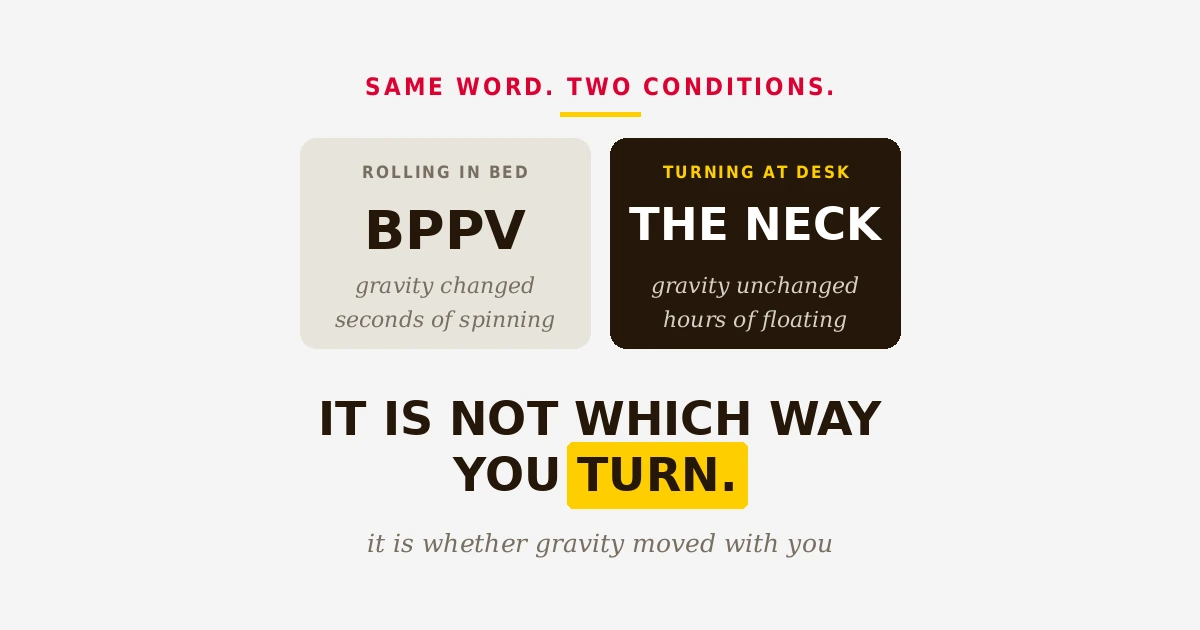
Two conditions, both called “giddiness” in Singapore, treated in completely different ways. One is confirmed by watching your eyes during a positional test and often fixed in a single appointment. The other has no confirmatory test at all and is still disputed by the body that classifies balance disorders.
Getting this distinction right matters more than any treatment decision that follows it. Here is how clinicians tell them apart, including the parts where the honest answer is that they cannot.
Read this first: what is not either of these
Call 995 or go to A&E now if dizziness comes with new weakness or numbness, facial drooping, slurred speech, double vision or vision loss, inability to walk, loss of coordination, a sudden severe headache or neck pain, fainting, or new sudden hearing loss. Dizziness that follows significant trauma, or a severe headache after neck manipulation, needs urgent assessment rather than a home manoeuvre or neck treatment.
The short version
- BPPV is the one with a real bedside test. A positional manoeuvre provokes vertigo with a characteristic eye movement, and the matching repositioning manoeuvre often resolves it in one to three visits.
- Cervicogenic dizziness has no confirmatory test. It is reached by excluding other causes, and the Bárány Society declined to publish clinical diagnostic criteria for it.
- Neck pain does not prove the neck is the cause. It can just as easily be a consequence of guarding your head still, and vestibular migraine is a common alternative explanation.
- Still dizzy after a successful Epley is normal, not proof of a neck problem. Residual dizziness is reported in roughly a third to two thirds of patients, usually settling within weeks.
- The sensible order is: rule out the treatable vestibular cause first. Only then does a neck question make sense.
Related reading
How Do I Know If My Dizziness Is From My Ear or My Neck?
Start with the pattern, but hold it loosely. These are tendencies that guide an assessment, not rules that settle it, and people describe dizziness inconsistently even when the underlying condition is clear.
| Feature | BPPV | Cervicogenic dizziness |
|---|---|---|
| Sensation | A distinct spinning or moving sensation | Unsteadiness, disorientation or lightheadedness; true spinning is less typical |
| Trigger | A change in head position relative to gravity: rolling over, lying back, looking up | Neck movement or a sustained neck position that also aggravates neck symptoms |
| Length of an episode | Brief, often seconds, though it can feel longer | Often minutes to hours |
| Neck symptoms | Can coexist, but are not needed for the diagnosis | Pain, stiffness or reduced movement occur alongside the dizziness |
| What confirms it | Characteristic nystagmus on positional testing | Nothing. No single finding confirms the neck is the cause |
It is not “does turning my head make me dizzy.” It is what kind of turning.
Rolling over in bed changes your head’s orientation relative to gravity, which points toward a positional vestibular problem like BPPV. Turning your neck while staying upright keeps gravity constant and raises a different question. That single detail separates the two patterns better than anything else you can report, and it costs nothing to notice.
Can BPPV Cause Neck Pain?
Yes, and this is where a great many people are misdirected. When head movement provokes vertigo, the natural response is to stop moving your head. Days or weeks of holding your neck rigid produces exactly what you would expect: stiffness, muscle tension and pain.
So the neck pain can be the consequence rather than the cause. Finding a tight, sore neck in someone who is dizzy tells you very little on its own. The Bárány Society specifically flags migraine, including vestibular migraine, as an important alternative explanation when neck pain and vestibular symptoms appear together. Dizziness plus neck pain does not equal cervicogenic dizziness, however intuitive that equation feels.
What Does a Dix-Hallpike Test Feel Like?
If a clinician suspects BPPV, this is usually the test. You sit on the couch, your head is turned about 45 degrees to one side, and you are then laid back quickly so your head hangs slightly below the level of the couch, still turned.
If that side is affected, the room spins for several seconds, and it can feel unpleasant enough that people brace for it. That reaction is expected, and it is also the point: the clinician is watching your eyes, not your face. A characteristic torsional, upbeating nystagmus during the manoeuvre is what supports the diagnosis of posterior-canal BPPV and tells them which ear and canal to treat.
If the first test is negative
A negative Dix-Hallpike is not always the end of the BPPV question. False negatives happen. If the history still sounds strongly positional, the guideline route is to repeat appropriate testing or assess the horizontal canal with a supine roll test, rather than jumping to a neck explanation. Ask whether both sides and the relevant canals were checked.
“The Epley Worked, But I’m Still Dizzy”
This is the single most common route into a wrong conclusion, so it deserves a section of its own.
In one prospective study, 61% of successfully treated patients still felt off afterwards. The median duration was 10 days.
The spinning stops, the nystagmus is gone, the test is negative, and yet people report lightheadedness, floating or brief unsteadiness when they move, stand or walk. Reported rates across studies run roughly from a third to two thirds. In that prospective study the range was 2 to 80 days, and symptoms had settled in everyone by three months without specific treatment.
So a non-spinning, floaty feeling after successful repositioning is a recognised phase of recovery, not evidence that your neck was the problem all along. Two practical consequences:
- Do not keep repeating the manoeuvre because you still feel offThe Epley is designed for posterior-canal BPPV, not for any dizzy sensation. Repeating it without confirmed active BPPV can make things worse, and people report debris shifting into another canal.
- Do not adopt the post-treatment restrictions eitherThe clinical guideline advises against routine postural restrictions after repositioning for posterior-canal BPPV: sleeping upright, avoiding one side, wearing a collar. Individual advice for another condition is different and should be followed.
- Do get re-tested rather than re-labelledThe guideline recommends reassessment within about a month. Persisting symptoms may mean unresolved BPPV, a different canal, another vestibular condition, or something separate, and each has a different answer.
Why Didn’t My ENT Find Anything Wrong?
Clear tests are genuinely good news, and they are also where a lot of people get stuck. A normal ENT work-up rules things out; it does not by itself point at your neck. Several possibilities sit in that gap.
- Residual dizziness after a BPPV episode that has already resolved, as above.
- Vestibular migraine, which can cause dizziness with or without headache and is a frequent explanation for combined neck and balance symptoms.
- PPPD (persistent postural-perceptual dizziness): non-spinning dizziness or unsteadiness on most days for three months or more, worse when upright, when moving, and in visually busy places like supermarket aisles. It often follows a vestibular episode, and it is not simply “BPPV that will not go away.” It has its own criteria and its own treatment.
- A genuine neck contribution, which is the one this clinic works on, and which still sits at the end of the list rather than the start.
If your dizziness is worse in bright, busy, moving environments and has run for months, PPPD is worth raising with your doctor by name. It is commonly mistaken for neck-related dizziness, including by people who have read a lot about neck-related dizziness.
Where Cervicogenic Dizziness Actually Stands
We treat neck-related dizziness, so it would be convenient to present this as settled. It is not, and you deserve the real picture before spending anything.
In 2022 the Bárány Society, which writes the international classification of vestibular disorders, concluded that the evidence for a mechanistic link between neck pathology and vertigo is insufficient, and declined to propose clinical diagnostic criteria for cervical dizziness outside research. A 2025 multidisciplinary perspective is more receptive to altered neck position sense as a mechanism, but still calls the entity debated and stresses excluding other causes.
What about the neck torsion test?
In one comparison, a cervical torsion test distinguished a selected cervicogenic-dizziness group from a BPPV group with 72% sensitivity and 92% specificity. Useful, but those figures come from that specific comparison, not from sorting every cause of dizziness in general practice, and no test in this area is an accepted gold standard.
On treatment, two reviews reach different tones and both are worth knowing. A 2022 systematic review of 13 trials found moderate-quality evidence that manual therapy reduces dizziness, neck symptoms and balance problems. A 2025 meta-analysis found upper-cervical manual therapy improved dizziness against control, but rated the certainty low to very low. Short-term improvement is reasonably consistent; long-term results are not.
And improvement does not settle the cause. Neck treatment can reduce dizziness through pain relief, reduced guarding, better movement confidence or general activity, none of which prove a structural mechanism. That is an uncomfortable sentence for a clinic to publish, and it is still true.