Physiotherapy vs Massage Therapy for Neck Pain Relief: Singapore Office Worker Guide
If your neck feels tight after a day of Teams calls, spreadsheets and laptop work, the fastest option is tempting: book a massage and get a quick neck release before the next workday. That can help, especially when the discomfort is mostly muscle guarding from a stressful week.
But for routine, non-traumatic neck stiffness that keeps returning, physiotherapy is usually the better first choice for lasting improvement. A physiotherapist assesses how your neck moves, what makes symptoms worse, how your shoulder blades and upper back are contributing and what needs to change in your work routine. The neck pain clinical practice guideline supports a multimodal approach that combines education, exercise and, when appropriate, manual therapy.
Massage therapy still has a useful place. It may reduce perceived tightness in the neck, upper trapezius and shoulders in the short term. The limitation is durability: A 2024 Cochrane medical review confirmed what most desk workers already know: a massage feels great today, but makes almost no difference to your pain levels a few weeks later. They found low-certainty evidence that massage made little to no difference compared with sham massage for pain or function at around 12 weeks in subacute or persistent neck pain.
So the practical Singapore answer is not simply physiotherapy versus massage therapy. The better question is: what does your symptom pattern need first?
Start here: 20-second symptom selector
Use this as a first filter before booking your next appointment.
Start here
20-second symptom selector
Tap the line that best matches you, as a first filter before booking your next appointment.
Better first step
Massage or a self-reset may be reasonable
It can help you relax and reduce short-term muscle tension. If it settles quickly and does not recur often, you may not need a full clinical plan.
Better first step
Physiotherapy
You need assessment, movement work, progressive strengthening, and ergonomic self-management rather than only passive relief.
Better first step
Clinical assessment first
These patterns need screening and targeted care. Do not treat them as ordinary muscle tightness. If you have progressive weakness, numbness or loss of coordination, seek prompt medical assessment.
Better first step
Consider a structural neck assessment
If the underlying neck alignment, cervical curve, or loading pattern is contributing, soft-tissue relief and exercises may not be enough on their own. An X-ray-guided assessment can show whether structure is part of the problem.
Office-related neck pain is rarely caused by one bad posture. The bigger issue is usually low movement variety over many hours. Your neck and shoulders hold a fairly narrow range of positions while your eyes stay fixed on a screen, your arms reach for the keyboard and mouse, and your upper back gradually rounds forward.
Singapore office workers often add extra strain without noticing: working from a laptop without a stand, taking calls with one shoulder raised, replying to messages on the MRT, sitting through back-to-back meetings, and then relaxing with more screen time at night. Workload stress can also increase muscle guarding, which makes the neck feel tighter even when nothing dramatic has happened.
Trying to hold a perfect posture all day is not the solution. A rigid upright position is still static. Your neck usually responds better to regular position changes, comfortable ergonomics, and gradual strengthening so the neck and shoulder region can tolerate the workday.
60 to 90 secondsThe between-meeting neck reset
1Stand up and change position before you open the next call.
2Look away from the screen and focus on something farther away for a few breaths.
3Gently turn your head left and right, within a comfortable range.
4Roll your shoulders slowly, then let them relax rather than forcing them down.
5Check your setup: screen near eye level, keyboard and mouse close enough that you are not reaching.
Do it between calls, a few times a day. Small, frequent resets beat one long stretch.
Local ergonomic advice commonly includes screen height, close input devices and regular movement breaks.
What physiotherapy does for office neck pain
Physiotherapy is assessment-led. A good session shouldn't feel like a random sequence of heat, massage, and machines. The physiotherapist should ask about your symptom history, screen for warning signs, check range of motion, test strength and control where relevant and understand your work habits.
For routine office neck pain, the active part of the plan is usually the most important. That may include cervical range-of-motion exercises, deep neck flexor training, upper back mobility, shoulder-blade strengthening and practical desk modifications. The goal is to improve your neck and upper back capacity, so the same workday causes less irritation.
Manual therapy may be included, but it should support the rehab plan rather than replace it. In other words, hands-on care can help you move more comfortably today, while exercise and self-management help reduce the chance of the same flare-up returning next week.
What massage therapy does well
Massage therapy is mainly a comfort and relaxation tool. If your neck feels guarded after a stressful week, a massage may calm the area, improve perceived looseness and give you temporary relief. This can help before a presentation, a flight, an intense deadline, or a week with poor sleep and high stress.
The limitation is that massage does not assess why your neck keeps tightening. It usually doesn't build strength, change work habits, improve movement control, or screen for nerve-related symptoms. If you need a quick neck release, massage may be enough. If you need a plan for recurring pain, it is usually incomplete.
Manual therapy is not the same as a spa massage
This distinction matters because many people use the words interchangeably.
A physiotherapist may use manual therapy as part of a clinical treatment plan. That can include soft-tissue work, joint mobilisation or other hands-on techniques based on assessment findings. A spa massage usually centres on relaxation, comfort, and muscle tension. Both involve touch, but their purpose and context differ.
If you choose physiotherapy, ask what the hands-on work is meant to change and what you should do after the session to keep improving. If the answer is only to come back when it feels tight again, you are not getting the full value of physiotherapy.
Physiotherapy vs massage therapy vs structural assessment
For many Singapore office workers, the real decision has three layers: soft tissue, active rehabilitation and structural correction.
Factor
Massage therapy
Physiotherapy
Structural chiropractic assessment
Main purpose
Short-term comfort, relaxation and perceived muscle release
Assessment, movement restoration, strengthening and self-management
Identify whether neck alignment, cervical curve or structural loading is contributing to chronic symptoms
Assessment depth
Usually limited
Clinical history, movement testing and symptom screening
X-ray-guided assessment when clinically appropriate, plus posture and structural analysis
Hands-on care
Central part of the session
May be used to support rehab
Used as part of a correction-focused plan when indicated
Exercise plan
Usually none
Core part of treatment
May include posture retraining, corrective exercises and maintenance education
Best for
Temporary tightness after stress, travel or long sitting
Recurrent desk pain, stiffness, reduced movement and prevention
Chronic neck pain, headaches, posture changes or symptoms that keep returning despite other care
Main limitation
Relief may fade quickly
Progress depends on doing the home plan consistently
Not every stiff neck needs structural correction, so assessment matters
Typical Singapore cost pattern
Lower per session
Higher per session
Varies by assessment and programme structure
The third dimension: when structure is the missing layer
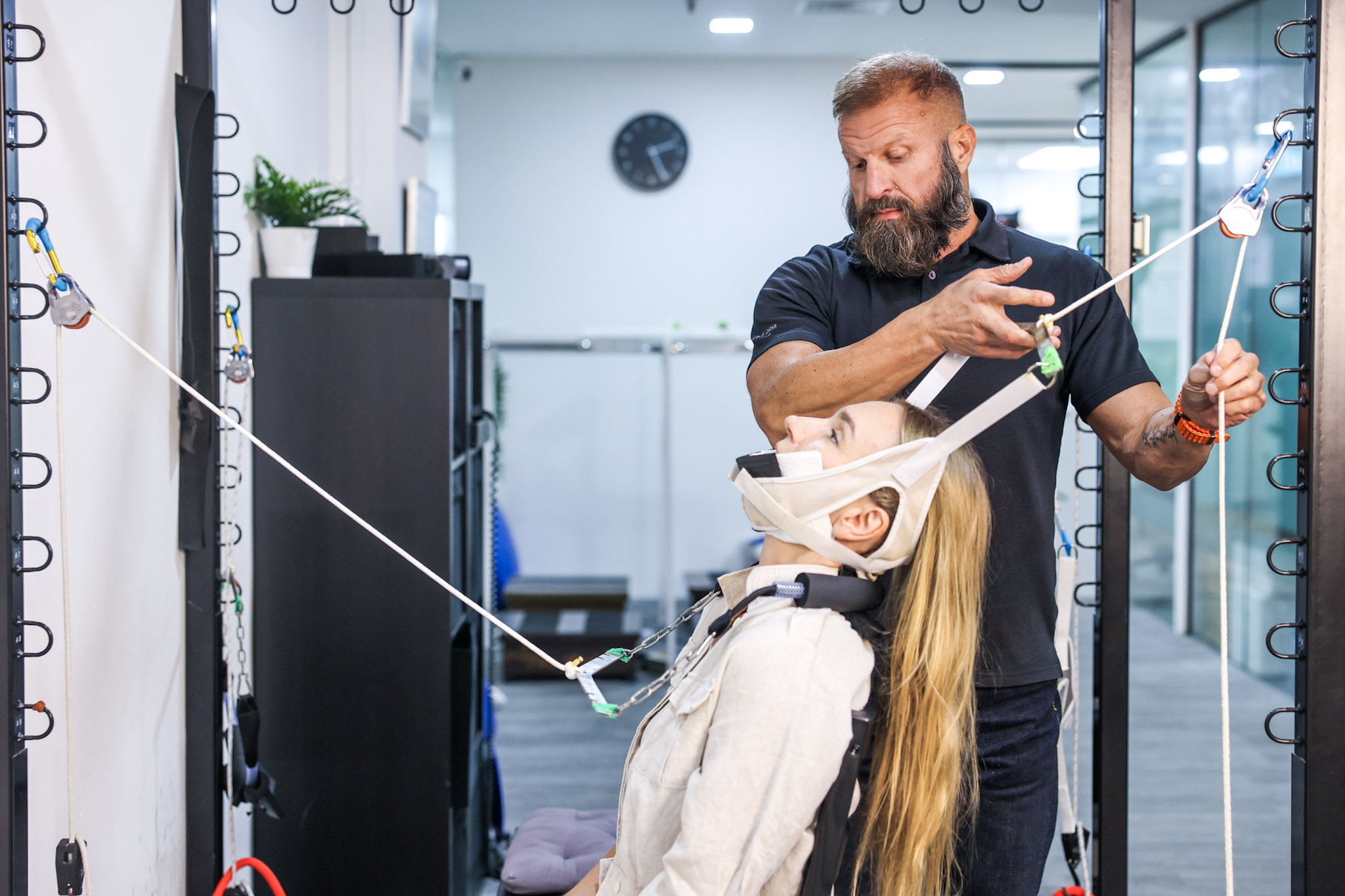
A patient undergoing the X-ray-guided R3NEW X™ protocol. This targeted extension traction is designed to correct forward head posture and restore the cervical lordosis.
Massage treats soft tissue. Physiotherapy trains movement, strength and tolerance. But some chronic cases need another question answered: is the neck structure itself forcing the same muscles to overwork?
If the natural cervical curve is reduced, the head sits forward, and the neck joints are loaded inefficiently, the surrounding muscles may tighten repeatedly to keep you upright.
Massage treats the soft tissue. Physiotherapy trains the muscles. But if your neck has lost its natural C-curve from years of desk work, neither of these will work long-term. Active rehab and stretching will not fix chronic issues if an underlying structural problem exists. You cannot exercise a misaligned spinal bone back into place. Until you physically move the bones back to their correct structural position, the muscles will keep spasming, and the pain will always return by Monday.
This is where Dr Neck Pain fits in. It is not meant to replace physiotherapy or massage in every case. It is the structural option for people whose symptoms keep coming back, especially when neck stiffness is paired with headaches, posture changes, chronic neck and shoulder discomfort or arm symptoms. Dr Neck Pain uses X-ray-guided assessments, personalised structural neck correction, posture retraining, progress tracking with X-rays, ergonomic guidance and maintenance education to support longer-term neck health.
The key point
You cannot massage a cervical curve back into alignment, and strengthening over poor loading can feel like an uphill battle.
If a structural issue is driving the problem, the plan has to address structure, muscles, and movement together, not just one of them.
Realistic outcomes: what to expect
One session can help you feel better, but persistent office neck pain rarely disappears permanently from a single appointment. Set expectations by timeline.
Timeframe
Massage therapy
Physiotherapy
X-Ray Guided R3NEW X™ Protocol
Today
May reduce tension and help you relax
May reduce pain, improve movement and teach starter exercises
May identify whether deeper structural factors need investigation
Over several weeks
Benefit is uncertain if used alone for persistent pain
Exercises and ergonomic changes can improve capacity and reduce flare-ups
A correction plan may target alignment, posture habits and measurable progress
Recurrence prevention
Limited unless paired with lifestyle and movement changes
Stronger when you follow the home plan
Stronger when structural findings, retraining and maintenance guidance are addressed together
For a simple stiff neck from one bad night of sleep, massage and gentle movement may be enough. For recurring pain that affects work, sleep, exercise or concentration, expect to need a proper plan.
Singapore money guide: price, claims and MediSave
Costs vary by clinic location, therapist experience, session length and package structure, but these are common private-market ranges in Singapore.
Some policies need a GP or specialist referral. Annual caps, direct billing and reimbursement rules vary.
Chiropractic or structural correction assessment
Varies by clinic and assessment needs
Sometimes under alternative-medicine or specialist caps
Check whether X-rays, consultation, treatment and packages are claimable under your policy.
Indicative figures only. Confirm current fees and claim eligibility with the provider and your insurer before you commit.
MediSave is different from corporate insurance. CPF sets defined medical pathways for outpatient use, and routine wellness appointments are not generally treated the same way as approved outpatient medical claims. Check CPF guidance on MediSave for outpatient treatments before assuming you can use MediSave for massage, physiotherapy or chiropractic care.
The cheapest session is not always the cheapest solution. An S$80 massage every week for months can cost more than an assessment-led plan that reduces recurrence. On the other hand, a mild one-off stiff neck does not always need a major programme. Match the spend to the pattern.
Two office worker examples
AAmanda, 31 Case 1: mild end-of-day tightnessMild pattern
Amanda feels tight across her upper shoulders after long meetings. She has no headaches, no arm symptoms, and full neck movement. The tightness eases overnight and only shows up on her busiest days.
Better first step
A massage before a stressful week may be reasonable. She should also add movement breaks, raise her laptop, and move her neck through the day instead of waiting until the evening. If the tightness starts appearing three or four times a week, physiotherapy becomes the better first step, because the pattern is no longer just occasional tension.
MMarcus, 42 Case 2: recurring headaches and arm symptomsNeeds assessment
Marcus has neck stiffness most evenings, headaches behind one eye, and occasional tingling into his hand. Massage helps for two days, then the pain returns once he is back at the desk.
Better first step
This pattern should not be treated as simple office tightness. He needs clinical assessment first. If symptoms suggest nerve irritation, structural loading, or a persistent neck and shoulder pain pattern, a structural neck assessment may be appropriate rather than continuing weekly massage alone.
Illustrative examples, not real patients. Your own plan depends on a proper assessment.
Booking questions to ask before you pay
If you are booking
Ask this
A useful answer should include
Physiotherapy
“Will I receive an assessment and a home plan?”
Clear testing, a working diagnosis, exercises, progress targets, and advice for your workstation.
Massage therapy
“What is the intended outcome beyond temporary relaxation?”
Safe pressure, clear symptom limits, and a willingness to refer you out if symptoms suggest more than muscle tension.
Structural chiropractic assessment
“How will you determine whether my neck structure is contributing?”
Assessment, X-ray guidance where appropriate, a clear explanation of findings, a correction plan, and progress tracking.
A good provider should welcome questions. Be cautious if every problem receives the same treatment, there is no explanation of findings or you feel pressured into a plan before your symptoms are properly assessed.
Red flags: do not book routine massage first
Seek prompt medical assessment instead of self-managing with massage if your neck pain follows significant trauma, or comes with any of these warning signs:
Significant trauma (a fall or accident)
Progressive arm weakness
Persistent numbness
Loss of hand coordination
Severe or unusual headache
Fever
Unexplained weight loss
Dizziness with neurological symptoms
Symptoms that are rapidly worsening
Neck pain guidelines place medical screening and referral before treatment when warning signs are present.
If you want to go deeper
Not every stiff neck is structural, so it helps to know which pattern is yours. If your pain travels into the arm with numbness or tingling, or you suspect a slipped disc, that points past posture strain toward nerve involvement and is worth assessing directly.
Should I see a physiotherapist, massage therapist, or chiropractor for a stiff neck?
If it is a short-lived stiff neck after poor sleep or a stressful week, massage may be enough for temporary comfort. If stiffness keeps returning or limits movement, physiotherapy is usually the better first appointment. If pain is chronic, linked with headaches, posture changes or arm symptoms, a structural chiropractic assessment can help determine whether cervical alignment is part of the problem.
Is it better to go for TCM, Tuina, massage, or physio for office syndrome?
TCM, Tuina and massage may help some people feel looser and more comfortable in the short term. Physiotherapy is usually more active and exercise-based. If you need weekly treatment just to survive the workday, the issue may not be only tight muscles, so consider assessment for movement, nerve and structural contributors.
Can massage make neck pain worse?
Yes, if the pressure is too aggressive, the therapist works over an irritated area, or nerve symptoms should have been assessed first. Stop if pain spreads, numbness appears, weakness develops, or symptoms feel unusual.
How many physiotherapy visits do I need for neck pain?
It depends on severity, irritability, work habits and how consistently you do the home plan. Some mild cases improve with a few sessions and self-management. Persistent cases may need several weeks of progressive strengthening and follow-up.
Can I combine physiotherapy and massage therapy?
Yes. A sensible approach is physiotherapy first for assessment and a plan, then massage selectively if it helps you relax enough to move and exercise. Massage should support the active plan, not replace it.
Does insurance cover physiotherapy or massage in Singapore?
Many corporate plans cover private physiotherapy under outpatient or extended health benefits, sometimes with a referral requirement. Routine spa massage is rarely covered. Some policies include chiropractic care under alternative medicine or specialist caps, but rules, limits and direct billing vary by insurer and employer.
Why does my neck pain keep coming back a few days after a massage?
Massage relaxes soft tissue, but it does not correct the reason those muscles are working so hard. If your neck posture, cervical curve, workstation habits or joint loading keep irritating the same area, the muscles often tighten again once you return to your normal desk routine.
When is neck pain more than office syndrome?
It is more than office syndrome when pain travels into the arm, numbness or weakness appears, headaches become frequent, sleep is disrupted, movement is clearly limited, or symptoms keep returning despite rest, massage and basic stretches.
If massage and physiotherapy have not solved it
For occasional tightness, start simple. Move more often, adjust your workstation and use massage when you need short-term relief. For recurring office neck pain, start with assessment-led care and an active plan.
If you have already tried massage or physiotherapy but your pain keeps returning, the missing piece may be structural. Dr Neck Pain helps with chronic neck pain, headaches and posture-related symptoms through X-ray-guided assessment, structural neck correction, posture retraining and maintenance guidance. If your symptoms fit that pattern, you can book a structural neck assessment to find out whether your neck alignment is part of why relief hasn't lasted.
Keeps coming back after every massage?
If relief only lasts a few days, the cause may be structural, not just tight muscles. An X-ray-guided assessment shows whether your cervical curve is part of the problem, and whether structural correction is the right fit for your case.