


If your neck stiffens up by 3pm after a day of laptop-on-the-dining-table Zoom calls, you are not imagining it. Here is what the evidence says actually works, what you can do at home in ten minutes a day, and the point where a Singapore professional is the smarter move.
Key takeaways
- Most desk-related neck stiffness is mechanical and improves with a structured home routine plus better ergonomics, not with the occasional stretch.
- The strongest home exercises are strengthening ones (deep neck flexors, shoulder-blade and upper-back work), not stretching alone.
- In a landmark trial, both home exercise-with-advice and hands-on treatment beat painkillers for recent neck pain, and were similar to each other.
- See a professional if pain lasts beyond one to two weeks, disturbs sleep or work, or sends symptoms down the arm. Seek urgent care for red-flag signs.
- When stiffness keeps relapsing despite consistent work, the driver may be structural, a flattened neck curve you can measure on X-ray but cannot feel. Exercises build capacity; they do not reshape a lost curve.
Related reading
For a lot of Singapore remote workers, neck stiffness has stopped being an occasional annoyance and become a daily pattern. The laptop sits at dining-table height. The shoulders creep up during back-to-back calls. There are fewer walking breaks than there ever were in the office. By late afternoon there is a familiar band of tightness at the base of the neck, sometimes with a headache, a heavy shoulder or a neck that does not turn as far as it used to.
The reassuring part: most uncomplicated, desk-related stiffness responds well to a structured home programme. The catch: stretching once in a while is rarely enough, because your workstation and daily habits keep reloading the same tissues. This guide compares proven home exercises with professional care in Singapore, so you can tell when self-care is reasonable and when physiotherapy, chiropractic or a medical review is the safer route.
Why remote work stiffens Singapore necks
Remote work changes more than your commute. It changes how often you move, where you sit and how long your neck holds a single position. A proper office usually has an external monitor, an adjustable chair and a desk you can set to the right height. At home, many people work from a laptop on a dining table, a sofa, a kitchen counter or, on the worst days, the bed. That pushes the head forward and down, and loads the muscles at the back of the neck for hours at a stretch. Over time those muscles get irritated, protective and stiff.
Singapore adds its own squeeze. Space is tight. Not every condo or HDB flat has room for a dedicated home office, so the "office" is wherever the laptop lands. A finance director takes a client call hunched over the dining table. A lawyer clears email from the sofa at 11pm because the study is now a nursery. A software engineer runs two screens off one laptop propped on a stack of books. And the heat and humidity quietly discourage the lunchtime walk that used to break up the day. None of it is dramatic. All of it is repetition, which is exactly what a neck struggles with.

Here is the pattern most remote workers fall into, and the cheaper fix for each:
| Remote-work habit | What it does to the neck | Better alternative |
|---|---|---|
| Laptop below eye level | Forces forward-head posture and sustained neck flexion | Raise the screen; add an external keyboard and mouse |
| Long calls without breaks | Keeps neck and shoulder muscles under static load | Stand or walk for a minute between calls |
| Sofa or bed working | Removes stable back, hip and arm support | Use a table with your feet supported |
| Cradling the phone | Adds side-bend and rotation strain | Use earphones; keep the phone nearer eye level |
| No strength work | Leaves deep neck and shoulder-blade muscles undertrained | Add targeted strengthening 3 to 5 times a week |
This is not a niche complaint, and Singapore now treats it more seriously at a policy level. From 1 December 2025, the Ministry of Manpower expanded its Occupational Disease list so that work-related musculoskeletal disorders, including neck, back and spine conditions linked to ergonomic risk, are reportable and compensable under the Workplace Safety and Health Act and the Work Injury Compensation Act. Whether an individual case qualifies is a separate clinical and legal question, but the direction of travel is clear: desk-driven neck and back strain is being recognised as a genuine occupational issue, not a personal weakness.
If your stiffness comes with the wider desk-worker picture, tension across the neck and shoulders, an aching upper back, and a head that sits forward of the shoulders, those linked guides go deeper on each piece.
First: simple stiffness or something more serious?
Home exercises are appropriate for mild to moderate stiffness that is local, mechanical and improving. They are not a substitute for urgent care when warning signs are present. Screen yourself honestly before you start.
Seek same-day or urgent medical assessment if
Neck pain comes with arm or hand weakness, spreading numbness or tingling, new clumsiness or dropping things, unsteady balance or walking, severe pain after a fall or accident, fever, unexplained weight loss, or any change in bladder or bowel control. These can signal nerve, cord or other serious causes that need proper evaluation, not stretches.
It is also worth remembering that not every ache above the shoulders is a neck problem. Jaw pain, tooth pain, pain on chewing or facial swelling point to a dental cause and belong with a dentist, not a neck routine. Eye strain and poor sleep can amplify tension headaches. The goal of this first step is simply to make sure you are treating the right thing.
For ordinary remote-work stiffness, a simple rule works well: if the pain is mild, local and less than two weeks old, start structured home care. If it is worsening, breaking your sleep or limiting work despite two weeks of consistent effort, book a professional review.
What the evidence actually says
The internet is full of neck stretches. The research is more specific about what actually shifts pain, and it points in a slightly uncomfortable direction for anyone hoping a gentle stretch will do it.
For recent neck pain, both a short home-exercise programme and hands-on treatment outperformed painkillers, and performed about the same as each other.
In a randomised trial of 272 adults with nonspecific neck pain (Bronfort and colleagues, Annals of Internal Medicine, 2012), spinal manipulation and home exercise-with-advice both beat medication for pain over 12 weeks and beyond, with no meaningful difference between the two active approaches. The honest read: movement and hands-on care both help more than masking pain with tablets, and a few well-taught home sessions can carry a lot of the load. The trial studied recent, mechanical neck pain, not radiating nerve pain or long-standing structural cases.
Two more themes run through the exercise research, and they shape the routine below:
- Strengthening beats stretching alone. Reviews of exercise trials consistently favour strengthening and endurance work for the neck, shoulder-blade and upper-back muscles over stretching-only programmes, which tend to give short-lived relief at best. The overall evidence quality is modest, but the direction is steady.
- Consistency beats intensity. Even a few minutes a day of targeted resistance work, done most days, has produced meaningful pain reductions in trials. Training hard matters less than training often, and progressing gradually.
The practical takeaway is that a good home programme is not a random list of stretches. It should train the deep neck flexors that counter forward-head posture, restore comfortable neck movement, and build shoulder-blade and upper-back strength so the base of the neck is supported through the day.
The 10 to 15 minute home routine
This routine covers the three areas that matter: deep neck flexor control, cervical mobility and shoulder-blade strength. Stay within a comfortable range. A mild stretch sensation is fine. Sharp pain, spreading symptoms, dizziness, nausea or new arm tingling means stop and get assessed.
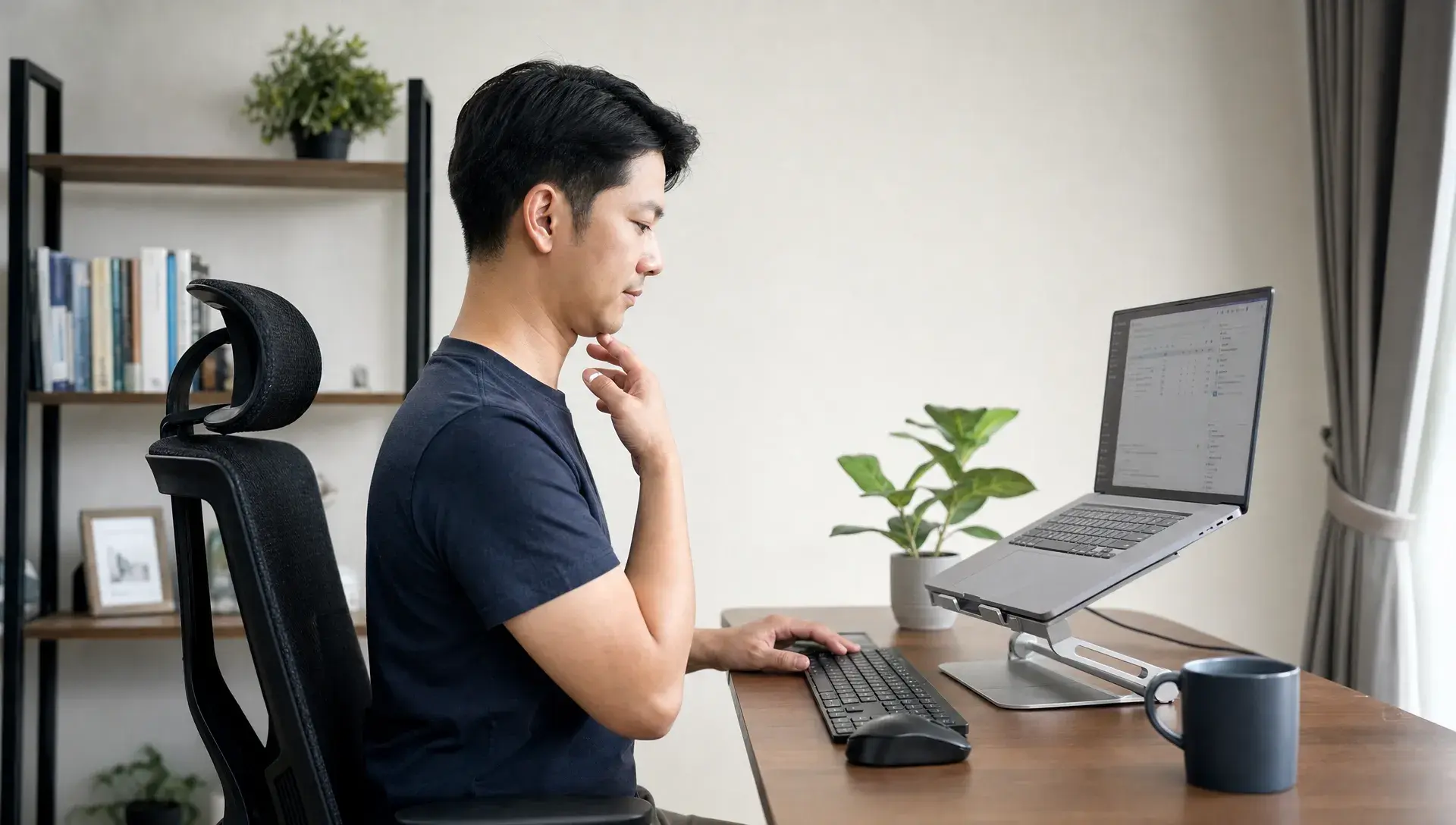
- Chin tuck (craniocervical flexion)Sitting tall or lying down, make a small "yes" nod, drawing the chin gently toward the throat and lengthening the back of the neck. It is a small nod, not a hard military brace. If the big front-neck muscles pop out or your jaw clenches, ease off. 10 reps, 5 to 10 second holds, once or twice daily.
- Seated neck rotationShoulders relaxed, turn your head left and right to a comfortable end range, pause, return to centre. Restores the everyday turning range for screens, conversations and blind spots. 10 reps each side, once or twice daily.
- Side-neck (lateral flexion) stretchTilt one ear toward the shoulder while keeping the opposite shoulder down. Do not pull hard. Eases upper-trap and side-neck tightness, best paired with strengthening rather than done alone. Hold 20 to 30 seconds, 3 times each side.
- Isometric neck holdsPress your forehead into your palm, then the back of your head into your hands, then each side into a hand. Resist without letting the neck move. Builds tolerance without forcing painful motion. 5 to 10 second holds, 8 to 10 reps per direction, 3 to 4 times a week.
- Scapular rows (band or bodyweight)Sit or stand tall and draw the shoulder blades gently down and back. With a band, row without shrugging up toward your ears. This is the single most valuable upgrade for a desk neck, because it strengthens the upper-back support the neck relies on. 10 to 15 reps, daily or 3 to 5 times a week with resistance.
- Thoracic chair extensionSit with your upper back supported over the chair back, support your head in your hands, and gently extend through the upper back. Counters the rounded upper-back posture that makes the neck compensate all day. 8 to 10 slow reps, daily.
- The 20-20-20 movement resetEvery 20 minutes, look about 20 feet away for 20 seconds, then stand or walk for about a minute. This is your highest-value habit: it breaks up the static loading that causes the stiffness in the first place. Use it throughout the workday.
Clinical note
Most people wreck the chin tuck by doing it too hard. It is not a retraction; it is a small nod that lengthens the back of the neck while gently switching on the muscles at the front. If the jaw clenches, the effort is wrong.
One thing I noticed in myself around 40: I was jutting my head forward just to read the screen. I fixed it by zooming spreadsheets and webpages to 125% so I stopped leaning in. It is a tiny change that removes hours of forward-head load a week.
A realistic schedule for a remote worker: run the full routine once a day, ideally after work, and drop in short 3 to 5 minute resets between meetings. Do not chase intensity early on. Progress every couple of weeks by adding a little hold time or light band resistance, never by forcing range through pain.
How to tell it is working
Track two things for 14 days: pain intensity and function. Pain can be a simple 0 to 10 score at the end of each workday. Function is whatever is meaningful to you, how long you can work before stiffness starts, how well you slept, or how freely you can turn your head while driving.
Improvement should feel gradual. Stiffness that used to arrive at 2pm starts arriving at 5pm. Headaches thin out. Stretching feels less urgent. That is the programme working.
If nothing changes in two weeks
If your pain score is flat after two weeks of consistent work, or it keeps snapping back within hours of every session, the issue may not be muscle capacity. It can involve a joint restriction, nerve irritation, an unaddressed workstation factor, or an underlying structural change in the neck. That is the signal to get assessed rather than to grind out more reps.
Most uncomplicated remote-work stiffness should show real change within four to six weeks when exercise and ergonomics are both consistent. If it does not, you are not failing at the exercises; you may be treating the wrong layer of the problem.
Professional treatment in Singapore
Professional care earns its place when pain is persistent, severe, recurrent or neurologically complicated, or when you are doing the work but cannot tell whether your technique, load or diagnosis is right. Here is how the main options compare.
Physiotherapy
Often the first professional stop for non-specific neck pain, especially when movement, strength and work habits are the main drivers. A good plan combines assessment, hands-on therapy where useful, progressive exercise and ergonomic coaching. For remote workers, the exercise progression and workstation advice usually matter more than passive treatments alone. You can check a physiotherapist's registration on Singapore's Allied Health Professions Council (AHPC) register.
Chiropractic and structural correction
Useful for mechanical neck pain where joint restriction, posture and spinal mechanics are major contributors. As the Bronfort trial above showed, hands-on treatment paired with exercise can outperform simply medicating the pain. The strongest results come from treatment combined with corrective exercise and posture retraining, not adjustment on its own. Note that chiropractic and structural correction are not MOH-registered in Singapore, are paid privately or through corporate benefits rather than Medisave, and are not a substitute for MOH-registered medical or surgical care. Review any practitioner's training, safety screening and willingness to refer.
GP, pain or spine specialist review
Go the medical route first if you have radiating arm pain, numbness, weakness, balance problems, a recent injury, or pain that is not behaving mechanically. A GP can assess neurological signs and decide whether medication, imaging or referral is appropriate. This is also the right path if your symptoms look more like a pinched nerve radiating down the arm than simple muscle stiffness.
Rough 2026 out-of-pocket ranges are below. Treat them as ballpark, not quotes, fees and subsidies change, so confirm current pricing before you book.
| Option | Typical 2026 cost (SGD) | Notes |
|---|---|---|
| Polyclinic / subsidised physio | ~S$15 to S$50 per session | Usually needs a referral; subsidies may apply |
| Public hospital physio | ~S$40 to S$90 (subsidised) | Referral required; some approved rehab is Medisave-claimable |
| Private physiotherapy | ~S$150 to S$350 per session | Often claimable under private insurance riders |
| Chiropractic (private) | ~S$80 to S$160 per visit; first visit higher | Non-MOH; not Medisave; some private riders only |
Indicative 2026 ranges for general reference. Verify current fees, subsidies and Medisave or insurance rules directly with the provider and official MOH or CPF sources.
Not sure whether yours is a self-care case or a see-someone case? A short structural assessment settles it quickly, and you can see how other Singapore patients progressed before deciding.
Book a pain assessment →Home vs professional: the decision guide
In most good recovery plans this is not really an either/or. Home care usually continues even after professional treatment starts. The real question is what comes next: diagnosis, hands-on intervention, imaging, supervised progression or medical screening.
| Your situation | Best first step | Why |
|---|---|---|
| Mild stiffness, no red flags, under 2 weeks | Home routine plus ergonomic fixes | Most mechanical cases ease once static load drops and support muscles are retrained |
| Back-of-neck stiffness that recurs every workday | Home routine plus a workstation audit | The trigger is repeated loading, not a one-off strain |
| Moderate pain affecting work or sleep beyond 2 weeks | Physio or chiropractic assessment, keep exercising | Hands-on care can find restrictions, technique errors and load issues you cannot |
| Headache with neck stiffness, no nerve signs | Professional assessment if recurrent | Cervicogenic headache, migraine and eye strain can overlap |
| Radiating arm pain, numbness or weakness | GP or specialist review within days | Possible nerve-root irritation; needs proper screening first |
| Fever, trauma, balance change, bladder or bowel change | Urgent or emergency care | Serious causes must be excluded before any exercise treatment |
The Singapore reality: your desk might be fine, your spine might not
Here is the trap that catches a lot of high-performing remote workers. You do the sensible thing. You buy the monitor arm. You raise the laptop. You might even invest in a proper built-in workstation, because a dining-table Zoom setup is no way to run a career from a condo. Your ergonomics go from a 4 to a 9. And your neck still stiffens by mid-afternoon.
✓ What exercises and a good desk fix
- Muscle fatigue from static loading
- Weak deep neck and shoulder-blade muscles
- Poor screen height and forward-reaching posture
- Recent, mechanical, load-related stiffness
✗ What they cannot fix
- A flattened or reversed neck curve (lost lordosis)
- A head that structurally sits forward of the shoulders
- Joint restrictions that keep reloading the same tissue
- Stiffness that relapses within hours despite consistent work
A healthy neck holds a gentle forward curve. Years of screen work can flatten or even reverse that curve, and pull the head into a fixed forward position. This is a change you can measure on a standing X-ray but usually cannot feel, and it is why some people never quite get on top of the problem with self-care. Chin tucks and band rows build the muscular capacity to tolerate load. They do not, on their own, restore a curve the neck has structurally lost. No amount of stretching on the living-room floor reshapes bone alignment.
This is the honest line most content skips: for the majority of remote workers, exercises plus ergonomics are genuinely enough. But if you are in the minority whose stiffness keeps returning no matter how disciplined you are, the missing layer is often structural, not muscular, and that is a different problem with a different fix.
Where Dr Neck Pain fits in
If your neck keeps relapsing despite doing everything right, the useful next step is to find out whether structure is part of the story, rather than repeating the same routine and hoping.
The structural-correction option: Dr Neck Pain
- Focus: Non-surgical correction of neck alignment, lost curve and forward-head posture, for stubborn, recurring, posture-driven cases.
- Method: R3NEW X™ (Release, Reset, Recalibrate), an X-ray-verified structural correction protocol.
- Lead clinician: Dr Will Kalla, 29 years of experience, 3,000+ cases, patients from 42 countries.
- Payment: Private billing or corporate health benefits. Non-MOH; not Medisave.
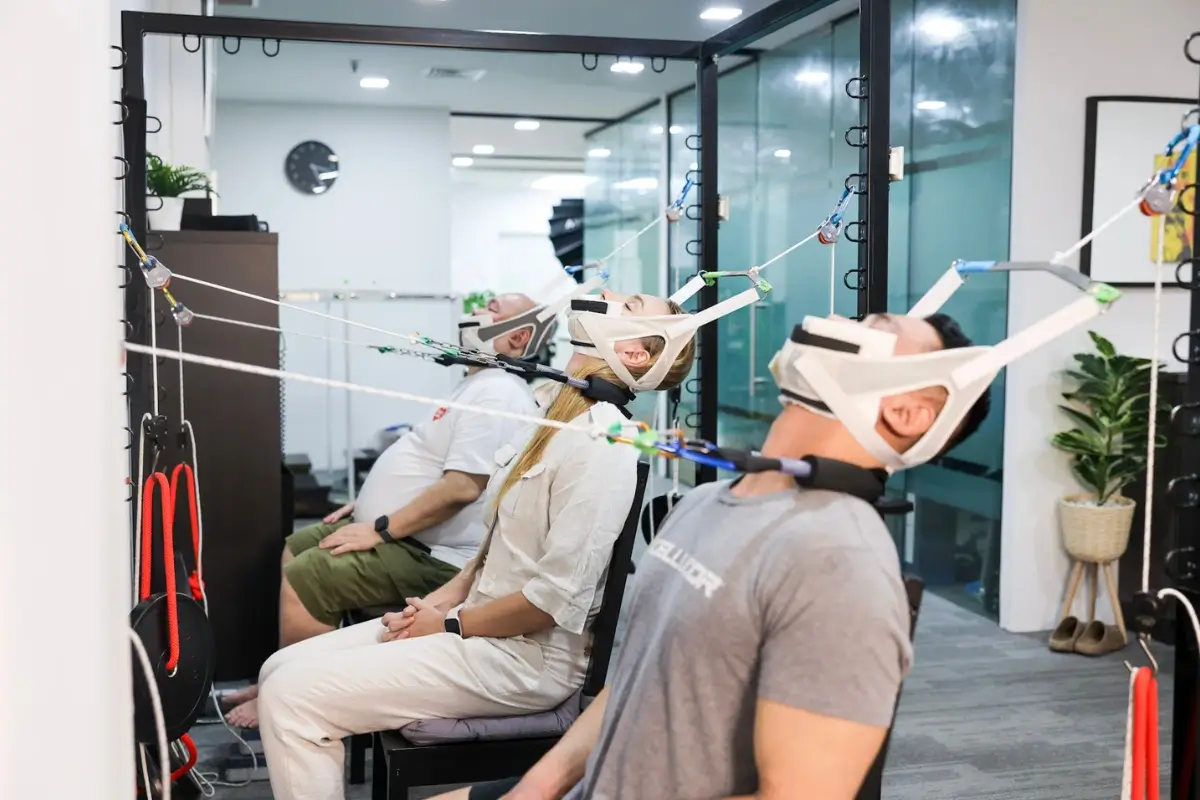
Instead of guessing, an assessment starts with a standing X-ray to measure your actual neck curve, then builds a correction and posture-retraining plan around what it shows, with progress tracked on repeat imaging. The aim is not another round of temporary relief; it is to establish whether your neck's structure and your daily loading are what keep the symptoms coming back.
Important: please read
Dr Neck Pain provides non-surgical structural correction (chiropractic) and is not MOH-registered. It is not a substitute for MOH-registered medical or surgical care, and serious complications after neck manipulation are extremely rare. Paid privately or via corporate benefits, not Medisave. If you have red-flag symptoms, seek urgent medical assessment first.
A sensible sequence: if your symptoms are mild and recent, run the home routine and fix the workstation for two weeks. If pain persists, breaks your sleep or keeps interrupting work, book an assessment to find out what is actually driving it. You can also compare cost and treatment options on the pricing page before you commit.
Which pathway is right for you?
This quick self-check mirrors the decision guide above. It is educational, not a diagnosis. If you have red-flag symptoms it will tell you to seek urgent care, not to book anything.
Interactive self-check
What is the smarter next step for your neck?
Frequently asked questions
What causes stiffness at the back of the neck in remote workers?
The usual drivers are forward-head posture, prolonged laptop use, static muscle loading, weak deep neck flexors, poor upper-back support and too few movement breaks. Stress and jaw clenching add to it. In Singapore, working from a dining table, sofa or bed, without an external monitor, concentrates the load and makes the pattern worse.
Are chin tucks enough to fix neck stiffness?
On their own, usually not. Chin tucks help, but they work best inside a broader plan that includes neck mobility, shoulder-blade and upper-back strengthening, and workstation changes. If stiffness keeps returning despite consistent chin tucks, the issue may be structural rather than muscular.
How long should I try home exercises before seeing a professional?
About two weeks, if symptoms are mild, local and improving. Seek care sooner if pain worsens, disturbs sleep, limits work, or brings arm symptoms such as numbness, tingling or weakness. Most uncomplicated cases show clear change within four to six weeks of consistent exercise plus ergonomics.
Is physiotherapy or chiropractic better for Singapore remote workers?
Neither is universally "better"; they suit different problems. Physiotherapy is strong for progressive exercise and movement retraining. Chiropractic and structural correction can help when joint restriction and lost neck alignment are major contributors. Many people do best with a combined approach that keeps active home exercise at its centre. Chiropractic is non-MOH and not Medisave-claimable.
Will an expensive ergonomic desk fix my neck pain?
A good setup reduces load, but it cannot correct a structural change in the neck. If your neck's natural curve has flattened or your head sits fixed forward of the shoulders, even a well-built workstation will not reshape that alignment. Ergonomics and exercise handle the muscular side; a structural driver needs an X-ray-guided assessment to identify and address.
Should I get an X-ray or MRI for neck stiffness?
Not for every stiff neck. Imaging is more relevant when there are red flags, a recent injury, nerve symptoms, pain that persists despite conservative care, or when structural alignment needs to be measured as part of a correction plan. A clinician should decide based on your assessment, not a routine.
References
- Bronfort G, Evans R, Anderson AV, et al. Spinal manipulation, medication, or home exercise with advice for acute and subacute neck pain: a randomized trial. Ann Intern Med. 2012;156(1 Pt 1):1-10. PMID 22213489. PubMed
- Blanpied PR, Gross AR, Elliott JM, et al. Neck Pain: Revision 2017. Clinical Practice Guidelines. J Orthop Sports Phys Ther. 2017;47(7):A1-A83. PMID 28666405. PubMed
- Gross A, Kay TM, Paquin JP, et al. Exercises for mechanical neck disorders. Cochrane Database Syst Rev. 2015;1(1):CD004250. PMID 25629215. PubMed
- Childress MA, Stuek SJ. Neck Pain: Initial Evaluation and Management. Am Fam Physician. 2020;102(3):150-156. PMID 32735440. PubMed
- Ministry of Manpower & Ministry of Health, Singapore. Updated List of Occupational Diseases, effective 1 December 2025 (Circular MOM/OSHD/2025-07). mom.gov.sg
This article is educational information only and is not medical advice, diagnosis or a treatment recommendation. Clinic details, credentials, pricing, and Medisave or insurance rules can change; verify current information directly and with official MOH and CPF sources before making decisions. If you have red-flag symptoms, seek urgent medical assessment.
Doing everything right and still stiff by 3pm?
If home exercises and a better desk have not settled a recurring neck, a standing-X-ray assessment can tell you whether structure is the missing piece.
Book your structural assessment