

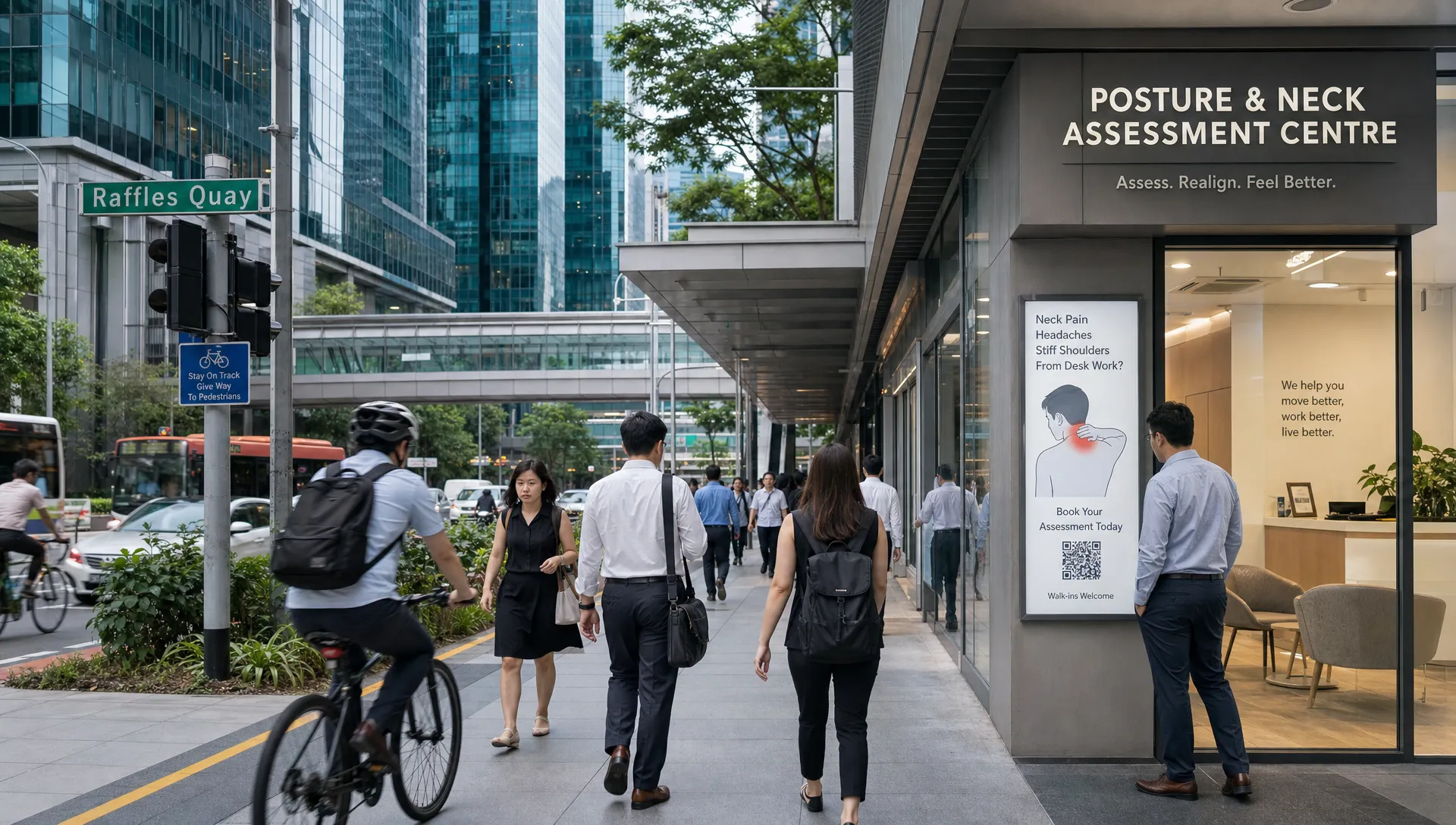
For most Singapore office workers with new or mild neck discomfort, the first step is not a full rehab plan. It is a posture check plus targeted self-care: fix the desk, break up sustained screen posture, and start simple daily exercises.
Full physiotherapy becomes the better first move when symptoms are persistent, recurrent, or spreading into the arm. And if the neck keeps tightening even after ergonomics and physio, there is a deeper gap: your posture can be seen from the outside, but your cervical alignment can only be assessed from the inside.
Key takeaways
- Decide by pattern, not pain level. Ask how long it has lasted, whether it is improving, and whether symptoms point to a habit, a tissue, or a structural problem.
- Posture check first for mild, recent, desk-linked aches with no red flags: fix the setup, add movement breaks, start basic exercises.
- Physiotherapy when it persists, recurs, or limits function: it adds diagnosis, manual therapy, and progressive strengthening of the deep neck flexors.
- Structural assessment when it keeps returning despite good ergonomics and physio, especially with visible forward head posture, an X-ray-guided step for the right cases.
- Red flags are not posture problems. Arm pain, numbness, weakness, trauma, fever, or unexplained weight loss need prompt medical review.
Quick Answer: What Do You Need First?
Use this as a first filter before you book anything. The common mistake is choosing based only on how much it hurts.
| Your situation | Best first step | Why |
|---|---|---|
| New neck ache after long laptop use, no red flags | Posture check plus self-care | Most early desk cases are driven by sustained posture, poor setup, and low movement variety. |
| Mild to moderate stiffness under 2 weeks | Ergonomic fixes, micro-breaks, daily exercises | Many cases improve before hands-on treatment is needed. |
| Pain lasting more than 2 weeks or recurring often | Full neck physiotherapy or clinical assessment | You may need a diagnosis, manual therapy, strength testing, and a progressive rehab plan. |
| Arm pain, numbness, tingling, weakness, trauma, fever, weight loss | GP, urgent care, or medical review | These are not simple posture problems and should not be self-managed. |
| Stiffness keeps returning despite stretching and desk fixes | Structural neck assessment with X-rays (when appropriate) | A postural or soft-tissue plan may miss cervical alignment, a reduced curve, or structural loading. |
Why a Posture Check Comes First for Many Singapore Office Workers
Office neck pain is often less mysterious than it feels. A Singapore General Hospital study of 324 office-worker respondents found 73% reported musculoskeletal pain, with the neck the most common site at 46%. The neck gets punished first when laptop height, chair setup, meeting posture, and phone use are poor. As SGH's own pain specialists put it, most desk neck pain is mechanical, related to how joints and soft tissues are loaded over time.
A posture check is useful because it looks for the drivers of strain before treatment begins: a monitor that is too low, a laptop used without an external keyboard, elbows floating away from the body, a chair that forces the shoulders up. It also catches behaviour: holding one position for 90 minutes, cradling the phone during calls, leaning in during video meetings. It answers one practical question, what is repeatedly loading your neck every day?
Hot-desk survival kit (Raffles Place, Marina Bay, One-North)
Hybrid work and hot-desking are great for space planning and terrible for neck mechanics: a low chair one day, a shared bench the next, the dining table on Friday. Keep a portable folding laptop stand, a compact wireless keyboard, and a wireless mouse in your bag. It turns a hunched laptop into a neutral workstation in under two minutes, and for hybrid workers it may prevent more strain than an expensive chair you use twice a week.
What a Posture Check Includes, and How It Differs From Physiotherapy
Both are useful, but they solve different problems. A good check should never just tell you to sit up straight, because no office worker holds a perfect posture all day. The goal is to reduce sustained strain and increase movement options.
| Aspect | Posture / ergonomic check | Full neck physiotherapy |
|---|---|---|
| Goal | Identify posture patterns, desk-setup issues, and movement habits driving strain | Diagnose tissue involvement, restore movement, reduce pain, retrain muscle control |
| Components | Workstation review, posture and habit observation, quick screening, basic exercise advice | Detailed history, range of motion, strength and neurological testing, manual therapy, graded exercise |
| Typical duration | Often 20 to 45 minutes | Initial 45 to 60 minutes; follow-ups 30 to 45 minutes |
| Output | Desk adjustments, a movement-break plan, 3 to 5 priority exercises | Diagnosis, hands-on treatment, individualised home programme, progression plan |
| Best suited for | New, mild, or clearly posture-linked discomfort | Persistent, recurrent, function-limiting, or complex neck pain |
Who Is Actually Doing the Assessing?
In Singapore, a "posture assessment" is offered by everyone from clinical physiotherapists to personal trainers to ergonomic-chair sales staff in Suntec City. They are not the same thing, and the difference decides whether you get a real answer or a sales pitch.
| Type of assessment | Who runs it | What it is really for |
|---|---|---|
| Retail posture screen | Chair or gadget retailer, some gyms | Often aimed at selling a S$1,200 chair or a device. Useful awareness, but not a clinical diagnosis. |
| Functional physio screen | Registered physiotherapist | Tests movement, strength, and muscle control to guide rehab. Strong for muscular and movement problems. |
| Structural clinical assessment | Structural chiropractic clinic (e.g. Dr Neck Pain) | Uses X-ray-guided evaluation to measure cervical alignment and curve, for chronic or recurring cases where structure may be the driver. |
Match the tier to the problem: a retail screen for general awareness, a physio screen for a muscular or movement issue, and a structural clinical assessment when the pain keeps returning and you need to know whether alignment is the reason.
When to Start With a Posture Check Plus Self-Care
Start here if your pain is mild to moderate, recent, and clearly linked to screen time, and you can still work, sleep, and exercise with minor changes. You are in the posture-first group if symptoms started within about 2 weeks, are worse after long meetings or phone scrolling, involve no trauma or night pain, no arm numbness or weakness, and you can still turn your head reasonably well.
The first-line plan is simple but needs consistency. Raise your screen so you look straight ahead at its centre with your head level, keep the keyboard and mouse close, support your lower back, and plant both feet flat. On a laptop, use an external keyboard and mouse whenever possible. Micro-breaks matter as much as the setup: SGH physiotherapists advise moving every 20 to 30 minutes, even for 30 seconds. The 20-20-20 rule helps break the frozen-neck pattern: every 20 minutes, look about 20 feet away for 20 seconds and gently reset your head and shoulders. Simple starters include chin tucks, scapular squeezes, shoulder rolls, doorway chest stretches, and gentle side-neck stretches; SGH has shared public tech-neck exercises you can do without equipment.
When to Go Straight to Full Neck Physiotherapy
Physiotherapy makes sense when the problem is no longer behaving like a simple desk ache. Book a session (or see a GP first if you prefer) when pain is worsening rather than settling, neck and shoulder stiffness keeps returning after short relief, headaches are getting more frequent, sleep is disrupted, or turning your head affects driving, exercise, or work. Physiotherapy adds value by combining manual therapy, soft-tissue work, joint mobilisation, motor-control retraining, and progressive strengthening, especially of the deep neck flexors, the key group that supports the head without overusing the upper traps. If you are weighing pathways, our guide to chiro vs physio for office syndrome explains when each fits.
Do not self-manage these: seek medical review
Singapore hospital guidance is consistent: some neck symptoms are not posture problems. Seek prompt medical review, and do not wait out the 2 weeks, if your neck pain comes with:
- Pain radiating down the arm
- Numbness or tingling in the fingers
- Weakness or clumsiness in the hand
- Symptoms after a fall or accident
- Fever or unexplained weight loss
- Night pain that wakes you, or severe unrelenting pain
Radiating arm symptoms can mean nerve involvement such as cervical radiculopathy and need proper assessment.
Before You Escalate: The 60-Second Wall Test
This is not a diagnosis, but it is a useful self-check for forward head posture.
- Stand against a flat wallHeels, buttocks, and shoulder blades all touching the wall.
- Look straight aheadKeep your eyes level; do not tilt your chin up to cheat the position.
- Relax your shouldersLet them settle without forcing your chest up or arching your back.
- Check the back of your headNotice whether it naturally touches the wall, or only if you strain.

If your head touches comfortably, your resting head position may be reasonably neutral. If it only touches when you strain, tilt your chin, or arch your back, your head carriage is likely shifted forward. That is not proof of a structural problem, but it suggests your neck is working from a mechanically disadvantaged position, useful motivation to fix the desk, and a clue worth taking seriously if stiffness keeps returning.
The Diagnostic Gap: Outside, Movement, and Structure
Posture checks look at the outside: how you sit, reach, type, and hold your head. Physiotherapy focuses on muscles, joints, movement quality, and strength. Both help. But if neck pain keeps returning, you may no longer have a simple habit problem. You may have structural loading: a reduced cervical curve, forward head translation, or alignment changes that keep forcing the muscles to guard and tighten. This is where trying to sit up straight reaches its limit. Stretching can ease tightness but cannot show whether your curve has flattened; strengthening can add support but may not resolve why the muscles keep overworking. You cannot reliably correct a misaligned spinal segment by willpower alone.
The desk-headache connection (cervicogenic headache)
Most office workers with chronic neck strain also get tension or cervicogenic headaches. A posture check may catch the upper-trapezius tightness behind a tension headache. But when the headache starts at the base of the skull (the suboccipital region) and refers behind the eye, it is often cervicogenic, linked to the upper cervical joints (roughly C1 to C3). Ergonomics and exercise help the muscles, but they cannot reposition an upper cervical segment that has shifted. That pattern, recurring neck stiffness with headaches from the base of the skull, is exactly where a structural, X-ray-guided look is worthwhile. At Dr Neck Pain, structural assessment uses X-ray-guided evaluation, structural posture correction, and progress tracking to identify whether alignment is contributing. X-rays are not needed for every mild ache; they become relevant when symptoms are persistent, recurrent, tied to visible forward head posture, or not responding to sensible care.
The 8am reality check: is it your pillow, or your desk?
If you wake up stiff, it is tempting to blame the mattress or pillow. But a pillow supports a healthy neck curve; it does not create one. If your curve has flattened during a 10-hour day at the desk (ligament creep from sustained forward load), no standard pillow can comfortably cradle the shape it was designed for, which is why you can buy a third S$200 pillow and still wake up sore. The fix is the daytime structure, not more bedding. If a visible hump is forming at the base of the neck, that is a further sign the change is structural.
A Practical 2026 Pathway for Singapore Office Workers
- Day 0 to 14: posture and desk fixSelf-guided or with a clinician: correct monitor height, laptop use, chair support, keyboard reach, mouse position.
- Day 0 to 14: daily routine10 to 15 minutes of chin tucks, scapular squeezes, thoracic extension, shoulder rolls, gentle neck mobility.
- If improvingContinue 4 to 6 weeks, keep micro-breaks every 20 to 30 minutes, and make your hot-desk setup portable.
- If not improvingBook full physiotherapy or a clinical assessment for range of motion, strength, nerve signs, and pain drivers.
- If it keeps returningConsider a structural X-ray-guided assessment of cervical alignment, especially if the wall test suggests forward head posture.
If red flags appear at any point, do not wait out the 2 weeks. Seek medical review promptly.
Typical Costs, Medisave & Insurance in Singapore
Costs vary by clinic, location, seniority, and package. Use these as planning ranges, not a quote from Dr Neck Pain or any specific provider.
| Service type | Typical Singapore range | Notes |
|---|---|---|
| Standalone posture or movement screen | S$39 to S$90 | Often an introductory screen or short assessment. |
| Combined ergonomic and clinical visit | Higher than a basic screen | May include a more detailed examination or treatment. |
| Private physiotherapy, initial | S$120 to S$300+ | Usually history, examination, treatment, exercise planning. |
| Private physiotherapy, follow-up | S$80 to S$250+ | Depends on length and clinic setting. |
| Public or subsidised physiotherapy | About S$45 to S$90 | Subsidised rates generally need the appropriate public referral route. |
Medisave & corporate insurance
Routine posture assessments at private clinics are generally not Medisave-claimable, and Medisave usually does not apply to routine chiropractic or structural-correction services. However, many corporate extended-health or specialist-outpatient plans do cover clinical physiotherapy and, in some cases, chiropractic care when properly referred. Check your policy wording, referral rules, and current pricing before you commit. The cheapest session is not always the cheapest solution: an S$80 massage every week for months can cost more than one assessment-led plan that reduces recurrence.
Frequently Asked Questions
Can desk neck pain be a sign of something serious?
Most office-related neck pain is mechanical, but it can occasionally signal nerve compression. Stop self-managing and seek urgent medical review if your stiffness comes with pain radiating down the arm, numbness or tingling in the fingers, hand weakness, unexplained weight loss, or a sudden severe headache. Stiffness alone, without those signs, is far more often muscular and postural.
How can I relieve neck pain from the computer fast?
For quick relief, break the static posture with the 20-20-20 rule, do gentle chin tucks, and apply a heat pack to relax spasming muscles. Just remember that stretching manages the symptom, not the cause. If the pain returns the next day, assess your workstation and check for forward head posture rather than repeating the same quick fixes.
What is the typical tech-neck pain location?
Tech neck usually shows up in three areas. The base of the skull (suboccipital tension, often causing headaches); the upper trapezius and shoulders (a heavy, loaded feeling); and the base of the neck in the lower cervical spine, where a firm "hump" can begin to form from prolonged forward-leaning.
What are the different types of office neck pain?
Office workers generally experience three types. Postural or habitual: mild, new aches that ease when you fix the desk. Muscular or soft-tissue: strains that respond to physiotherapy to release tension and retrain movement. Structural: chronic, recurring stiffness driven by a flattened cervical curve, which needs X-ray-guided assessment to confirm and correct.
Is a posture assessment enough for neck pain from office work?
It can be enough for new, mild, or clearly posture-linked discomfort without red flags. The key is that it leads to real changes: a better workstation, more movement breaks, and specific exercises. If pain persists or recurs, move to a full physiotherapy or clinical assessment.
How long should I try self-care before booking physiotherapy?
About 2 weeks for mild symptoms. If pain is improving, continue for 4 to 6 weeks. If it is not improving, keeps returning, or limits work, sleep, or exercise, book a full physiotherapy or clinical assessment.
Does a failed wall test mean I need an X-ray?
Not automatically. A failed wall test suggests forward head posture, not a diagnosis. If it appears together with persistent stiffness, frequent headaches, or recurring pain, an X-ray-guided structural assessment may be a logical next step.
When Your Neck Problem Has Moved Beyond Posture Tips
If your neck discomfort is new, start with the basics: check your posture, fix the workstation, and move more often. If the stiffness keeps returning, another stretch or another reminder to sit up straight will not answer the real question. That is when it is worth looking at structure.
Stiffness that keeps coming back? Look at the structure.
If posture fixes and physiotherapy have not stopped the cycle, your cervical alignment may be part of the problem. Find out with an X-ray-guided assessment whether structural correction is the right next step for your neck.
Book a structural neck assessmentReferences
- Singapore General Hospital / SingHealth. Musculoskeletal Disorders and Office Ergonomics: study of 324 office-worker respondents (73% pain; neck 46%). SingHealth
- Singapore General Hospital. Tech neck: coping tips, micro-breaks, and simple exercises (Physio Philip Cheong). HealthXchange (SingHealth)
- Sengkang General Hospital. Neck pain: warning signs and self-care. SKH
- Tunwattanapong P, et al. Neck and shoulder stretching exercise programme for office workers: a randomised controlled trial. Clin Rehabil. 2016. PubMed
Related reading
This article is educational information only and is not medical advice, diagnosis, or a treatment recommendation. Most desk neck pain is mechanical and improves with posture, movement, and exercise; imaging and structural correction are appropriate only in selected cases. Costs are planning ranges, not a quote. If you have red-flag symptoms (arm pain, numbness, weakness, trauma, fever, unexplained weight loss, or severe unrelenting pain), seek prompt medical assessment.