

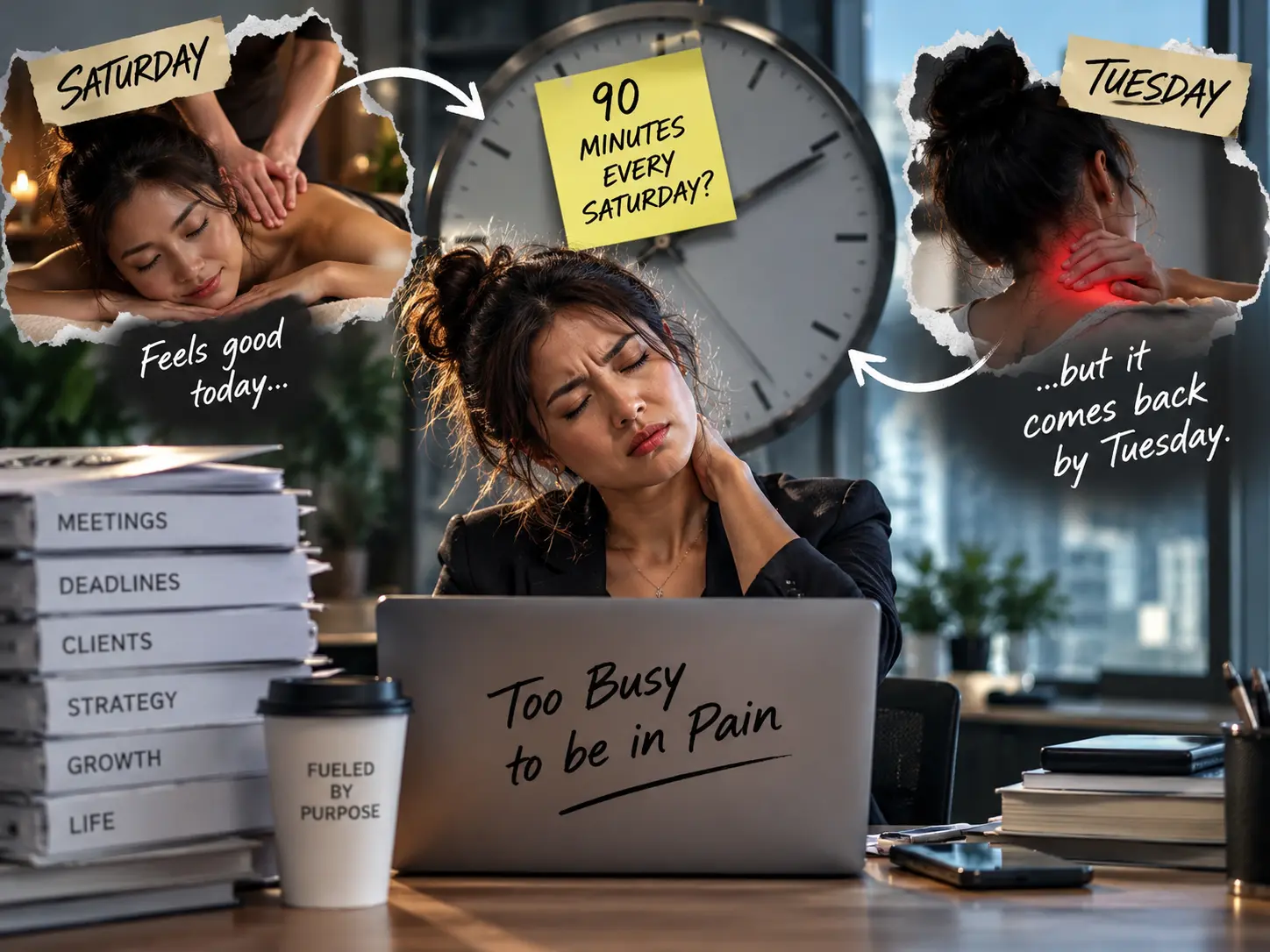
You are too busy to be in pain, and too busy to keep losing 90 minutes every Saturday to a massage that wears off by Tuesday. For a professional with a stiff neck, the real question is not "what feels good today?" but "what actually ends the cycle?"
The honest, evidence-based answer for most neck stiffness is active, multimodal care: targeted exercise plus manual therapy and sensible ergonomics. But when stiffness keeps returning despite all of that, the driver may be structural, and that is a different problem with a different fix. Here is how the options really compare, on the one metric professionals care about most: time.
Key takeaways
- Exercise is first-line, not rest. Current guidelines make active, multimodal care (exercise plus manual therapy) the central treatment for nonspecific neck pain.
- Passive-only care fades. Massage or adjustments without exercise tend to give smaller, shorter-lived results.
- Imaging is not routine. For simple mechanical stiffness without red flags, guidelines do not recommend routine X-ray or MRI.
- The exception is structural. When stiffness keeps returning despite good care, a flattened cervical curve or forward head posture may be driving it, and that subset benefits from objective, X-ray-guided assessment.
- Red flags change everything. Arm pain, tingling, numbness, or weakness point past ordinary stiffness and need prompt clinical assessment.
What the Evidence Actually Says (2025 to 2026)
Before comparing options, it helps to know where the clinical consensus sits, because it is clearer than most product marketing suggests.
- Activation, not rest. For nonspecific neck pain without a structural cause, current guidelines recommend staying active, with exercise as the central element of care.
- Multimodal beats single-modality. Combining manual therapy (mobilisation, manipulation, or soft-tissue work) with therapeutic exercise consistently outperforms any one approach for reducing pain and disability.
- Strengthening helps office workers specifically. Systematic-review evidence supports strengthening exercises for reducing neck and shoulder pain in symptomatic desk workers, with better results when exercises are targeted and adherence is high.
- Imaging is usually unnecessary. For mechanical neck pain without red flags such as trauma, night pain, or neurological signs, history and examination are enough, and routine imaging is discouraged.
What this means for you
If your neck stiffness is recent and muscular, the highest-value first move is not a scan or a gadget. It is a short, consistent programme of targeted exercise plus, if needed, a few sessions of manual therapy to get you moving. The rest of this guide is about what to do when that is not enough.
The S$200 Pillow Myth
Most professionals with a stiff neck have already bought two or three "orthopaedic" pillows, convinced the next one will finally fix it. Here is the uncomfortable logic: a pillow is designed to support a healthy neck curve, not create one. If you wake up stiff no matter which memory-foam, latex, or contour pillow you try, the pillow is probably not the problem. A neck curve that has flattened from years of desk work cannot be comfortably supported by any pillow, because the shape it is built to cradle is no longer there. A better pillow is worth having, but if the stiffness is daily and pillow-independent, that is a clue pointing at the curve itself, not your bedding.
Massage Guns & Neck Stretchers: A Quick Reality Check
Professionals love optimising with gadgets, and some of these genuinely help. The key is knowing what each tool can and cannot do.
✓ Reasonable uses
- A massage gun is good for a post-workout muscle flush and easing general tension in large muscles.
- Gentle mobility tools and heat can loosen a tight, tired neck short-term.
- Anything that gets you moving more often beats sitting still.
✗ Where they fall short (or backfire)
- Using a massage gun on a structurally misaligned neck is like hammering a bent nail: it will not straighten the underlying bone.
- Aggressively cracking or over-stretching your own neck can, over time, encourage joint hypermobility and more stiffness.
- None of these change cervical alignment, posture, or the load your muscles carry all day.
One habit to drop
Repeatedly cracking your own neck for relief is a short-term dopamine hit that does not address why it feels stuck. If you feel the constant urge to crack it, that is worth assessing, not repeating.
The Three Tiers of Neck Pain Treatment (Through the Lens of Time)
Every option below has a place. The difference for a busy professional is durability: how much of your time it buys back, and for how long.
| Tier | Best for | Time and ROI for professionals |
|---|---|---|
| Tier 1The Band-Aids: massage, medication, basic stretching | A tense week, an acute flare, short-term comfort | Fast relief, low durability. You are managing the symptom of a long work week, not the cause. Fine occasionally, expensive as a permanent plan. |
| Tier 2The Functional Fix: physiotherapy, acupuncture, dry needling | Muscular strain, movement retraining, nerve irritation; strong evidence when paired with exercise | Durable when the problem is genuinely muscular and you do the exercises. Less durable if a structural driver keeps reloading the same muscles. |
| Tier 3The Root-Cause Fix: structural correction (X-ray-guided) | Chronic, recurring, posture-driven stiffness with a confirmed structural change | A defined, trackable course aimed at the root cause, suited to professionals who want a finite plan rather than indefinite maintenance. |
Tier 2 deserves real respect. For a sports strain, active myofascial pain, or a recent muscular problem, physiotherapy-led exercise, and sometimes acupuncture or dry needling, can resolve it well. The limitation shows up in a specific scenario: a neck that has spent 10 years bent toward a screen. There, the muscles are stiff because they are compensating for something underneath.
When Stiffness Is Actually Structural
Muscles rarely tighten for no reason. When you sit hunched toward a monitor for years, the head drifts forward off its balance point and the neck's natural C-curve can flatten, a pattern clinicians call forward head posture and hypolordosis. Sustained load also stretches the supporting ligaments over time, sometimes described as ligament creep. The result: the muscles at the back of your neck are working far harder than they should, all day, just to hold your head up. That is why the stiffness returns the moment you sit back down.
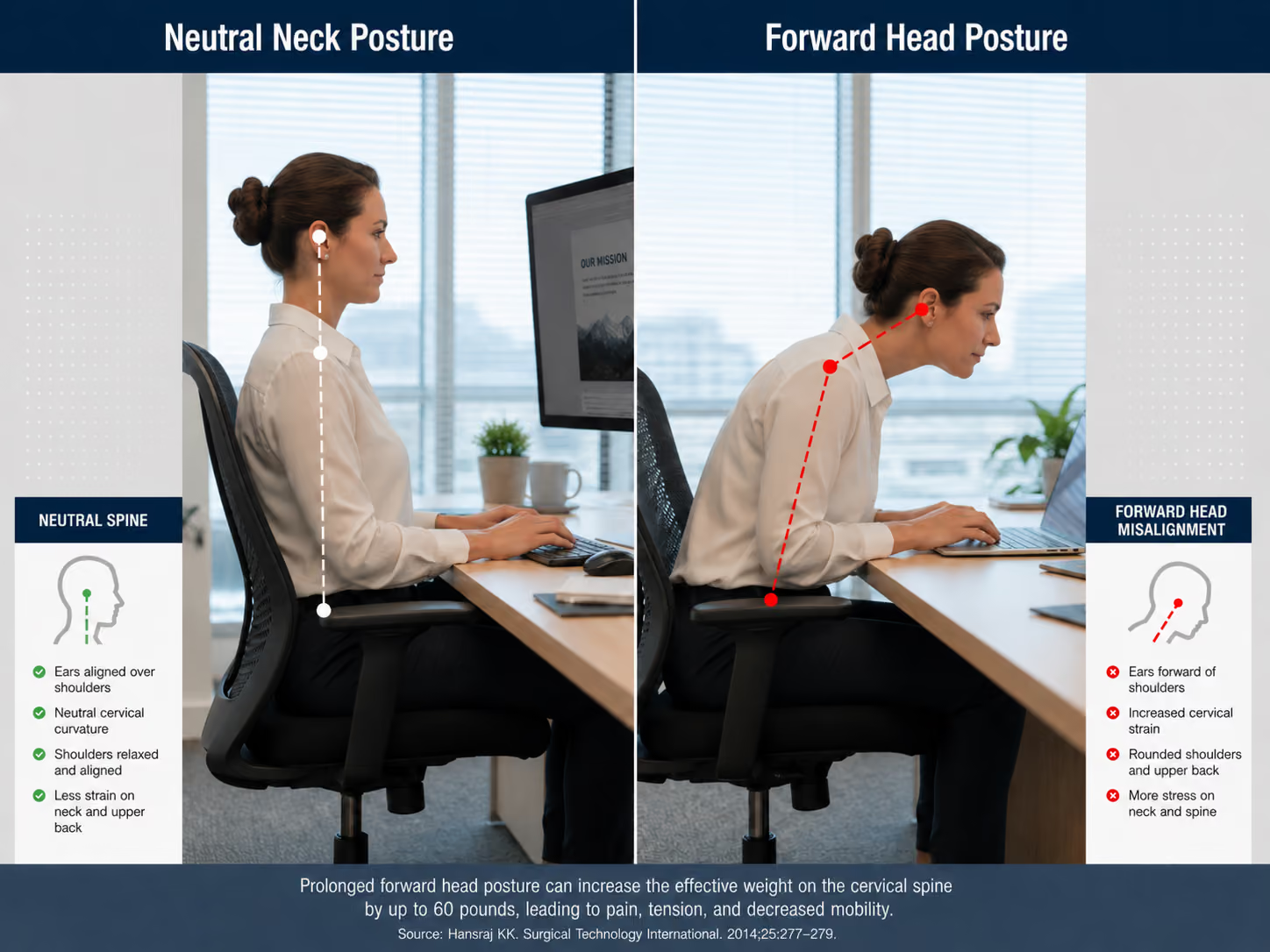
Here is the mechanical point that soft-tissue care cannot get around: you cannot massage, stretch, or crack a misaligned bone back into position. If the curve has genuinely changed, muscle work manages the symptom while the structure keeps generating it. This does not apply to every stiff neck, and it is not a reason for everyone to seek imaging. It is the specific pattern behind the desk worker whose stiffness never fully leaves, and it is worth identifying rather than guessing at.
Stiffness or slipped disc? Know the difference
Ordinary mechanical stiffness is muscles working overtime. These signs suggest something has moved past that and needs prompt clinical assessment, not a gadget or another massage:
- Pain radiating down the arm
- Tingling or numbness in the fingers
- Weakness or clumsiness in the hand
- Symptoms after a fall or accident
- Loss of balance or coordination
- Sudden severe or unusual headache
If any of these apply, you may have nerve involvement such as a slipped disc or cervical radiculopathy, which needs proper assessment (and sometimes imaging) rather than self-management.
The X-Ray Advantage: Why Data-Driven Professionals Look Deeper
If you work in law, tech, or finance, you already know the value of measuring before deciding. The weakness of much neck care is that progress is judged almost entirely by how you feel that day. For simple mechanical stiffness that is fine, and imaging is genuinely not needed. But for chronic, recurring, posture-driven cases, an objective picture of your cervical alignment changes the conversation from guessing to measuring.
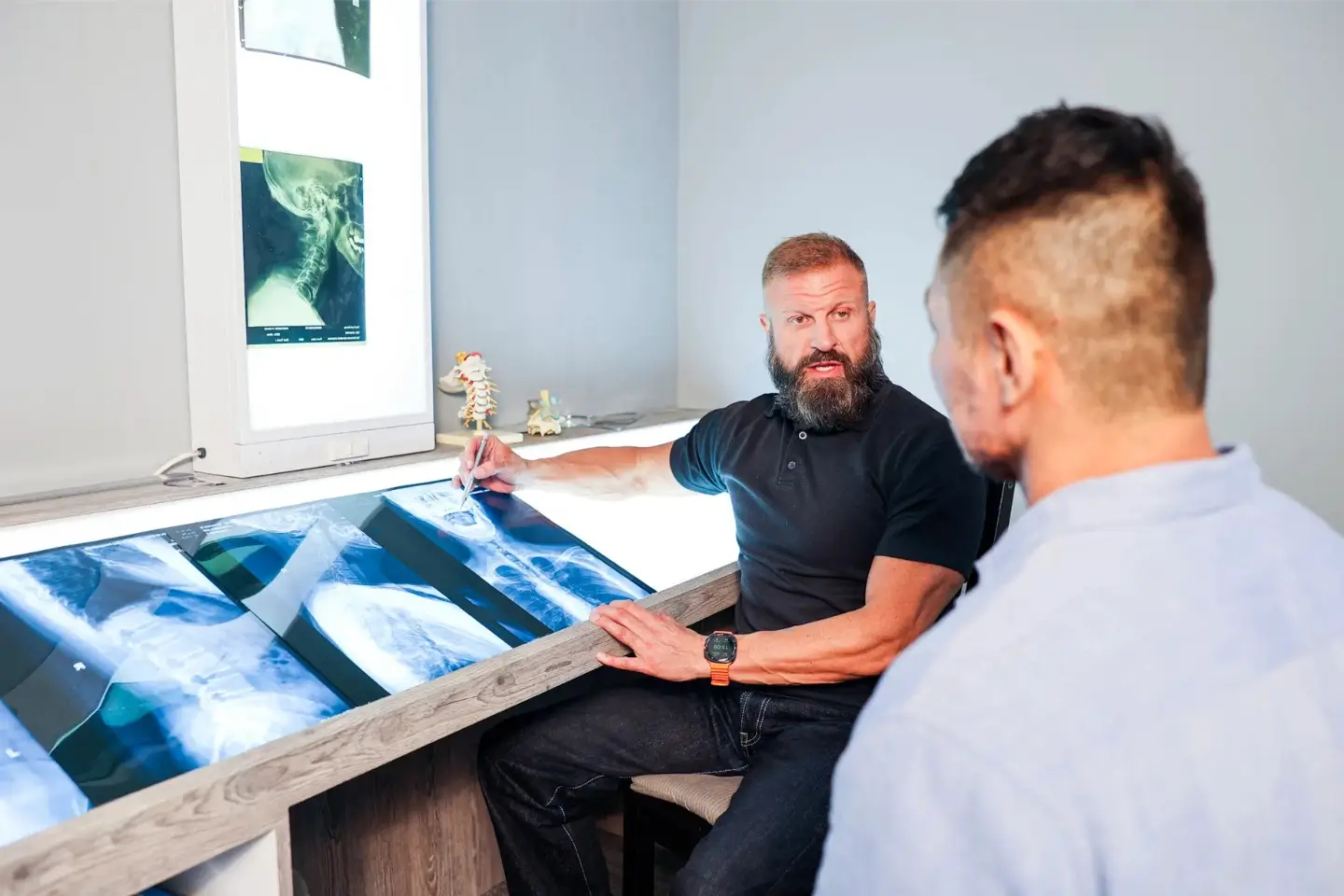
Dr Neck Pain is a structural chiropractic clinic in Singapore that uses standing digital X-rays, taken under your own body weight, when clinically appropriate, to see actual alignment rather than infer it. The R3NEW X™ protocol is built around that data: a structured, trackable course aimed at restoring the curve and retraining posture, with progress re-checked on imaging rather than assumed. Crucially, this is a targeted intervention: imaging is reserved for cases where history, symptoms, and examination justify it, and always after red-flag screening. That is what makes it evidence-guided rather than a blanket scan.
- One-on-one consultationYour history and specific neck issues, so the assessment is targeted rather than generic.
- Physical and neurological examPosture, mobility, and nerve function are checked, which also screens for the red flags above.
- Standing digital X-rays (when appropriate)Alignment viewed under body weight, for suitable chronic or recurring cases, not as a routine screen.
- A clear structural report and planA plain-language explanation of findings and a personalised plan. The first visit runs about an hour, with time for questions.
On timelines, most people begin to see lasting change over roughly 12 to 24 sessions across a few months: milder or recent cases nearer 12, long-standing misalignments closer to 24 or more, with progress verified on X-ray. Your own course depends on findings and how your neck responds, but the point professionals appreciate is that it is a defined plan with an endpoint, not open-ended maintenance.
2-minute self-check
Is your stiffness structural or muscular?
Tick any that sound like you. A result appears as soon as one is true.
Your result will show here.
Some early signs, mostly still muscular.
One of these on its own is common and often muscular. The highest-value move now is the evidence-based basics: consistent targeted exercise, a little manual therapy if needed, and better desk habits for two to four weeks.
If it keeps returning despite that, it is worth looking deeper. Watch whether more of the patterns above start to apply.
A recurring pattern worth assessing.
Several of these together suggest your stiffness is not settling with ordinary care, which points beyond simple muscle tension. A flattened cervical curve or forward head posture may be reloading the same muscles day after day.
This is the point to stop guessing and get a proper assessment, so you know whether you are treating the cause or just the symptom.
This strongly points to a structural driver.
When nearly all of these are true, you are almost certainly managing a structural problem with muscular tools: soft-tissue care and gadgets buy a day or two because the underlying alignment keeps reloading the muscles. You cannot massage a misaligned curve back into place.
The next step is not another massage. It is an objective, X-ray-guided assessment (after a red-flag screen) to measure whether your cervical alignment is the driver, and whether a finite correction plan fits your case.
Educational self-check only, not a diagnosis. If you have arm pain, numbness, weakness, or a sudden severe headache, seek prompt medical assessment.
Time, Cost & Logistics for Busy Professionals
The two real objections are always time and money, so here is the practical picture.
- Time: sessions are designed to be efficient enough to fit a busy schedule, and the clinic sits at North Bridge Centre (02-20) in downtown Singapore, roughly five minutes from Bugis and City Hall MRT, which is convenient for a lunch-break appointment.
- Bring your own X-rays if you have them and they are less than a year old; otherwise new standing X-rays can be arranged. A brief call usually happens before an in-clinic assessment to understand your situation.
- Benefits and claims: many executive and extended-health plans cover chiropractic or specialist outpatient care, though rules vary by insurer and panel. Medisave generally does not apply to routine chiropractic or structural-correction services. Check your plan wording and current pricing before you commit, and see real patient results if you want proof before booking.
Frequently Asked Questions
What is the most trusted, evidence-based treatment for neck stiffness?
Active, multimodal care: targeted exercise combined with manual therapy and sensible ergonomics. Current guidelines make exercise the central element for nonspecific neck pain, with manual therapy as an effective adjunct. Passive-only care (massage or adjustments without exercise) tends to give smaller, shorter-lived results. Structural correction is for the specific subset whose stiffness keeps returning because of a measurable alignment change.
Why do I wake up with a stiff neck every day regardless of my pillow?
Because a pillow supports a neck curve, it does not create one. If your stiffness is daily and independent of which pillow you use, the likely issue is the curve itself, which years of desk posture can flatten. A good pillow helps a healthy neck; it cannot compensate for a lost cervical curve.
Are massage guns and neck stretchers good for neck stiffness?
They can ease muscular tension short-term, but they do not change alignment. A massage gun is fine for general muscle relief. Using it, or aggressive self-stretching and neck-cracking, on a structurally misaligned neck will not straighten the bone and can, over time, encourage joint hypermobility. Treat gadgets as comfort tools, not corrections.
Is my neck stiffness a slipped disc?
Ordinary stiffness is muscular; a slipped disc usually adds nerve symptoms. If your stiffness comes with pain radiating down the arm, tingling or numbness in the fingers, or hand weakness, that suggests possible nerve compression and needs prompt clinical assessment rather than self-management. Stiffness alone, without those signs, is far more often mechanical.
Do I really need an X-ray for a stiff neck?
Not for simple mechanical stiffness. Guidelines do not recommend routine imaging without red flags. Imaging becomes useful in selected chronic, recurring, or posture-driven cases where an objective view of cervical alignment will change the plan, and in anyone with red-flag symptoms. It is a targeted step, not a default.
How long does structural correction take, and can it fit a work schedule?
Most people see lasting change over about 12 to 24 sessions across a few months. Milder cases are nearer 12; long-standing misalignments closer to 24 or more, with progress verified on X-ray. Sessions are designed to be efficient, and the downtown location suits a lunch-break visit. It is a defined plan with an endpoint rather than indefinite maintenance.
The Bottom Line for Professionals
If your neck stiffness is recent and muscular, start where the evidence points: consistent targeted exercise, a little manual therapy if needed, and better desk habits. That resolves most cases and costs you the least time. But if you have done all that and the stiffness still returns every week, you are likely managing a structural problem with muscular tools. The way to know is to measure, not guess.
Stop renting relief. Find out if it is structural.
If massage, stretches, and better pillows keep buying you only a few days, your cervical alignment may be the driver. Find out with an X-ray-guided assessment whether the R3NEW X™ protocol is the right, finite plan for your neck.
Book your assessment on WhatsAppReferences
- El-Allawy A, et al. Clinical practice guideline: Nonspecific neck pain (activation as the central element; imaging not routine without red flags). Dtsch Arztebl Int. 2025. Deutsches Arzteblatt
- Effectiveness of exercise in office workers with neck pain: systematic review and meta-analysis (strengthening reduces neck pain). PMC
- Combined effects of manual therapy and exercise on nonspecific neck pain: systematic review with meta-analysis. PMC
- Neck Pain Clinical Practice Guidelines (multimodal manual therapy plus exercise). J Orthop Sports Phys Ther. 2017. JOSPT
Related reading
This article is educational information only and is not medical advice, diagnosis, or a treatment recommendation. Guidelines favour active, multimodal care for most neck pain and do not recommend routine imaging without red flags; imaging and structural correction are appropriate only in selected cases. Always consult a licensed healthcare professional for a diagnosis tailored to your condition. If you have arm pain, numbness, weakness, loss of coordination, or sudden severe headache, seek prompt medical assessment.