

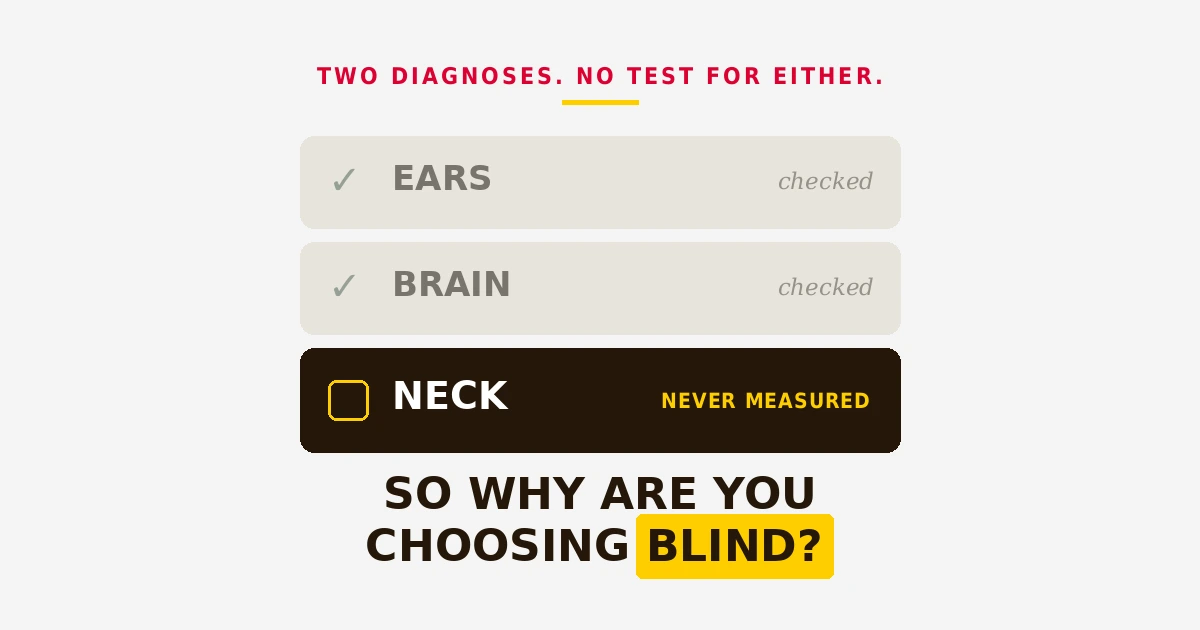
You have had the hearing test. You have had the MRI. Everything came back clear, and you walked out with a diagnosis that was decided by what the scans could not find. Here is how the two most commonly confused explanations differ, how each is actually diagnosed, what the research says about treating them, and the question almost nobody asks before the prescription is written.
- Neither condition has a confirming test. Vestibular migraine is diagnosed against a checklist of symptoms. Cervicogenic dizziness is diagnosed by ruling everything else out. No blood test, scan or hearing test proves either one.
- The sensation will not tell you which it is. Patients in both groups describe the same thing: walking on a boat, floating, rocking, a head that feels unhooked. Spinning is not exclusive to migraine, and swaying is not exclusive to the neck.
- What sets it off is the more useful clue. Migraine episodes track with sleep, stress, hormones and visual overload. Neck-related dizziness tracks with load on the neck: looking down, holding a posture, turning the head.
- The evidence for preventive migraine medication is thinner than most patients assume. Cochrane could find only a handful of small trials, and rated them low to very low certainty. That is a grade on the research, not on you, but it is worth knowing before you commit a year to it.
- They can coexist, and often do. Treating one while ignoring the other is the most common reason people improve halfway and stall.
- Dr Will’s stand: before you commit to months of daily neurological medication, it is worth knowing whether anyone has actually examined and measured the structure holding your head up. In most Singapore pathways, nobody has.
The short answer
Vestibular migraine is a migraine disorder that produces dizziness. Cervicogenic dizziness is dizziness driven by the neck. Neither is confirmed by a scan.
Vestibular migraine has a published checklist, four criteria agreed internationally, and you either match it or you do not. Cervicogenic dizziness has no checklist at all. It is reached only once the ear, brain, heart and medication causes have been excluded and the dizziness reliably tracks with neck pain, neck position or neck movement.
That difference matters more than any symptom. One diagnosis is made by matching a pattern. The other is made by elimination, and only after someone has actually examined your neck.
What vestibular migraine actually is
Most people hear “migraine” and think headache. Vestibular migraine is migraine that shows up in the balance system instead, and in many people the headache is mild, late, or absent altogether. That is why it is so often missed for years: patients keep saying “but I do not get headaches,” and assume migraine has been ruled out.
It affects up to about 1% of the population, which in Singapore terms is tens of thousands of people. It is a real neurological condition with real treatment, and nothing in this article should be read as talking you out of that diagnosis.
What it does not have is a test. There is no blood marker, no scan finding, no hearing result that confirms it. The diagnosis is made by matching your history against a published checklist, agreed between the Bárány Society and the International Headache Society and last updated in 2022.
The actual criteria
- At least five episodesVestibular symptoms of moderate or severe intensity, each lasting between 5 minutes and 72 hours. Not seconds. Not constant for months.
- A migraine historyCurrent or previous migraine, with or without aura, meeting the international headache criteria.
- Migraine features in at least half the episodesOne or more of: a migraine-type headache, both light and sound sensitivity together, or visual aura. In at least 50% of your dizzy episodes, not occasionally.
- Nothing else explains it betterNot better accounted for by another vestibular or headache diagnosis.
The category most patients are never told about
If you meet the episode pattern but only one of the other two conditions, a migraine history or migraine features, the correct label is probable vestibular migraine, not vestibular migraine. It is a separate category in the same document. A great many people walking around Singapore with a confident “vestibular migraine” diagnosis technically sit in the probable column, and were never told the distinction exists.
What cervicogenic dizziness actually is
Cervicogenic dizziness is dizziness or unsteadiness generated by the neck. The proposed mechanism is straightforward: the joints and deep muscles of the upper neck are densely packed with position sensors, and the brain blends their signal with what the eyes and the inner ear report. If the neck sends a distorted signal, the three inputs disagree, and the brain reads that disagreement as unsteadiness.
It is also the more contested of the two labels. The Bárány Society has published criteria for many vestibular disorders; cervicogenic dizziness is not among them. Some specialists treat it as a clear clinical entity they see weekly. Others consider it over-diagnosed. Both positions exist in the literature, and you should know that before anyone tells you it is settled either way.
What is not in dispute is how it is reached. The 2017 review in Archives of Physiotherapy that most clinicians work from puts it plainly: there is no definitive clinical or laboratory test, so it is diagnosed only after other causes are ruled out. That review lists vestibular migraine by name as one of the conditions that must be excluded first.
Read that in the right order
Cervicogenic dizziness is not a label you reach instead of seeing a doctor. It is the label you can reasonably reach after the ear, brain, heart and medication causes have been looked at and the symptoms still track with your neck. Work-up first. Neck second. Anyone who skips that order is guessing, whatever their job title.
The key differences, side by side
Clues, not a home diagnostic test. Real patients cross these columns constantly.
| What differs | Cervicogenic dizziness | Vestibular migraine |
|---|---|---|
| The sensation | More often unsteadiness, floating, rocking or disorientation. True room-spinning is less typical. | Can be spinning, but also motion-induced dizziness, visual-motion sensitivity, or non-spinning imbalance. |
| What sets it off | Neck load: looking down, sustained desk posture, turning the head on a still body, an awkward night’s sleep. | Sleep loss, stress, hormonal shifts, skipped meals, bright or busy visual environments, weather. Can also be head motion. |
| How long an episode runs | Often minutes to hours, and frequently tied to how long the neck has been loaded. The overall problem can persist for months. | The criteria specify 5 minutes to 72 hours, with at least five such episodes. |
| Neck findings | The neck pain and stiffness that usually comes with it is nearly always present, and symptoms change with neck position. | Neck pain is common in migraine too, and can be part of the attack itself. Its presence proves nothing. |
| Migraine features | Not a defining part of the picture. | Light and sound sensitivity, visual aura, or migraine headache, in at least half of episodes. |
| How it is diagnosed | By exclusion No confirming test. Other causes ruled out, plus a symptom pattern that tracks the neck. | By criteria No confirming test. History matched against the Bárány and IHS checklist. |
| What treatment targets | The neck: its movement, its control, its load tolerance, and in Dr Will’s approach, the structure underneath. | The migraine process: triggers, routine, acute relief, and preventive medication if episodes are frequent. |
Why describing the sensation will not settle it
If you have spent nights reading patient forums, you have already met this problem. People with a confirmed vestibular migraine diagnosis and people convinced their neck is the culprit reach for exactly the same words: walking on a boat, a trampoline, marshmallows, drunk without the fun, a head that feels like it is floating half a second behind the body.
The widely repeated rule that “rocking means neck, spinning means migraine or ear” is not supported by the criteria. The vestibular migraine definition explicitly includes spontaneous dizziness, positional dizziness, visually induced dizziness and head-motion-induced dizziness. Spinning is one option among several, not the signature.
This is worth knowing because it is the single most common way patients talk themselves into the wrong box, and then spend a year treating it.
More useful to track
- Sequence. Does the neck tighten before the dizziness, or after?
- Posture dependence. Does it build through a desk day and ease on a day off?
- Head versus body. Turning your head alone, or turning your whole body?
- Migraine company. Light and sound sensitivity together, in the same episode.
- Episode length. Minutes, hours, or a constant background hum.
Less useful than you think
- Which metaphor you use for the feeling.
- Whether it spins or sways.
- Whether you have neck pain, on its own.
- Whether your MRI was clear.
- Whether a treatment helped, used as proof of cause.
Why your Singapore specialist landed on vestibular migraine
The pathway is remarkably consistent. You see a GP, you get referred to an ENT, you have an audiogram and a vestibular battery, possibly an MRI. Everything is normal. You are told it is not Meniere’s, not a tumour, not BPPV, which has its own distinct pattern, not your hearing. If that description of walking out with normal results and no explanation is familiar, this is what a clear MRI does and does not rule out. Then comes a diagnosis that explains dizziness without needing an abnormal test result, and vestibular migraine is the one that fits that description best.
This is not incompetence, and it is worth saying so clearly. Ruling out the dangerous causes is exactly what an ENT or neurologist should do first, and they did it. Vestibular migraine is also genuinely common and genuinely under-diagnosed, so reaching for it is often correct.
 The hardest appointment is often the one where everything comes back normal and you still feel unwell.
The blind spot is structural, not clinical. An ENT examines the ear. A neurologist examines the brain. Neither specialty routinely measures the alignment of the cervical spine under load, because that is not what they are for. So when the tests come back clear, the neck has not been excluded. It has simply never been looked at.
“I see people who have been on daily migraine medication for eighteen months, with a folder of normal scans, and nobody in that folder has measured their neck once. They are not being failed by bad doctors. They are being failed by a gap between specialties. The ear was checked. The brain was checked. The column holding the head up was assumed.”
“My position after three thousand cases is not that migraine is a myth. It is that you should not spend a year medicating a diagnosis of elimination while one of the things being eliminated was never actually examined.”