

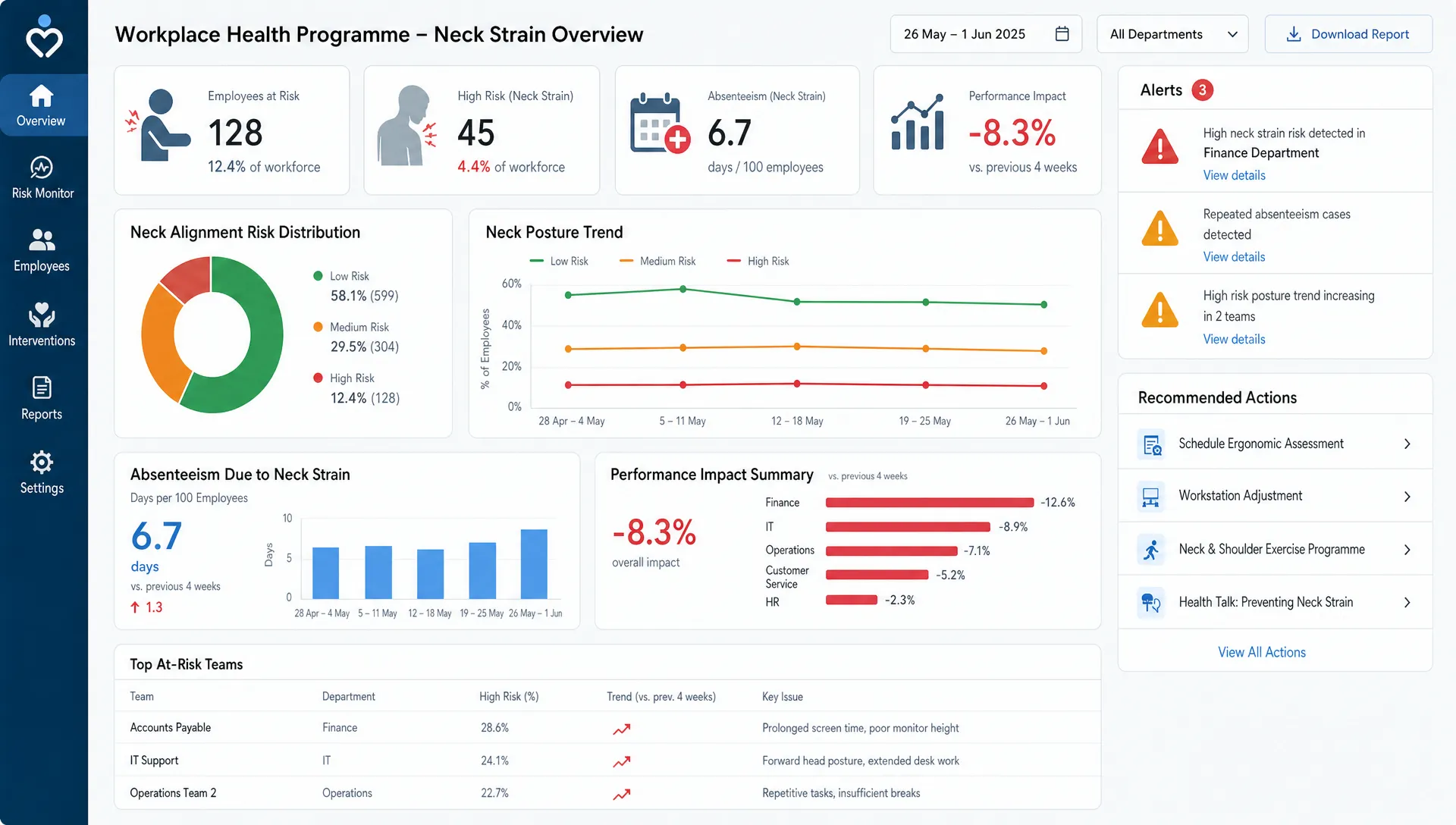
Corporate neck pain is no longer a soft wellness topic. For HR leaders, business owners, office managers, and WSH teams in Singapore, it is a productivity, retention, and risk-management issue with a measurable cost.
In a Singapore General Hospital study of 324 office-worker respondents, 73% reported musculoskeletal pain, with the neck the most common site at 46% (followed by shoulder and lower back at 42% each). That means almost one in two office employees may be working through neck stiffness, headaches, or recurring discomfort during the day. The expensive part is rarely the clinic bill. It is presenteeism, medical leave, slower work, and the quiet loss of output from people who are present but physically distracted.
Key takeaways for employers
- It is a business cost, not a perk. Recurring neck pain drives presenteeism, MC days, and admin friction that usually exceed the medical bill.
- WICA exposure is rising. From 1 November 2025, permanent-incapacity compensation is capped at up to S$346,000 and medical expenses at S$53,000, so inaction has a real financial tail.
- Perks alone do not fix recurrence. Chairs and massage days help mild cases; recurring headaches, forward head posture, or a reduced cervical curve need clinical and structural assessment.
- Triage saves budget. Match the intervention to the case: ergonomics and movement for prevention, physiotherapy for function, structural correction for chronic recurrence.
- Measure it. A structured pathway with pain scores, MC trends, and recurrence rates turns wellness spend into trackable ROI.
Related reading
Why Neck Pain Matters for Singapore Employers
Most companies already treat safety seriously in factories, kitchens, and logistics. Desk work looks safer, but prolonged sitting, laptop work, and poor monitor setups create a different kind of occupational load. Office-related neck pain builds gradually: tightness at the base of the skull, shoulder heaviness, headaches after long screen sessions, difficulty turning the head. Over time it interferes with concentration, sleep, and work pace.

For employers, the most expensive part is often invisible: repeated MC days, unfinished work, delayed projects, manager time spent redistributing tasks, and staff who avoid full performance because sitting at a desk has become uncomfortable. In organisations built around high-value knowledge workers, one chronic case can bottleneck a whole team, and it stays hard to measure until it becomes obvious.
The Business Case: Productivity, MC Days & WICA Exposure
Work-related musculoskeletal disorders create both direct and indirect costs. Direct costs include medical bills, MC wages, temporary cover, and, in serious cases, compensation. Indirect costs, which are widely considered to exceed direct medical cost when symptoms recur, include reduced output, admin work, retraining, and delays.
The Work Injury Compensation Act (WICA) sets the compensation framework, and the limits rose from 1 November 2025. These are verified figures employers should plan around.
| Cost driver | Typical impact for Singapore employers |
|---|---|
| WICA permanent-incapacity cap | Up to S$346,000 maximum (minimum S$116,000) for total permanent incapacity, effective 1 Nov 2025; a further 25% may apply for 100% incapacity. |
| WICA medical-expense cap | Up to S$53,000, or one year from the date of accident, whichever comes first. |
| Medical bills and MC wages | Anjou Health estimates S$2,000 to S$8,000 per poorly managed workplace-injury case, including medical costs, wages, and temporary cover. |
| Indirect costs | Productivity loss, admin time, retraining, and delays, which often exceed the direct medical cost, especially when symptoms recur. |
| Return-to-work savings | Anjou Health estimates a structured return-to-work programme may save around S$800 and roughly 10 MC days per case in suitable scenarios. |
Not every office neck-pain case falls under WICA, and gradual-onset symptoms require careful, case-by-case assessment. But from December 2025, reportable and compensable occupational diseases were harmonised across the Workplace Safety and Health Act and WICA, so employers should not treat chronic desk-related conditions as a purely personal issue. The practical takeaway: if neck pain is common in your office, ignoring it is not cost-neutral.
The work-from-home liability question
Hybrid work has blurred the lines of occupational health. Whether WICA applies to a gradual-onset injury developed at a home dining table is a genuine legal grey area, and case-specific advice is needed. But there is a simpler point HR can act on immediately: you cannot control an employee's home desk, yet the productivity loss still belongs to the business. Because you cannot mandate a perfect setup in a private home, corporate wellness cannot rely entirely on ergonomic furniture. The protective move is to add clinical support, such as posture screenings and structured care pathways, to counteract the strain that hybrid setups inevitably create.

Why Ergonomic Chairs and Wellness Perks Often Fall Short
Ergonomic chairs, standing desks, mobile massage, stretch posters, and wellness talks all have a place. They reduce discomfort, raise awareness, and give quick relief. The mistake is assuming they solve every neck-pain problem. Many workplace programmes fail because they treat every case as simple soft-tissue tightness.
If an employee has a mildly stiff neck after a long week, a massage and a better desk setup may be enough. If the employee has recurring headaches, forward head posture, a reduced neck curve, or symptoms that keep returning despite better ergonomics, the problem needs a deeper clinical and structural assessment. This is where HR needs clearer triage: a massage relaxes muscles, physiotherapy improves movement and work habits, and structural correction investigates whether cervical alignment is driving repeated symptoms. Choosing the wrong one leads to repeated spending without lasting change. If your team is comparing short-term options, our guide to physiotherapy versus massage for neck pain explains when each fits.

What Effective Corporate Neck Pain Treatment Should Include
A strong programme combines prevention, early detection, clinical care, and outcome tracking. The best results come from layered intervention rather than one-off events. This layered approach also aligns with Singapore's Total WSH philosophy, which encourages employers to look beyond basic safety and address the chronic health issues that quietly affect work.
| Programme layer | Purpose | What it looks like in the workplace |
|---|---|---|
| Ergonomic audit | Reduce environmental strain | Monitor at eye level, laptop risers, chair adjustment, keyboard and mouse repositioning, document holders. |
| Symptom screening | Identify who needs care | Short neck-pain surveys, movement checks, posture review, and referral criteria for persistent symptoms. |
| Clinical treatment | Reduce pain, restore function | Physiotherapy, chiropractic assessment, therapeutic exercise, manual care, or referral depending on findings. |
| Structural assessment | Investigate chronic or recurring cases | X-ray-guided evaluation when clinically appropriate, especially for long-term posture distortion or repeated symptoms. |
| Movement culture | Prevent relapse | Micro-breaks every 30 to 40 minutes, posture resets, stretch prompts, walking discussions, manager support. |
| Outcome tracking | Prove ROI | Pain and function scores, MC trends, claim patterns, workstation fixes completed, and employee feedback. |
Workstation changes work better when paired with active retraining. A small office-worker study found that adding scapular bracing to ergonomic changes improved posture, neck-disability scores, and work productivity over four weeks, which supports pairing environmental fixes with posture and movement work rather than relying on either alone.
When Neck Tension Symptoms Need Escalation
Not every stiff neck needs specialist care. Many cases improve with rest, better ergonomics, regular movement, and guided exercise. But a corporate programme needs a clear escalation pathway so employees do not stay trapped in a loop of temporary relief. Consider clinical assessment when symptoms persist for more than a few weeks, repeatedly return after massage or stretching, interfere with sleep or concentration, or cause recurring MC.
Direct to urgent medical care, not a wellness pathway
Pain spreading into the shoulder or arm, numbness, tingling, weakness, dizziness, or balance issues warrant prompt clinical assessment. Severe neurological symptoms, fever, unexplained weight loss, sudden severe headache, or pain after trauma should go to urgent medical care, not a routine workplace wellness track.
The Executive Posture Trap
Companies will spend to protect their highest earners, and there is a clinical reason to. C-suite executives and frequent flyers often accumulate severe cervical load: hours hunched over tablets in transit, back-to-back boardroom meetings, and chronic high stress that keeps the neck and shoulder muscles switched on. A standard massage is reasonable maintenance for general staff, but for high-value leaders whose focus drives revenue, guessing with cervical health is a poor bet. These cases are exactly where an objective, X-ray-guided assessment earns its place, and where proactive neck-health optimisation can protect long-term performance rather than assuming the problem is only muscular.
The Structural Solution: Where Dr Neck Pain Fits
For employees with chronic neck pain, recurring headaches, or posture-related symptoms that keep returning, the missing piece is often structural assessment, especially when the issue is not just muscle tightness but a pattern of forward head posture, a reduced cervical curve, or a visible neck hump. Dr Neck Pain is a structural chiropractic clinic in Singapore focused on correcting neck alignment, using X-ray-guided assessments when clinically appropriate, personalised treatment plans, posture retraining, and progress tracking.
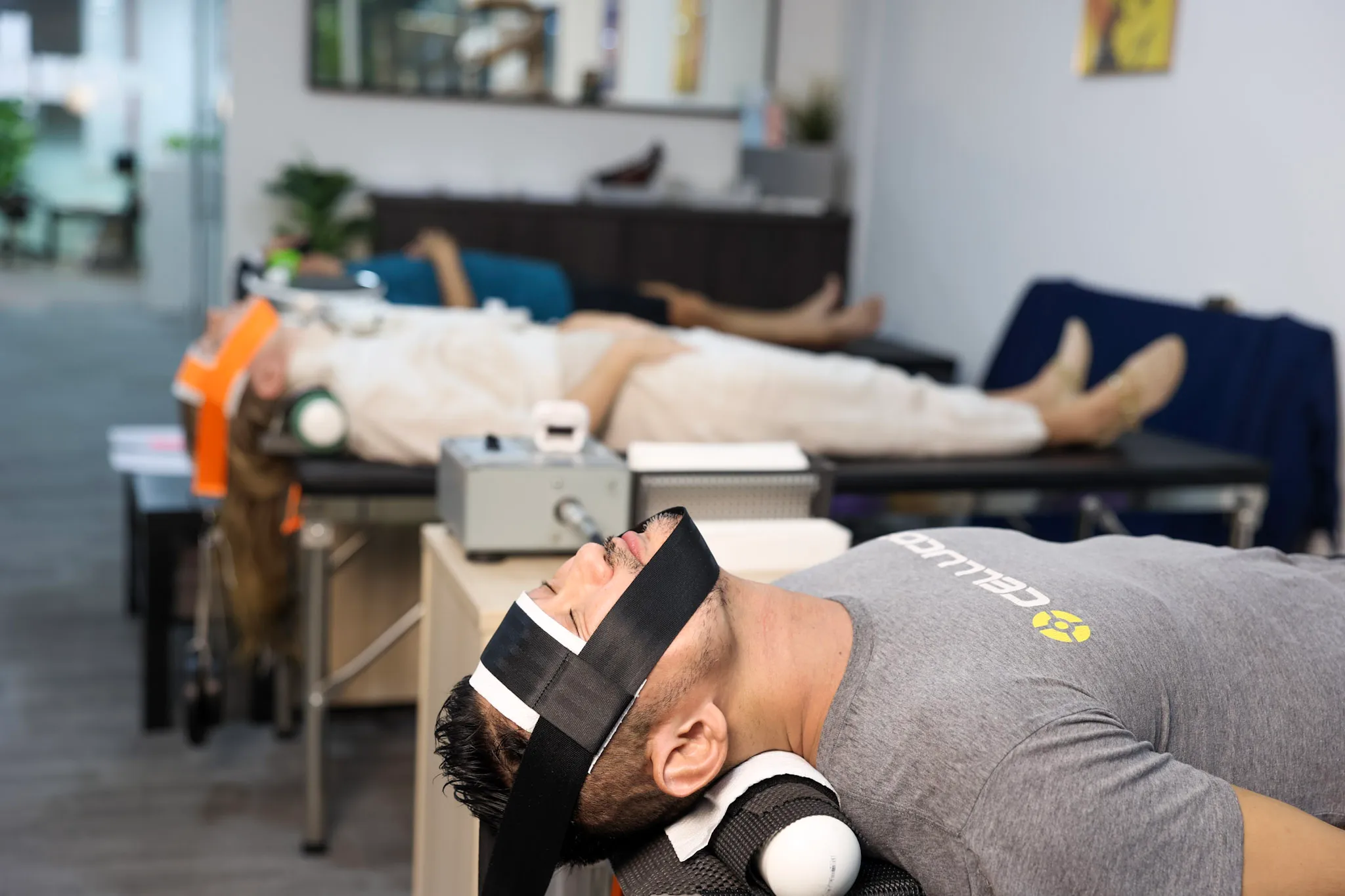
For employers, the distinction matters: a generic wellness day makes employees feel cared for, but may not identify the structural reason a key employee keeps taking MC. An X-ray-guided assessment gives a more objective view of cervical alignment. This does not mean every employee should be X-rayed; a responsible pathway reserves imaging for cases where history, symptoms, and clinical findings justify it, which is what makes structural correction a targeted intervention rather than a blanket perk. It is most relevant for employees who have chronic neck pain lasting months or years, recurring posture-linked headaches, visible forward head posture, a cycle of massage or painkillers without lasting change, or business-critical roles where repeated MC has measurable operational impact.
Insurance, Benefits & Claims: What HR Should Clarify Early
Before launching a programme, map the reimbursement and documentation pathway so employees can access care without delays. Medisave should not be assumed for chiropractic or structural-correction services unless a specific pathway qualifies under applicable rules, so employees should verify eligibility before committing. Corporate extended-health benefits may cover physiotherapy, chiropractic care, or specialist outpatient services depending on the insurer, panel arrangement, referral requirements, and annual limits, so check plan wording rather than making broad promises. Employees can review current assessment and treatment pricing before they commit.
For WICA and workplace-injury governance, early documentation matters. Keep records of reported symptoms, work modifications, ergonomic interventions, referral dates, MC trends, and return-to-work arrangements. Gradual-onset neck pain is not always handled like a sudden accident, so case-specific advice may be needed, but a clear process reduces avoidable disputes and shows the company is taking reasonable steps. A good programme includes three administrative basics: a symptom-reporting channel, referral criteria for clinical assessment, and a return-to-work process for temporary duty modification.
How to Launch a High-ROI Neck Pain Programme
Start small, measure outcomes, and scale what works. You do not need to overhaul every workstation or send every employee for treatment on day one.
- Run a baseline auditA short anonymous survey (pain frequency, headaches, work interference, MC history, workstation comfort) plus a quick ergonomic scan of high-risk teams such as finance, engineering, legal, and operations.
- Segment employees by needPrevention (ergonomic education, movement breaks), early-care (physiotherapy-led exercise), and chronic-care (structural evaluation). Flag high-value or executive roles for closer attention.
- Pilot for 6 to 8 weeksChoose one department and combine workstation fixes, movement-break training, clinical screening, and referral pathways. Keep it focused enough to measure clearly.
- Track business and health outcomesPre and post pain scores, self-rated productivity, function scores, MC days, workstation changes completed, and satisfaction. Compare against a similar department where possible.
- Scale with policy supportConvert what works into manager routines, onboarding ergonomics, desk-setup standards, and recurring assessment windows for chronic cases.
Suggested KPIs to prove ROI to your CFO
| KPI | How HR can measure it | Why it matters |
|---|---|---|
| Neck pain intensity | Monthly 0 to 10 score | Shows whether symptoms are improving. |
| Work interference | Short survey on focus, sitting tolerance, task completion | Captures presenteeism, not just MC. |
| MC days | HR attendance data, reviewed in aggregate | Measures business impact and trend reduction. |
| Referral completion | Employees assessed and started on care | Shows whether the pathway is being used. |
| Ergonomic fixes | Number of workstations adjusted | Confirms prevention actions were completed. |
| Recurrence rate | Repeat reports after initial care | Separates temporary relief from durable improvement. |
Where Dr Neck Pain Fits for Your Employees
Dr Neck Pain is not a corporate wellness vendor and does not run onsite programmes. What it offers is the piece most workplace wellness misses: an individual, X-ray-guided structural assessment for the specific employees whose neck pain keeps returning. The most useful thing HR can do is give those employees a clear route to it.
Rather than a company-wide contract, the practical model is simple referral. When an employee fits the pattern below, point them to book an individual assessment directly:
- They have chronic neck pain, recurring headaches, or visible posture change that has not settled with massage, physiotherapy, or better ergonomics.
- They keep taking MC or losing focus because of the same neck and shoulder symptoms.
- They hold a business-critical or senior role where repeated downtime has a measurable operational cost.
Employees can review real patient results and current pricing before they decide, and book an assessment on their own. It costs the company nothing to make the introduction, and it moves your most affected people out of the temporary-relief loop.
HR & Employer FAQs
Is "tech neck" or office-related neck pain claimable under WICA?
Gradual-onset conditions like chronic neck pain are assessed case by case, unlike a clear-cut accident. Sudden injuries (a slip and fall) are clearly covered, but musculoskeletal disorders from prolonged sitting must be shown to arise out of and in the course of employment. Even where it is not a formal WICA claim, the business still absorbs the cost of MC and lost productivity, which is why proactive assessment helps before symptoms escalate. Confirm specifics with a qualified adviser.
Is the company responsible for neck pain caused by work-from-home setups?
Liability for gradual-onset WFH injuries is a genuine grey area in Singapore, but the productivity loss is still the employer's. You cannot mandate a perfect ergonomic setup in an employee's home, so corporate wellness cannot rely on furniture alone. The practical protection is to add clinical support, such as posture screenings and structured care pathways, to offset the strain hybrid setups create.
Will our corporate insurance panel cover structural neck correction?
It depends on your policy's extended-health benefits, insurer, and panel arrangement. Many corporate tiers now include allowances for specialist outpatient, physiotherapy, or chiropractic care. Even where a panel does not cover it directly, companies can set up corporate preferred rates so employees access X-ray-guided assessments at a subsidised rate, at no direct cost to the employer. Check plan wording before communicating any reimbursement details.
Should we invest our wellness budget in ergonomic chairs or clinical treatment?
They do two different jobs: ergonomics is preventative, clinical care is restorative. Chairs and laptop stands stop healthy spines from getting worse. If an employee already has a flattened cervical curve and chronic headaches, a S$1,000 chair will not push the bones back into place. For staff already taking MC for pain, budget is better spent on an objective assessment of the root cause, with ergonomics running in parallel for everyone else.
How do we prove the ROI of a corporate neck pain programme?
Measure recovered time across three metrics: MC-day reduction, pain and focus scores before and after, and reduced use of low-value temporary fixes. A structured pathway moves employees out of the temporary-relief loop and into measurable improvement. Track over at least 6 to 8 weeks before judging returns, and compare against a similar team that has not yet joined.
Should every employee with neck pain get an X-ray?
No. X-ray-guided assessment should be reserved for chronic, recurring, or structurally suspicious cases. Mild neck stiffness can start with ergonomics, movement changes, and conservative care. Imaging is a targeted step for employees whose history, symptoms, and clinical findings justify it, not a blanket screen.
How quickly can an employer see results?
Basic ergonomic and movement changes can improve comfort within weeks. Chronic structural cases usually need a longer personalised plan, so track outcomes over at least 6 to 8 weeks before judging ROI. The clearest early signal is a fall in repeat reports and low-value claims among the pilot group.
Protect Your Team From Preventable Neck Pain
If your company is seeing recurring neck pain, headaches, MC days, or reduced productivity among desk-based employees, it may be time to move beyond wellness perks and investigate the structure behind the symptoms. The goal is not to medicalise every stiff neck. It is to stop recurring neck pain from becoming a normal cost of office work.
Have an employee whose neck pain keeps coming back?
For the staff who keep taking MC or losing focus to chronic neck pain and headaches, an individual X-ray-guided assessment can find whether the cause is structural. Point them to Dr Neck Pain, or share the link, and let them book directly.
Refer an employee for assessment →References
- Singapore General Hospital / SingHealth. Musculoskeletal Disorders and Office Ergonomics: study of 324 office-worker respondents (73% reported pain; neck 46%). SingHealth
- Ministry of Manpower / Allen & Gledhill. Higher Work Injury Compensation limits from 1 November 2025 (permanent incapacity to S$346,000; medical expenses to S$53,000). Allen & Gledhill
- Anjou Health. Workplace injury management and office-worker musculoskeletal pain (employer cost and return-to-work estimates). Anjou Health
This article is general information for employers and is not legal, financial, or medical advice. WICA applicability, insurance coverage, and Medisave eligibility depend on the specific case, policy, and current regulations; confirm details with MOM, your insurer, and qualified advisers. Clinical decisions should be made by a licensed healthcare professional. If an employee has red-flag symptoms, direct them to urgent medical care.