

If you have spent hours reading about “spinal decompression” for your neck, you have probably seen both miracle stories and hard skepticism. The truth sits in between, and it depends entirely on one thing most clinics never check: the shape of your neck curve.
Here is what the research actually shows for Singapore professionals, the difference between traction that only offloads and traction that restores your curve, and when decompression is worth it, honestly.

Short answer
For nerve-root neck pain (cervical radiculopathy), non-surgical decompression can give real short-term relief for some people, usually as part of a wider programme. For ordinary desk-related, posture-driven neck pain, plain traction is not a fix on its own. The version with the strongest long-term evidence is extension traction that restores the cervical curve, and only in people who actually have a flattened curve on X-ray.
Key takeaways
- Not all traction is the same. “Regular” traction mostly straightens and offloads the neck for temporary relief. Extension traction is designed to rebuild the natural cervical curve.
- Regular traction relief tends to fade. Studies show initial improvement that often regresses toward baseline within about a year once treatment stops, if the curve and posture are not addressed.
- Curve restoration is the durable version. In controlled trials, restoring cervical lordosis produced pain and nerve-function gains that were maintained, and sometimes kept improving, up to 1.5 to 2 years.
- It is not for every neck. The strong results are in patients with confirmed loss of curve (hypolordosis) and nerve-root pain, which is why an X-ray matters before assuming decompression is your answer.
- It is an adjunct, not a cure. The best outcomes combine traction with exercise, posture retraining, and ergonomic change.
What “Spinal Decompression” Actually Means in Singapore Clinics
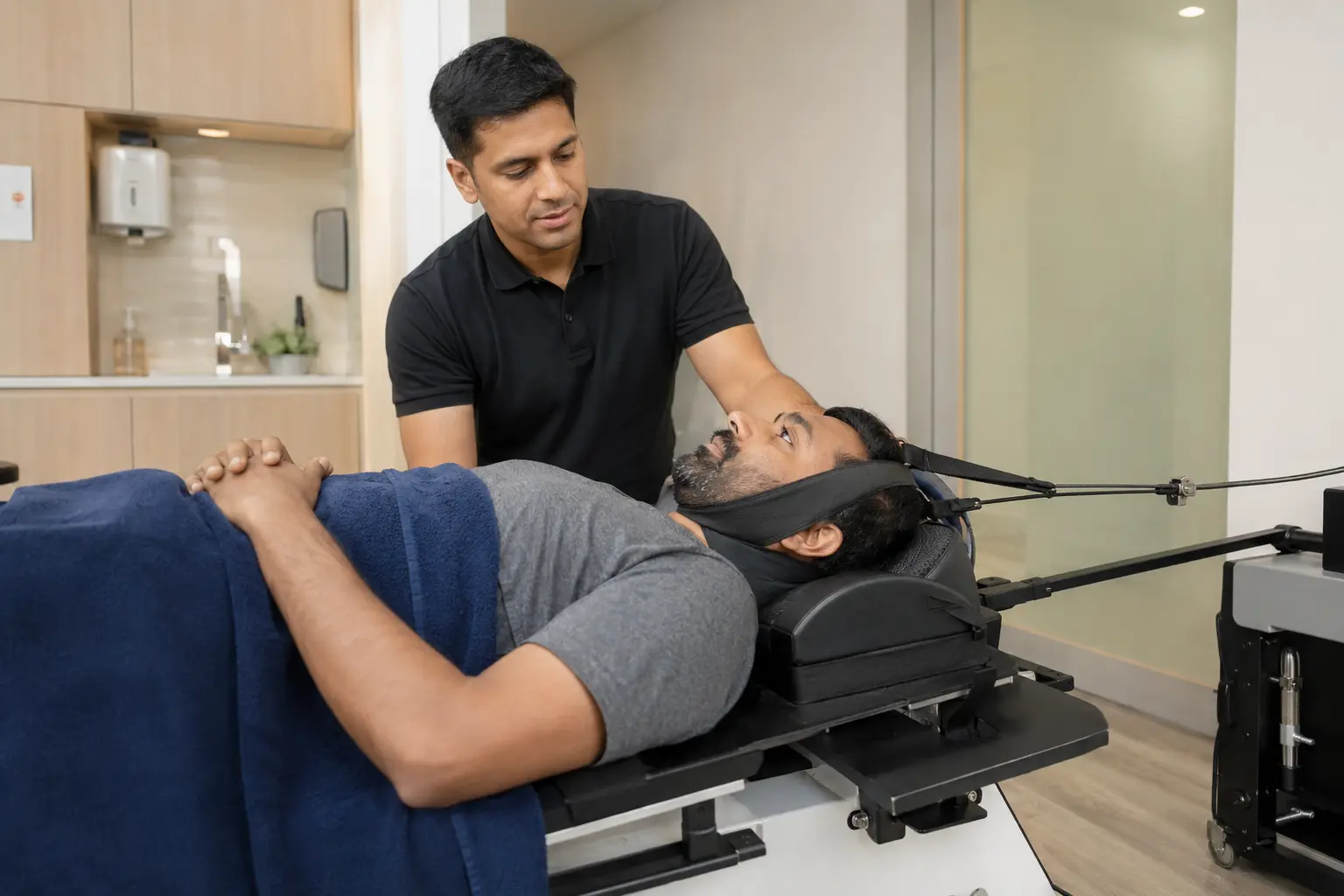
In most private clinics (chiropractic, physiotherapy, and pain clinics), “spinal decompression” refers to non-surgical, computer-controlled traction: a table or device that applies gentle, cyclic pulling forces to the neck to lower disc pressure and ease nerve irritation. You may see it branded as IDD Therapy or similar. It is marketed for cervical disc bulge or herniation, degenerative disc disease, nerve pain, and stubborn neck pain that has not settled with standard care.
This is completely different from surgical decompression (for example, anterior cervical discectomy and fusion, or ACDF), which is reserved for severe or progressive neurological problems and structural compression confirmed on imaging. This article is about the non-surgical kind.
The Distinction That Matters: Regular Traction vs Extension Traction
This is the part almost every “is decompression worth it?” article misses. When you do conventional cervical traction, the pull is roughly neutral: you are essentially stretching and straightening the neck to offload the discs and joints. It can feel great, and it can genuinely calm an irritated nerve for a while. But straightening is not the same as restoring the neck’s natural C-shaped curve. Take the traction away, and if the underlying curve and posture have not changed, the symptoms tend to drift back.
Extension traction is different by design. It uses an extension-biased pull, as part of a wider programme, specifically to rebuild the C2 to C7 lordotic curve, rather than just offload it for the afternoon. That structural difference is what the long-term studies keep pointing to.
| Approach | What it does | Effect on the curve | Typical durability |
|---|---|---|---|
| Regular / neutral traction | Gently pulls to offload discs and nerve roots and ease pressure | Straightens and offloads; does not restore lordosis | Temporary; relief often fades within months to about a year after stopping |
| Extension traction (curve restoration) | Extension-biased traction within a multimodal programme to rebuild the curve | Restores lordosis (12 to 18 degrees in controlled trials) | More durable; gains held up to 1.5 to 2 years, sometimes improving after stopping |
| Exercise / physiotherapy only | Active strengthening, mobility, and posture retraining | Limited direct change to the curve | Strong for muscular and postural pain, especially when habits change |
Patients who restored their neck curve kept improving for up to 2 years. Those treated without curve correction regressed.
In a 2-year randomised controlled trial of chronic cervical spondylotic radiculopathy with a flattened curve, adding cervical extension traction to standard rehab restored the lordosis and produced pain and nerve-function improvements that were maintained, and in some measures kept improving, at 2 years. The control group, treated with the same rehab but no curve correction, had short-term relief that then worsened by the 3-month and 2-year marks. The study also found an inverse correlation: more curve restored meant less pain.
What the Evidence Actually Says (2022 to 2026)
It helps to split neck pain into two groups, because the evidence differs.
1. Nerve-root pain (cervical radiculopathy)
This is pain that radiates into the arm or hand, often with tingling or numbness, from an irritated nerve root. Here, traction can help, but the details matter.
| Claim | Evidence | What it means for you |
|---|---|---|
| Traction eases radicular (nerve-root) pain short-term | Supported, short-term | Useful as part of a plan, but relief can fade after sessions stop |
| Regular traction beats exercise for most neck pain | Not shown | For posture-driven pain, exercise and ergonomics have stronger support |
| Extension traction restores cervical lordosis | Supported | 12 to 18 degree gains in controlled trials, in confirmed hypolordosis |
| Restoring the curve gives more durable relief | Supported, emerging | 2-year RCT: maintained or improving; control group regressed |
| Any traction cures neck pain on its own | Not proven | It is an adjunct; active rehab and ergonomics still matter |
A 2021 systematic review of 9 controlled trials (including 6 randomised trials) found that cervical extension traction produced 12 to 18 degrees of lordosis increase over 5 to 15 weeks, with 2 to 4 point pain reductions, and benefits maintained up to about 1.5 years. Comparison groups that did the same rehab without extension traction saw their gains regress toward baseline by around a year.
2. Posture-related neck pain (most desk workers)
If your pain is mainly from prolonged sitting, forward head posture, and muscle tension, with no nerve symptoms, the picture is different. For this common pattern, plain traction is not clearly better than good exercise-based physiotherapy, and any relief tends to be modest and temporary. Guidelines and recent reviews point to active, multimodal care (targeted strengthening, manual therapy, movement, and ergonomics) as the most reliable route. The exception is the desk worker who also has a documented loss of curve on X-ray, where curve-restoring care becomes relevant.

Honest caveat (this is why we say “emerging”)
Much of the strongest long-term curve-restoration research is led by Professor Ibrahim Moustafa, a Professor of Physical Therapy at the University of Sharjah, where he chairs research and supervises postgraduate physiotherapy students evaluating different treatments for efficacy and long-term effect. This is independent academic physiotherapy research, which strengthens its credibility. That said, the trials still tend to have modest sample sizes (roughly 15 to 60 per group), mostly in mid-aged adults, and use multimodal programmes, so the isolated effect of traction alone is hard to separate, and independent replication by other groups is still limited. The results are high-quality and consistent, but this specific approach is not yet standard in mainstream guidelines.
Who Is (and Isn’t) a Good Candidate
✓ More likely to benefit
- Confirmed or strongly suspected cervical radiculopathy (neck pain radiating into the arm with nerve signs).
- Disc bulge or herniation with nerve irritation, after red flags are excluded.
- A flattened or reversed neck curve (hypolordosis) confirmed on X-ray.
- Chronic, recurring pain that keeps returning despite stretches, massage, or short courses of neutral traction.
✗ Less likely to benefit
- Purely muscular or postural neck pain with no nerve symptoms and a normal curve.
- Long-standing pain driven mainly by central sensitisation without clear compression.
- Anyone expecting a permanent cure from decompression alone, without exercise and lifestyle change.
Safety and Realistic Expectations
Non-surgical cervical traction is generally safe for healthy adults when patients are properly screened and the force is dosed sensibly. Reported side effects are usually mild and short-lived, such as temporary soreness or a brief symptom flare. Serious events are rare in the literature, but screening is essential (for example, for instability, severe osteoporosis, myelopathy, or vascular concerns), which is another reason a proper assessment should come first.
Keep expectations grounded: expect short-term pain reduction during and after a course, no guarantee of long-term superiority over exercise-based care unless a lost curve is being corrected, and the best, most durable results when traction is combined with strengthening, mobility, and ergonomic change.
Seek urgent care first if
You have progressive weakness, hand clumsiness, unsteady walking, new bladder or bowel changes, or symptoms after significant trauma. These are red flags for something that needs urgent medical or surgical review, not traction.
A Practical Pathway for a Singapore Professional
- Screen for red flags firstProgressive weakness, hand clumsiness, gait or balance problems, or new bladder or bowel changes mean urgent medical review, not a traction table.
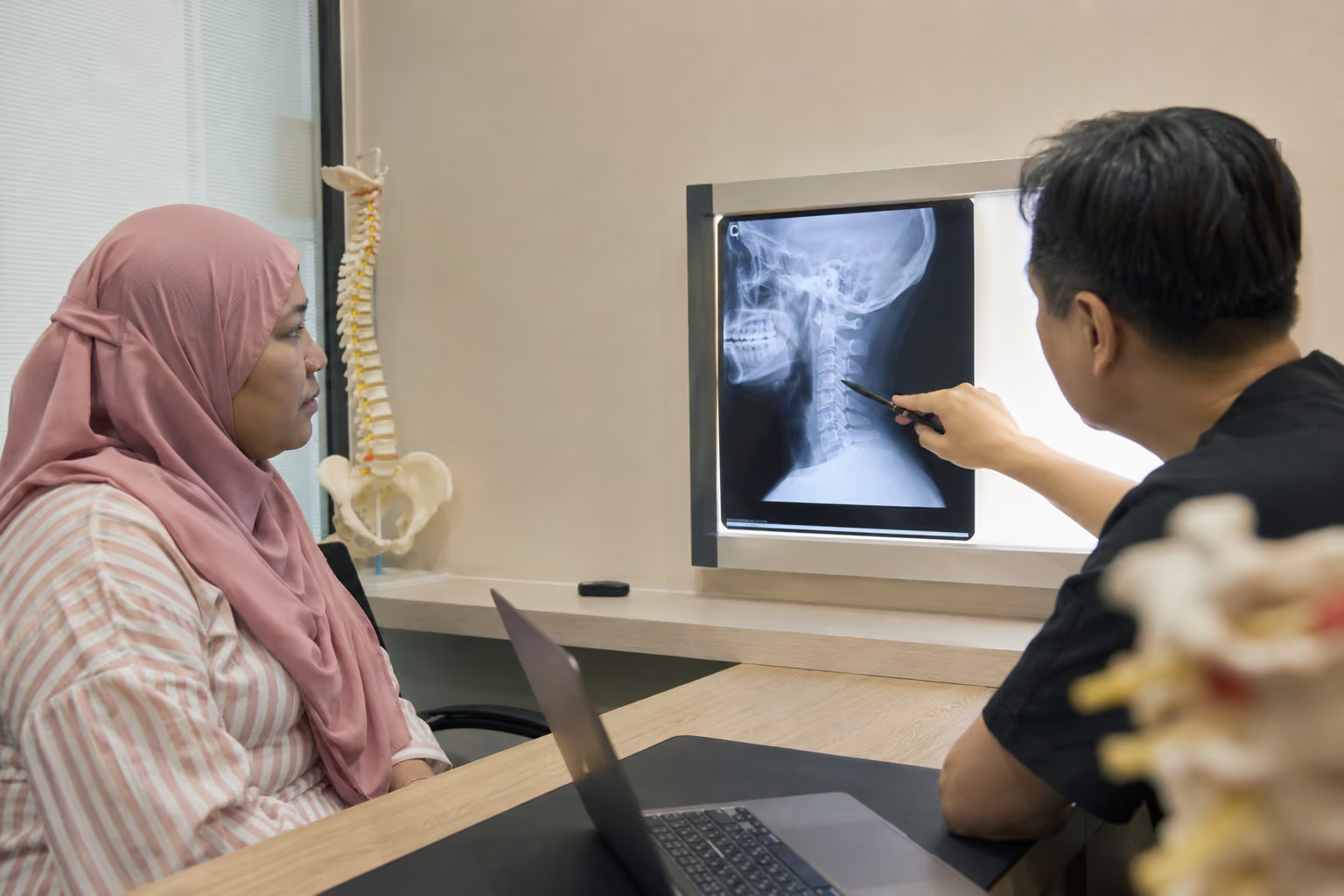
- Get a proper assessmentSeparate radicular (nerve-root) from non-radicular pain, and muscular from joint or disc-dominant patterns. For chronic or recurring pain, this is where an X-ray earns its place, because you cannot see a lost curve without one.
- Start with active, conservative carePhysiotherapy (manual therapy plus exercise), ergonomics (monitor height, chair, keyboard and mouse position, micro-breaks every 30 to 40 minutes), and a simple home programme (chin tucks, scapular squeezes, gentle mobility).
- Trial decompression or extension traction only if indicatedConsider it when radicular features persist despite 4 to 6 weeks of good rehab, or imaging shows nerve-root compression or a flattened curve and your clinician thinks traction may help.
- Re-evaluate after 4 to 6 sessionsContinue only if you see clear, meaningful improvement. If not, pivot: a different approach, a pain-specialist review, or a surgical opinion if indicated.

Where Structural Correction Fits at Dr Neck Pain
This is exactly the gap Dr Neck Pain is built around. Plain traction that only straightens the neck can offload it and buy you temporary relief, but for a neck that has lost its curve, the symptoms usually come back. Our R3NEW X™ protocol uses combined extension traction to restore cervical lordosis, not just offload it, and every phase is verified with X-ray, so you can see whether the curve is actually changing rather than hoping it is. That imaging-first, curve-restoration approach is precisely the model the durable studies describe. It is paid privately or through corporate benefits (non-MOH), and it is only the right tool if your X-ray shows a lost curve, which is why we assess before we treat.
Frequently Asked Questions
Is spinal decompression the same as surgery?
No. In private clinics, “spinal decompression” means non-surgical, computer-controlled traction. Surgical decompression (such as ACDF) is a hospital operation reserved for severe or progressive nerve compression confirmed on imaging. This article is about the non-surgical kind.
Does spinal decompression actually work for neck pain?
It depends on the type of pain. For nerve-root pain (radiculopathy), it can give real short-term relief for some people as part of a wider plan. For ordinary posture-driven desk-neck pain with no nerve symptoms, plain traction is not a stand-alone solution, and exercise plus ergonomics has stronger, more durable evidence.
What is the difference between regular traction and extension traction?
Regular traction straightens and offloads the neck; extension traction is designed to restore its natural curve. That structural difference matters: studies link curve restoration (not just offloading) to more durable pain and nerve-function improvement in people with a confirmed flattened curve.
How long do the results last?
Regular traction relief often fades within months to about a year after you stop. Extension traction that restores the curve has shown benefits maintained, and sometimes still improving, up to 1.5 to 2 years in controlled trials, with the best durability when some maintenance and home exercise continue.
Do I need an X-ray before decompression?
For chronic or recurring pain, yes. You cannot tell whether your neck has lost its natural curve (hypolordosis) without imaging, and that is exactly what determines whether curve-restoring care is right for you. Treating long-standing neck pain without looking first is guessing.
Is cervical decompression safe?
Generally yes for healthy adults, when properly screened. Side effects are usually mild and temporary, such as short-lived soreness. Screening matters (for instability, severe osteoporosis, myelopathy, or vascular issues), and red-flag symptoms need urgent medical review before any traction.
Your Next Step
If your neck pain is recent and muscular, active physiotherapy and ergonomic changes are the sensible first move. But if it keeps returning, radiates into your arm, or has not settled despite months of stretches and short traction courses, the question worth answering is whether your neck has lost its curve. An X-ray-guided assessment tells you that, and whether curve-restoring correction is actually the right fit for your case, rather than another round of temporary relief.
Is your neck pain structural, or just being offloaded?
Find out whether your cervical curve has flattened, and whether X-ray-guided extension-traction correction (R3NEW X™) is right for you. Direct booking, no referral needed.
Book on WhatsAppReferences
- Moustafa IM, Diab AA, Harrison DE. The Efficacy of Cervical Lordosis Rehabilitation for Nerve Root Function and Pain in Cervical Spondylotic Radiculopathy: A Randomized Trial with 2-Year Follow-Up. J Clin Med. 2022;11(21):6515. PubMed
- Oakley PA, Ehsani NN, Moustafa IM, Harrison DE. Restoring cervical lordosis by cervical extension traction methods in the treatment of cervical spine disorders: a systematic review of controlled trials. J Phys Ther Sci. 2021;33(10):784–794. PubMed
Related reading
This article is educational information only and is not medical advice, diagnosis, or a treatment recommendation. Research on cervical traction is evolving and much of the curve-restoration evidence comes from a specialised research network; individual results vary. Confirm any treatment decision with a qualified clinician. If you have red-flag symptoms, seek urgent medical assessment.