


That 3pm headache creeping up your neck and into your temples is not random. Tilt your head toward the screen and the load on your neck can climb from about 5 kg upright to nearly 27 kg at a steep forward angle. Here is what actually stops the cycle.
If a headache builds through your workday and peaks by mid-afternoon, it is rarely random. For most desk workers, the trigger sits in the neck and shoulders, loaded by hours of screen posture, and it is largely preventable once you understand what is driving it.
This guide explains why desk work causes tension headaches, the specific triggers to look for, and how to prevent them for the long term. If you have already got the headache and want the exercise routine to ease it, we cover that in a separate neck-strengthening guide.
Key takeaways
- Most desk headaches are neck-driven. Sustained forward head posture overloads the muscles at the base of the skull, which refer pain up into the head.
- Know the type. Tension-type headache and migraine are primary headaches; a cervicogenic headache is a secondary headache caused by the neck. Neck pain can feature in all of them.
- Posture is measurable. Forward head posture is captured by the craniovertebral angle (a CVA below about 50 degrees), and modelled load estimates rise from about 5 kg upright to roughly 27 kg at a steep forward tilt.
- Prevention is mostly mechanical. Screen height, movement breaks, and strengthening prevent far more headaches than painkillers manage.
- If they persist, look deeper. Headaches that keep returning despite good habits can be structural, and that needs assessment, not more paracetamol.
First, Name the Headache: Primary vs Secondary
Headache specialists split headaches into two groups, and knowing which you have shapes what actually helps. Primary headaches are conditions in their own right; secondary headaches are a symptom of something else.
| Headache | Category | Typical pattern |
|---|---|---|
| Tension-type headache | Primary (the most common; about 30% of people in a year) | Dull, tight, band-like pressure, often both sides; linked to stress and sustained muscle tension |
| Migraine | Primary (about 15%) | Throbbing, often one-sided, with nausea or light and sound sensitivity; individual triggers |
| Cervicogenic headache | Secondary (caused by the neck) | Starts in the neck or base of the skull, usually one side, brought on by neck posture, movement, or pressure |
Here is the honest complication: neck pain is common in all three, and headache authorities note that the border between cervicogenic headache, jaw-related headache, and tension-type headache is not sharply defined. For desk workers, the practical point is that a large share of "tension" headaches have a genuine neck-and-posture component, which is exactly why addressing the neck helps so many of them. If you have clear migraine features (throbbing, one-sided, nausea, aura), see a doctor for migraine-specific care, as neck work alone will not be the whole answer.
Why Desk Work Specifically Triggers Headaches
Your head weighs roughly 5 kg, about the weight of a bowling ball. When your spine holds its natural curve, your skeleton carries that weight efficiently. When you lean toward a screen, the head drifts forward, and the muscles at the back of the neck (the suboccipitals and upper trapezius) have to work much harder to stop it dropping. Modelled estimates suggest the effective load rises steeply with the angle: around 12 kg at 15 degrees of forward tilt, and roughly 27 kg at 60 degrees. These are biomechanical estimates, not exact measurements, but the trend is clear, small angles, big loads.
Clinicians measure this drift with the craniovertebral angle (CVA), the angle formed between the base of the neck and the ear. A healthy, upright neck sits at roughly 50 degrees or more; as the head slides forward, the CVA drops, and a CVA below about 50 degrees is the common marker for forward head posture. It is a useful number because it makes posture concrete rather than vague. In a 2025 cross-sectional study of neck-pain patients with forward head posture, about 54% had a cervicogenic headache, and a smaller CVA came out as an independent predictor of it (each degree of lower angle raised the odds), alongside factors like poor sleep. This is a correlation, not proof that a forward head directly causes the headache, but the pattern is consistent: a more forward head tends to mean higher headache odds. In other words, your posture is not just a feeling. It is a measurable angle, and the number tracks with the headache.

Two things then happen. The overworked muscles at the base of the skull develop tension and trigger points that refer pain up and over the head, the classic desk headache. And the deep neck flexors at the front, which should help hold the head up efficiently, switch off and weaken. The longer this runs, the more the head settles into forward head posture, and the more the neck and shoulder muscles guard and ache. That is the loop behind recurring neck and shoulder pain with headaches.
The Full List of Desk Triggers
Rarely is there just one cause. Most desk headaches are a stack of small daily loads. Recognising yours is the first step to preventing them.
| Trigger | How it feeds the headache |
|---|---|
| Low screen or laptop use | Forces the head and chin down, driving forward head posture and base-of-skull overload |
| Sustained static posture | Holding one position for 60 to 90 minutes fatigues the postural muscles into guarding |
| Stress and jaw clenching | Tightens the jaw, temples, and neck; a major contributor to tension-type headache |
| Eye strain and screen glare | Squinting and leaning toward the screen pull the head forward and tense the forehead |
| Dehydration and skipped meals | Common, under-recognised headache triggers during long work stretches |
| Poor or short sleep | Lowers your pain threshold and is strongly linked with chronic tension-type headache |
| Frequent painkiller use | Taking pain relief on many days can cause a medication-overuse (rebound) headache |
The Hidden Drivers Most Articles Miss
Posture and muscle strain explain most desk headaches, but three less-obvious factors decide why some become stubborn. They are worth knowing, because they change what actually works.
The jaw connection (TMJ)
Your jaw and neck share muscles and nerves, so a forward head changes how the jaw loads too. The 2025 to 2026 evidence here is genuinely growing: people with temporomandibular disorder (TMD) show forward head posture far more often than those without it (in one 2025 study, roughly 58% versus 25%), and different head-and-neck postures measurably change the activity of the chewing muscles. There is even a small pilot trial suggesting that correcting forward head posture can improve jaw-pain outcomes in the short term, though the authors call it preliminary and a larger trial is still under way. The honest summary: people with forward head posture are more likely to have TMD symptoms, and early trials suggest correcting the posture may ease jaw pain short term, not that fixing posture cures TMJ. If your headaches come with jaw ache, clicking, or clenching, the jaw and neck are likely feeding each other, and treating only one can leave the other driving the pain.
Central sensitisation: when the volume gets turned up
When posture strain and workplace stress persist, the nervous system can become more sensitive to pain, a process called central sensitisation. The evidence differs by headache type. In desk workers with migraine, a 2026 study found that higher central-sensitisation scores went hand in hand with more work stress and more widespread musculoskeletal pain, with the highest scores in chronic migraine. In tension-type headache, research describes a continuum: occasional (episodic) tension headaches are driven more by the muscles themselves, while chronic, frequent tension headaches increasingly involve central sensitisation, where the nervous system amplifies pain signals coming from the neck and shoulder muscles. The practical takeaway is the same: once a desk headache has become frequent and long-standing, it can feel out of proportion to the strain, and calming the system usually needs consistent movement, better sleep, and stress management, not just a stronger painkiller.
Proprioception: your neck's position sense
The neck is packed with tiny position sensors that tell your brain where your head is in space (joint position sense). A 2025 systematic review found that forward head posture is linked to poorer cervical proprioception, and that exercise-based training can improve it along with postural control. The direct link to headaches is more indirect, it works through the neck-pain and cervicogenic pathway, but the practical point holds: retraining position sense may help reduce the muscle overactivity that feeds into headaches. That is why good rehabilitation trains control, not just raw strength, and it is a hidden purpose of slow, precise chin nods and movement-control drills. "Just strengthen your neck" is only half the picture.
How to Prevent Desk Headaches for the Long Term
Prevention beats management, and most of it is mechanical. You are aiming to reduce the daily load on your neck and raise its capacity to handle a workday.
1. Fix the setup (the biggest single lever)
Raise your screen so you look straight ahead at its centre with your head level, not tilted down. Keep the keyboard and mouse close, support your lower back, and plant your feet flat. On a laptop, use an external keyboard and a laptop stand so the screen comes up to eye level. Our full ergonomic workstation guide has the exact measurements.
2. Break the static load
Sustained posture is the enemy. Move every 20 to 30 minutes, even for 30 seconds. Use the 20-20-20 rule to protect the eyes and upper neck: every 20 minutes, look about 20 feet away for 20 seconds and gently reset your head and shoulders. Micro-breaks prevent the guarding that a "perfect" posture held for hours cannot.
3. Build capacity (the missing piece)
Stronger neck and shoulder muscles mean the same desk posture is a smaller share of their capacity, so less fatigue and fewer headaches. A short, progressive strengthening routine (deep neck flexor and postural work) is the highest-value long-term step. We lay out the full research-backed routine in our neck-strengthening guide.
4. Manage the non-posture triggers
Sip water through the day and do not skip meals. Protect your sleep. Reduce screen glare and get your eyes checked if you squint. Notice jaw clenching under stress, and see a dentist if you grind. And track how many days a week you take painkillers, if it is often, speak to a doctor about rebound headache.
Your daily prevention checklist
Screen centre at eye level · external keyboard on a laptop · move every 20 to 30 minutes · 20-20-20 for the eyes · water within reach · a short strengthening routine most days · notice the jaw when stressed. Small, consistent habits prevent far more headaches than any single fix.
When Prevention Is Not Enough: The Structural Angle
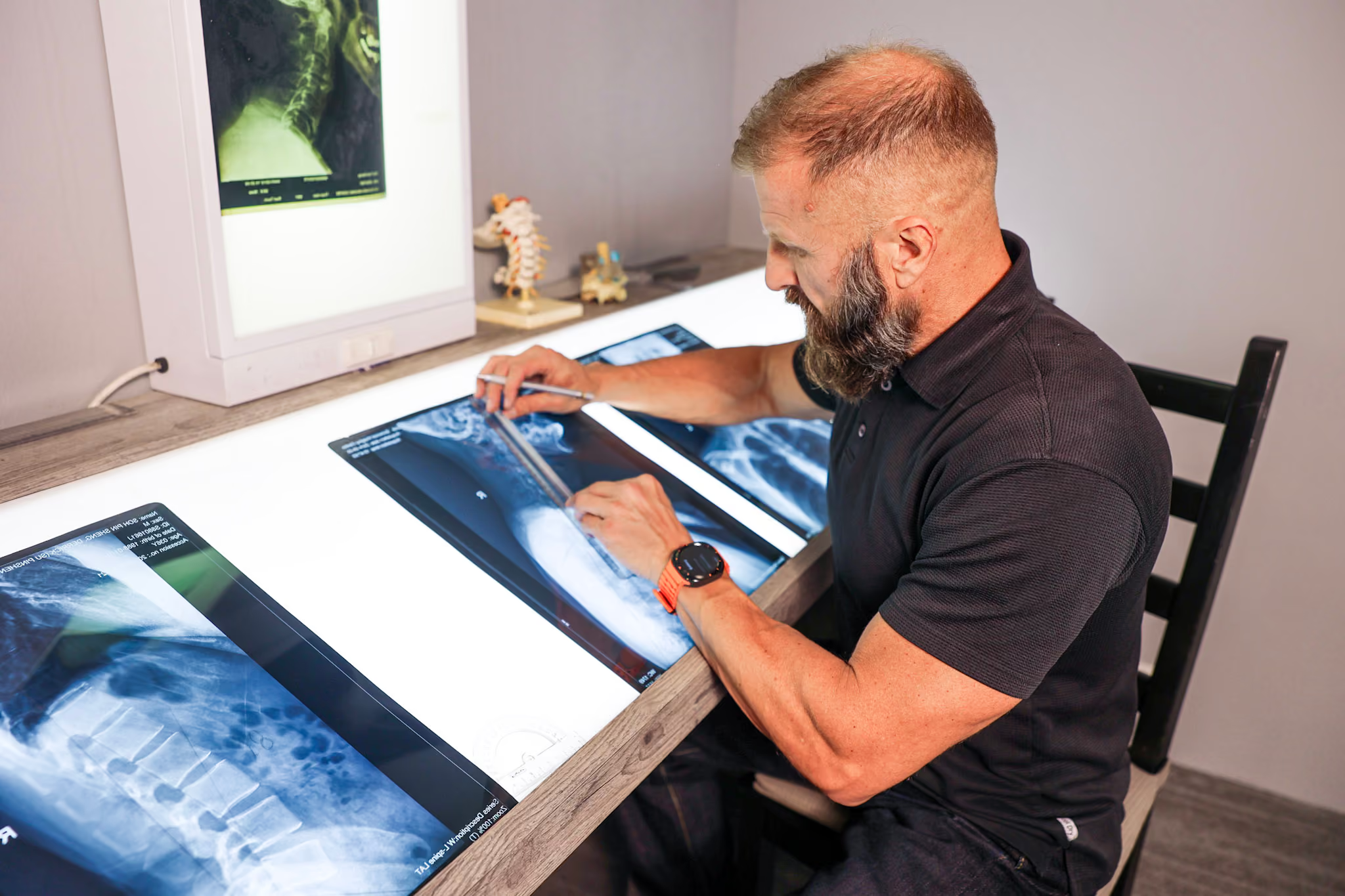
Good habits prevent most desk headaches. But some resist every ergonomic fix and every exercise, and there is a measurable reason. Remember that posture is not just a feeling, it is an angle: the craniovertebral angle described earlier, and the shape of the cervical curve seen on X-ray. In long-standing cases these have genuinely changed, so the muscles end up working around an altered structure and keep overloading no matter how strong they get or how carefully you sit on a given day.
That is the ceiling prevention and exercise eventually hit. Once your posture angle has shifted, more reps and more reminders can only do so much. The useful question stops being "which stretch?" and becomes "what are my craniovertebral angle and cervical curve actually measuring?", and you cannot answer that by feel. Dr Neck Pain uses X-ray-guided assessment to quantify the cervical curve objectively and, where appropriate, works to restore it rather than only easing the tension around it. It is a targeted step for chronic, recurring, posture-driven cases where imaging shows a real structural change, and always after red-flag screening. See whether posture correction relieves desk-worker neck pain for the evidence behind it.
When a headache is not a desk problem: see a doctor
Most desk headaches are benign, but some need prompt medical attention, not ergonomics. Seek urgent care if a headache:
- Comes on suddenly and severely (the "worst headache of my life")
- Follows a head or neck injury
- Comes with fever, a stiff neck, or a rash
- Comes with weakness, numbness, vision loss, confusion, or slurred speech
- Is new or different after age 50, or steadily worsening over days to weeks
- Comes with pain or numbness travelling down the arm
Frequently Asked Questions
Why do I get a headache at my desk every afternoon?
Because the load on your neck builds through the day. Hours of forward head posture keep the muscles at the base of the skull contracting, and by mid-afternoon they are fatigued enough to refer pain into the head. Raising your screen and taking movement breaks earlier in the day usually blunts the afternoon peak.
Can bad posture really cause headaches?
Yes. Sustained forward head posture is a well-recognised driver of tension-type and cervicogenic headaches. The further the head sits forward, the harder the neck muscles work, and modelled estimates put the load at roughly 27 kg at 60 degrees of tilt. Over a workday that overload refers pain into the head. Correcting posture and screen height addresses the cause, not just the symptom.
Is my headache from my neck, stress, or a migraine?
Neck-driven headaches usually start at the base of the skull and worsen with posture; stress headaches feel like a band around the head; migraines are often one-sided and throbbing with nausea. Many people have a mix. If the pattern is clearly posture-linked, desk and neck changes help most. If it looks like migraine, see a doctor for migraine-specific care.
Why do I get headaches from looking at the computer screen?
It is usually a combination of the head drifting forward and eye strain, not the screen itself. A low screen pulls the head down; glare and small text make you squint and lean in. Both tense the neck and forehead. Raising the screen to eye level, reducing glare, and using the 20-20-20 rule address most screen-linked headaches.
How can I prevent tension headaches from work?
Fix the setup, move regularly, and build neck strength. Get your screen to eye level, move every 20 to 30 minutes, use the 20-20-20 rule, stay hydrated, protect your sleep, and do a short strengthening routine most days. These habits prevent far more headaches than painkillers manage. If they still return, the cause may be structural.
Do posture correctors or taping actually work for desk neck pain and headaches?
They can give short-term relief and a useful reminder to stay aligned, especially when combined with exercise, but on their own they have not been shown to fix posture or stop headaches long term. Recent 2025 trials found that posture-correction taping produced immediate improvements in pain and neck movement, and that adding a neck brace to a strengthening programme reduced muscle stiffness and headache scores more than exercise alone. But reviews of posture braces show the postural gains largely last only while you are wearing them, with thin long-term evidence. Treat taping or a brace as a helpful adjunct alongside strengthening and better ergonomics, not as a standalone cure.
Why do my tension headaches keep coming back after a massage?
Massage relaxes overworked muscles and feels great, but it does not build the capacity or change the posture that keeps overloading them. Within a day or two back at the desk, the same muscles tighten again and the headache returns. Lasting relief needs stronger, better-coordinated muscles, an improved setup, and, if it keeps recurring, an assessment of the structure driving it, not just another round of relief.
Can neck problems cause headaches every day?
Yes. A neck that stays in a poor position all day can drive frequent, even daily, headaches. When forward head posture and a flattened neck curve keep the muscles overloaded, the headaches recur predictably. Daily headaches also warrant a medical review to rule out other causes, including medication-overuse headache if you take pain relief often.
Your Next Step
If your headaches follow your desk day, start with prevention: raise the screen, move often, build a little neck strength, and manage the non-posture triggers. That resolves a large share of desk headaches. If you have done all that and they still return, you may have hit the structural ceiling, and the next step is to measure your cervical alignment rather than reach for another painkiller.
Headaches that keep coming back despite good habits?
If prevention and exercise have not stopped your desk headaches, a flattened cervical curve may be the reason. Find out with an X-ray-guided assessment whether structural correction is the right next step, X-rays currently covered under our promotion.
Book a structural neck assessmentReferences
- International Classification of Headache Disorders, 3rd edition (ICHD-3): primary vs secondary headaches; cervicogenic headache as a secondary headache. ICHD-3
- Tension-type headache prevalence (about 30% one-year) and migraine (about 15%). PMC
- Singapore General Hospital. Tech neck: posture load, coping tips, and micro-breaks. HealthXchange (SingHealth)
- Singapore General Hospital / SingHealth. Musculoskeletal Disorders and Office Ergonomics (324 office-worker respondents). SingHealth
- Cervicogenic headache in forward head posture: frequency and associated factors (craniovertebral angle and headache burden). J Oral Facial Pain Headache. 2025. PubMed
- Interaction between pain, disability, mechanosensitivity and cranio-cervical angle in cervicogenic headache (central sensitisation). PMC
- Cervical proprioception impairment in neck pain: pathophysiology, evaluation and management (narrative review). Pain Ther. 2021. PMC
- Neck brace added to sling exercise for forward head posture: randomised controlled trial (2025). PubMed
- Forward head posture, cervical proprioception and exercise: systematic review (2025). PubMed
- Central sensitisation, work stress and musculoskeletal pain in desk-based workers with migraine (2026). PMC
- Temporomandibular disorder, forward head posture and craniovertebral angle: association study (2025). PubMed
- Effect of head and neck posture on masticatory muscle activity in myogenic TMD (EMG study, 2025). PubMed
Related reading
This article is educational information only and is not medical advice or a diagnosis. Load figures are modelled estimates, not exact measurements. Most desk headaches are benign and improve with posture, movement, and exercise; imaging and structural correction are appropriate only in selected cases. If you have a sudden severe headache, a headache after injury, or a headache with fever, neurological symptoms, vision loss, or confusion, seek urgent medical care.