

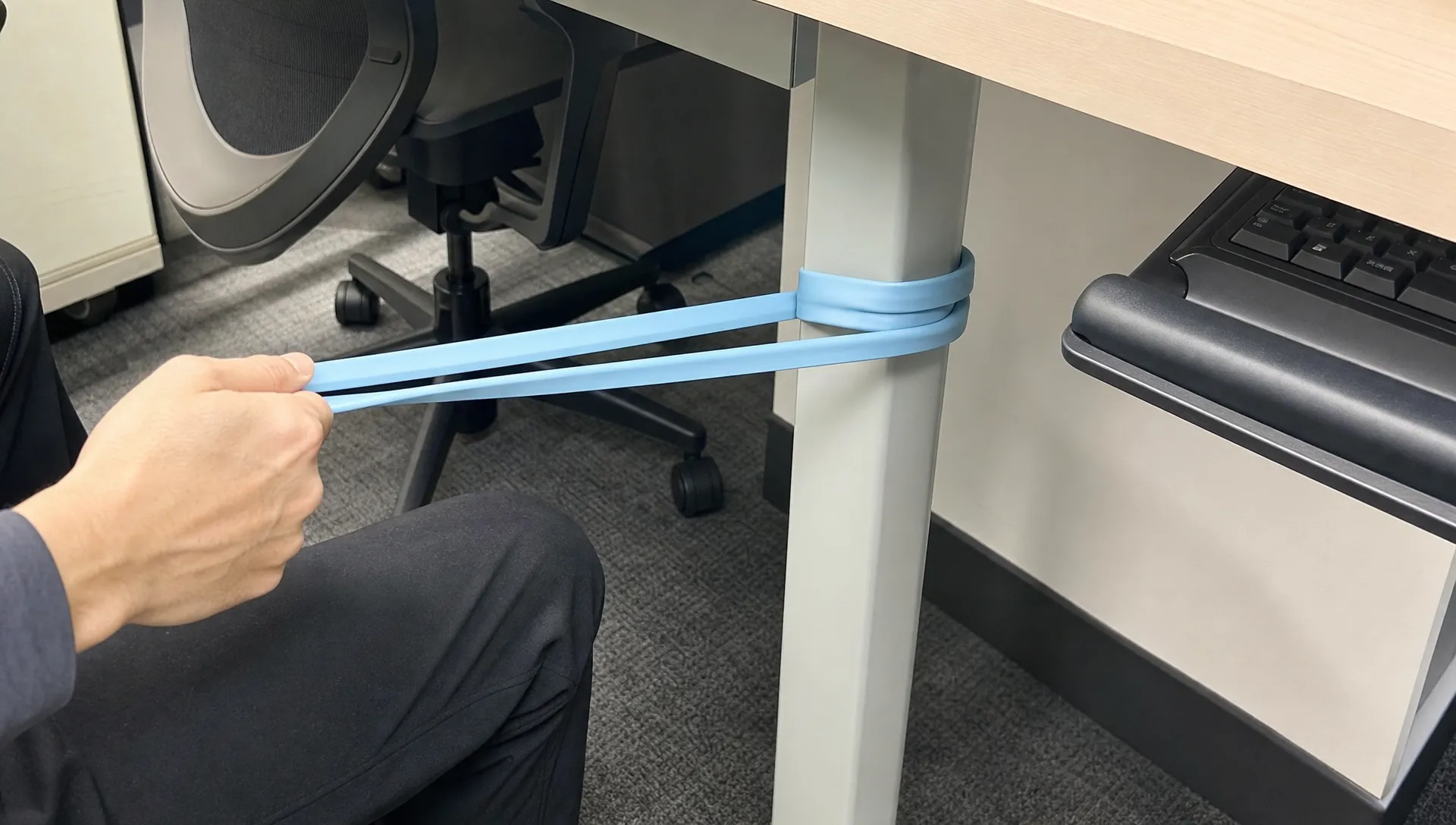
If you get a dull headache that creeps up from the base of your skull by mid-afternoon at your desk, the cause is often not your head at all. It is your neck. And the fix that actually holds is not more stretching, it is targeted strengthening.
This is the evidence-based routine for neck-driven (cervicogenic) and tension-type headaches in Singapore desk workers: a 2-minute daily protocol you can do at your desk, how to tell a neck headache from a migraine, and when the problem has become structural and needs more than exercises.
Key takeaways
- Many desk headaches start in the neck. Weak deep neck flexors and a forward head make the muscles at the base of the skull overwork, referring pain into the head.
- Strengthening beats stretching. Stretching eases tightness for an hour; specific neck strengthening is what the research shows reduces headache frequency and intensity.
- The evidence is strong for neck-related headache, not migraine. Neck exercise helps cervicogenic and tension-type headaches; for true migraine, the evidence is weaker.
- Give it about 6 weeks. Consistency matters more than intensity; results build over weeks, not days.
- If exercises stall, it may be structural. A flattened cervical curve can keep the muscles overloaded no matter how much you train, and that needs assessment, not more reps.
Why Your Desk Gives You Headaches
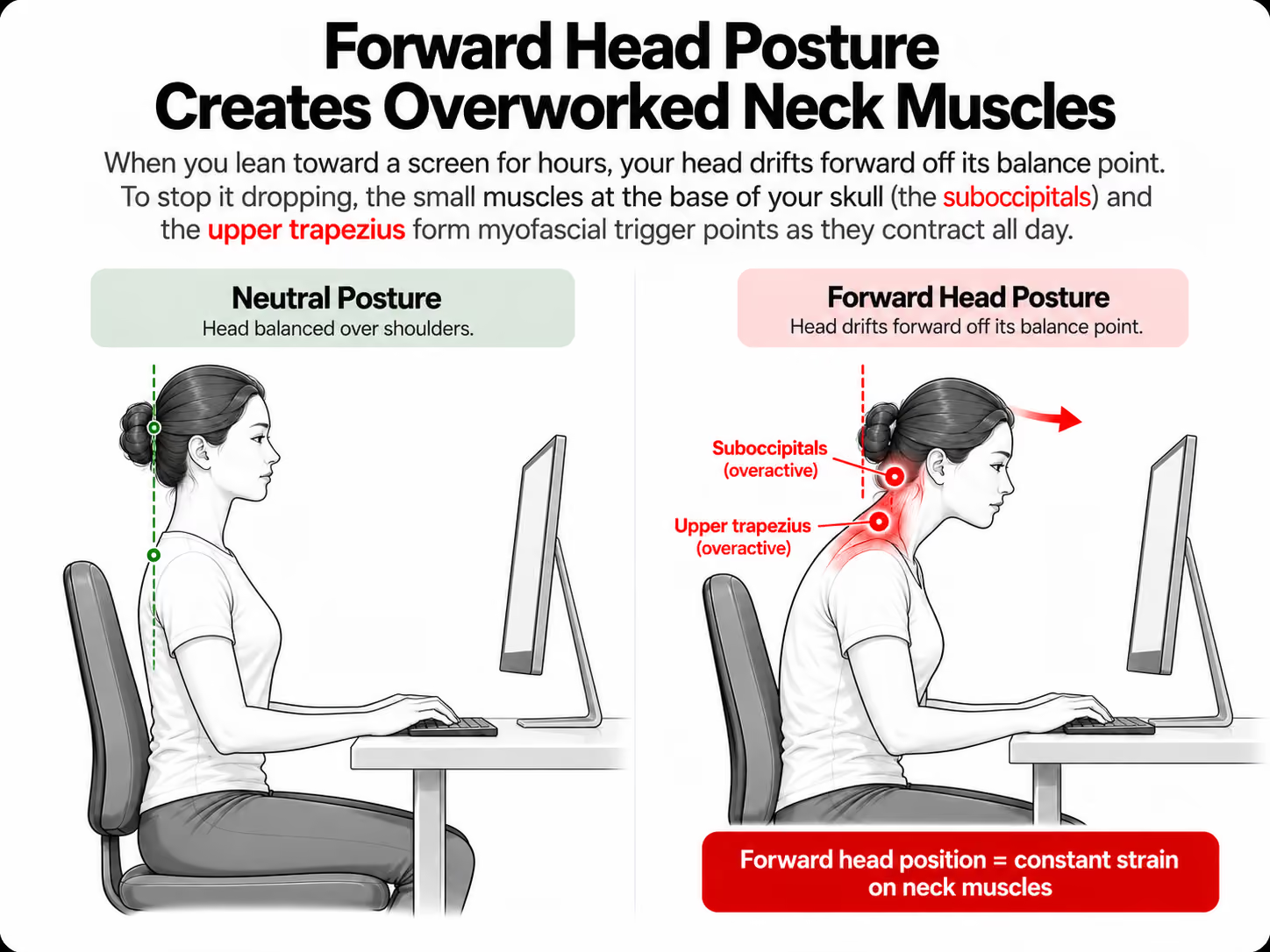
When you lean toward a screen for hours, your head drifts forward off its balance point. To stop it dropping, the small muscles at the base of your skull (the suboccipitals) and the upper trapezius form myofascial trigger points as they contract all day. Meanwhile the deep neck flexors at the front, the muscles that should hold your head up efficiently, switch off and weaken. The result is a classic pattern of neck and shoulder tension: tight, overworked muscles at the back of the neck that refer a dull, band-like ache up into the head. Clinicians call this a cervicogenic headache, and it overlaps heavily with tension-type headache. It tends to start at the base of the skull, sit on one side, and worsen the longer you sit (a core feature of office syndrome). For the full picture of what causes these headaches, including the newer research on the craniovertebral angle, the jaw, and pain sensitivity, see our guide to why desk workers get tension headaches.
Why Strengthening Beats Stretching Alone
Almost everyone with a desk headache tries the same thing: stretch the neck, roll the shoulders, maybe a massage on Saturday. Stretching can reduce the sensation of tightness for a short period, but it does not necessarily increase your neck's ability to tolerate a workday. Many desk workers stretch the same tight upper trapezius daily, feel temporary relief, then get the same afternoon headache.
That happens because the muscle is usually tight for a reason. It may be compensating for weak scapular stabilisers, poor deep neck flexor coordination, or a forward head position that increases the workload on the back of the neck. Stretch the symptom and you leave the cause in place.
Strength training changes the equation. When the neck and shoulder muscles get stronger, the same desk posture represents a smaller percentage of their total capacity. Less relative effort means less fatigue, less protective guarding, and less tenderness by the end of the day. Coordination work adds the missing control: the deep neck flexors help guide the head and upper neck, but they often underperform in people with chronic neck pain. The chin nod trains them without overloading the superficial front muscles, restoring a better balance between the front and back of the neck.
Where manual therapy, chiropractic care and massage fit
Hands-on care (manual therapy, chiropractic, massage) can genuinely help, especially when pain is high, movement feels blocked, or trigger points are active. The limitation is that passive care alone does not usually build the muscular capacity needed to prevent recurrence. A sensible clinical sequence is to reduce pain and guarding first, then use strengthening and posture retraining to make it stick. Hands-on work might help you turn your neck more comfortably; progressive resistance training then teaches the neck and shoulders to handle a full workday with less irritation. This is also why comparing treatment types in isolation can mislead. The better question is whether a plan includes assessment, symptom relief, strengthening, posture retraining, and maintenance. If you are weighing local options, our comparison of chiropractic and physiotherapy for office-syndrome neck pain explains where each tends to fit.
What the Research Actually Shows
This is not a hunch. Specific neck exercise has some of the better evidence in headache care.
In one randomised trial, 76% of the neck-exercise group cut their headache frequency by at least half, versus 29% of controls.
In the same trial, headache intensity fell by about 52% with exercise, compared with 25% in the control group. Separately, a landmark 200-patient randomised trial found that specific neck exercise significantly reduced cervicogenic headache frequency, intensity, and neck pain, with benefits sustained at 12 months.
The exact protocol from the research
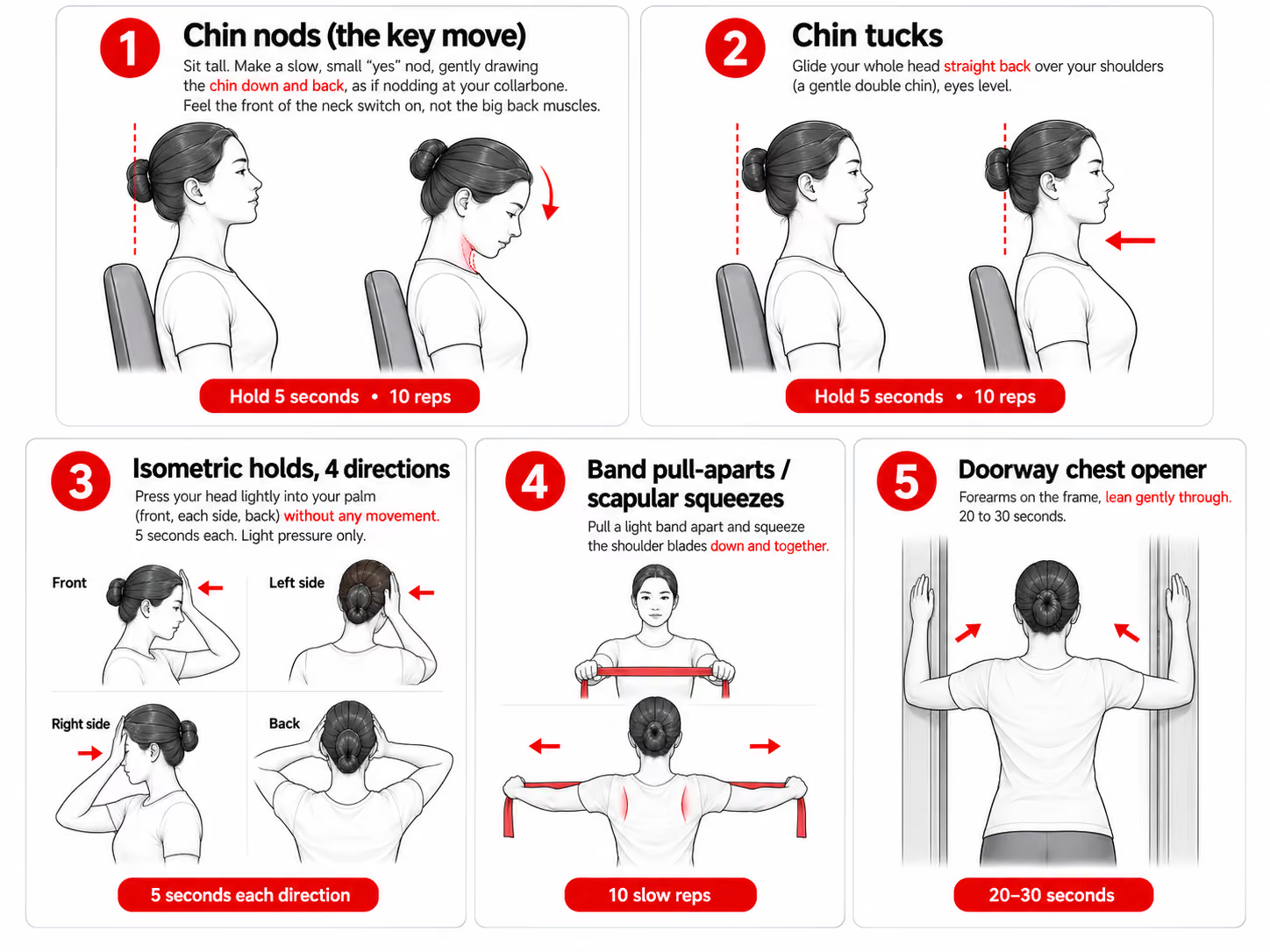
The Deep-Flexor Headache Routine
Craniocervical flexor training, the method behind those numbers. About 2 minutes.
- Chin nods (the key move). Sit tall. Make a slow, small "yes" nod, gently drawing the chin down and back, as if nodding at your collarbone. Feel the front of the neck switch on, not the big back muscles. Hold 5 seconds. 10 reps.
- Chin tucks. Glide your whole head straight back over your shoulders (a gentle double chin), eyes level. Hold 5 seconds. 10 reps.
- Isometric holds, 4 directions. Press your head lightly into your palm (front, each side, back) without any movement. 5 seconds each. Light pressure only.
- Band pull-aparts / scapular squeezes. Pull a light band apart and squeeze the shoulder blades down and together. 10 slow reps.
- Doorway chest opener. Forearms on the frame, lean gently through. 20 to 30 seconds.
Dose: once or twice daily, every day, for 6 weeks. Gentle and slow, never into sharp pain. Consistency beats intensity.
One honest caveat. This evidence is strongest for cervicogenic and tension-type headaches, the neck-driven kind. For diagnosed migraine, the picture is weaker: at least one randomised trial found craniocervical strengthening was not enough on its own to reduce migraine frequency. So neck exercise is a high-value first move for a neck-pattern headache, but it is not a migraine cure. Knowing which one you have matters, which is why the "neck headache or migraine?" section below is worth reading.
Keep the Full Routine: Download the Guide
The card above has the exact protocol. If you want a version you can keep, print, and stick by your monitor, with photos of each movement, the common mistakes to avoid, and a simple 6-week tracker, download the full guide.
Free download
The Desk Headache Fix: your printable 6-week neck-strengthening guide. It walks through each exercise with cues, shows the chin-nod technique most people get wrong, and gives you a tick-box tracker so you can see your progress week by week. Message us and we will send it over, no cost.
A quick reminder on form: the routine only works if the chin nod is done correctly (front of the neck switching on, not the big back muscles) and if you pair it with an eye-level screen and micro-breaks. The exercises undo the load; the ergonomics stop you re-loading it. If you are unsure whether you are doing it right, the guide shows you, or just ask us.
The Minimum Effective Daily Routine
You do not need a 45-minute gym session to start preventing desk-related tension headaches. The research-backed starting point is short, specific, and progressive. Aim for about 2 minutes per day, 5 days per week. Use a light resistance band at first, then increase the load or difficulty every 1 to 2 weeks if symptoms stay controlled.
| Exercise | Dose | Key cue | Why it helps |
|---|---|---|---|
| Band row | 1 set of 10 to 15 reps | Keep elbows close to your ribs and gently squeeze the shoulder blades back | Builds upper-back support for the neck |
| Band lateral raise | 1 set of 10 to 15 reps | Lift only to a comfortable height and avoid shrugging hard | Trains shoulder and upper-trapezius capacity |
| Isometric neck press | 5 holds of 5 to 10 seconds, each direction | Press your head gently into your hand without moving the neck | Builds neck strength safely in multiple directions |
| Chin nod (lying down) | 10 holds of 10 seconds | Make a small "yes" nod without lifting the head | Retrains deep neck flexor coordination |
Get the chin nod right
The chin nod is often misunderstood. It is not a forceful chin tuck. It should feel small and precise, with minimal activity in the front superficial neck muscles. If you feel your jaw clench or the large neck muscles bulge, reduce the effort.
To progress the strengthening work, change one variable at a time: use a slightly heavier band, add 2 to 3 repetitions, or slow down the lowering phase. The programme must become gradually more challenging, because the goal is to increase the neck and shoulder's capacity, not just to repeat an easy movement.
Neck Headache or Migraine? How to Tell
They need different plans, so it helps to know which pattern fits you. This is a guide, not a diagnosis.
| Feature | Cervicogenic / tension (neck-driven) | Migraine |
|---|---|---|
| Where it starts | Base of the skull or neck, spreading up and over | Often one side of the head, around or behind the eye |
| What brings it on | Long desk sessions, sustained posture, neck movement or pressure | Triggers such as light, sleep changes, hormones, certain foods |
| Character | Dull, tight, band-like; steady ache | Throbbing or pulsing; often moderate to severe |
| Company it keeps | Neck stiffness, tight shoulders, reduced neck turning | Nausea, light or sound sensitivity, sometimes visual aura |
| What tends to help | Posture change, neck strengthening, addressing the neck | Migraine-specific management and triggers, guided by a doctor |
Many people have a mix of both, and a neck problem can also trigger or worsen migraines. If your pattern is clearly neck-driven, the routine above is a strong first step. If it looks like migraine, see a doctor for migraine-specific care; neck work may still help the neck component, but it is not the whole answer.
When a headache is not a neck problem: see a doctor
Most desk headaches are benign, but some need prompt medical attention, not exercises. Seek urgent medical care if a headache:
- Comes on suddenly and severely (the "worst headache of my life")
- Follows a head or neck injury
- Comes with fever, a stiff neck, or a rash
- Comes with weakness, numbness, vision loss, confusion, or slurred speech
- Is new or different after age 50, or steadily worsening over days to weeks
- Comes with unexplained weight loss
Also worth reviewing with a professional: frequent painkiller use (which can cause medication-overuse headache), uncorrected vision or screen glare, dehydration and skipped meals, and jaw or bite issues (TMJ). A dentist or doctor in Singapore can assess the jaw and dental contributors if clenching or grinding is part of your pattern.
The 6-Week Plan
- Weeks 1 to 2: groove the movementDo the 2-minute routine once or twice daily. Focus on doing chin nods correctly (front of the neck, not the back). Fix your monitor height and add micro-breaks.
- Weeks 3 to 4: build enduranceAdd a second set, hold the chin nods a little longer, and progress the band work. You should notice headaches becoming less frequent or less intense.
- Weeks 5 to 6: consolidateKeep the routine daily and make the desk habits automatic. This is the window where most people see a clear, durable change if the headache is neck-driven.
- If little has changed by week 6Do not just push harder. A plateau despite consistent, correct effort is a signal to have the neck properly assessed, because the driver may be structural rather than muscular.
When Neck Exercises Are Not Enough: The Structural Ceiling
Here is the part that explains the stubborn cases. Exercises retrain muscles, but they do not move bone. After years at a laptop, some necks do not just get weak, they change shape: the natural C-curve flattens (hypolordosis and forward head posture), sometimes with a visible hump at the base of the neck, and the upper cervical joints (roughly C1 to C3) sit in a shifted position. When that happens, the suboccipital muscles are stretched and loaded around a misaligned joint. You can strengthen the deep flexors all you like, but if the head is mechanically locked in a forward position, those muscles keep working overtime and the headache keeps returning.
This is exactly why a well-executed 6-week programme sometimes stalls. It is not that exercise "does not work", it is that exercise has reached its ceiling for a problem that is now structural. At that point the useful question is no longer "which stretch?" but "what is my cervical curve actually doing?", and you cannot answer that without measuring it.
If six weeks of correct exercise has not shifted a neck-pattern headache, the issue may be a flattened cervical curve, not weak muscles.
Dr Neck Pain is a structural chiropractic clinic that uses X-ray-guided assessment to measure cervical alignment objectively, then works to restore the curve rather than just manage the muscle tension around it. It is not the right tool for every headache, only for chronic, recurring, posture-driven cases where imaging shows a genuine structural change, and always after red-flag screening. See whether posture correction relieves desk-worker neck pain for the evidence behind that approach.
Frequently Asked Questions
Can neck exercises really cure tension headaches?
For neck-driven (cervicogenic) and tension-type headaches, specific neck strengthening has good evidence for reducing how often and how hard they hit. In one randomised trial, most of the exercise group halved their headache frequency. It works best done consistently for about six weeks. For diagnosed migraine, the evidence is weaker, so exercise helps the neck component but is not a migraine cure.
Why do I get a headache at the base of my skull at my desk?
Because the small muscles there (the suboccipitals) are overworking to hold your forward-drifting head up. Hours of screen posture weaken the deep neck flexors, so the base-of-skull muscles compensate all day and refer pain up into the head. Raising the screen and strengthening the deep flexors addresses the cause, not just the symptom.
How long until neck exercises help my headaches?
Most people who respond see a clear change over about six weeks of daily practice. Some feel looser within days, but durable reduction in headache frequency builds over weeks. Consistency matters more than intensity, a gentle routine done daily beats an intense one done occasionally.
Is my headache from my neck or is it a migraine?
Neck-driven headaches usually start at the base of the skull, feel dull and band-like, and worsen with sustained posture; migraines are often one-sided, throbbing, and come with nausea or light sensitivity. Many people have both. If yours is clearly neck-linked, start with the routine above; if it looks like migraine, see a doctor for migraine-specific care.
Why does my headache keep coming back even though I stretch every day?
Because stretching relaxes an overworked muscle, but it does not fix why it is overworked. The muscles tighten again within the hour because they are still stabilising a forward-shifted head. Strengthening the deep neck flexors and improving your desk setup addresses the driver. If it still returns after six weeks of correct work, the cause may be structural.
What is the single best exercise for a tension headache from the neck?
The chin nod (craniocervical flexion) is the highest-value single exercise. A small, slow nodding motion that switches on the deep neck flexors at the front of the neck, done correctly without using the big back muscles. It directly retrains the group that supports the head, which is the group that fails in desk-related headaches.
Your Next Step
If your headaches start in your neck and follow your desk day, begin where the evidence points: the 2-minute routine, done daily, plus an eye-level screen and regular movement, for six weeks. That resolves a large share of neck-driven headaches. But if you do it properly and the headache still returns, you have likely hit the structural ceiling, and the next step is to measure your cervical alignment rather than add another stretch.
Did the 6-week plan stall? Measure the structure.
If correct neck exercises have not stopped your headaches, a flattened cervical curve may be the reason. Find out with an X-ray-guided assessment whether structural correction is the right next step, X-rays currently covered under our promotion. See assessment and treatment pricing.
Book a structural neck assessmentReferences
- Neck exercise and headache: randomised trial reporting 76% vs 29% achieving a 50%+ reduction in headache frequency, and a 52% fall in intensity. J Rehabil Med. Journal of Rehabilitation Medicine
- Jull G, et al. A randomised controlled trial of exercise and manipulative therapy for cervicogenic headache (200 participants, 12-month follow-up). PubMed
- Therapeutic exercise for cervicogenic headache: systematic review. ScienceDirect
- Craniocervical muscle strengthening in migraine: randomised controlled trial (evidence weaker for migraine). PMC
Related reading
This article is educational information only and is not medical advice or a diagnosis. Neck exercise has good evidence for cervicogenic and tension-type headaches but is not a treatment for migraine, and structural correction is appropriate only in selected cases. If you have a sudden severe headache, a headache after injury, or a headache with fever, neurological symptoms, vision loss, or confusion, seek urgent medical care.