

Floating or spinning? Ear symptoms or neck pain? How clinicians tell cervicogenic dizziness and Ménière’s apart, what the evidence can and cannot prove, and what to do in Singapore when your tests come back clear.
Key takeaways
- The clearest clue: hearing changes in one ear point toward Ménière’s, and neck pain that moves with the dizziness points toward the neck.
- Ménière’s is diagnosed by a pattern: repeated spontaneous attacks of 20 minutes to 12 hours plus hearing loss on a test.
- Cervicogenic dizziness is a diagnosis of exclusion, so ears, migraine, BPPV, heart and medication come first.
- Neck stiffness can be the result of dizziness, not the cause. Note which came first.
- Work-up first, standing X-ray second. A film raises or lowers the odds; it never settles it alone.
The 10-second answer: neck-linked or inner-ear?
Patterns, not a self-diagnosis. Real cases overlap, and some people have more than one cause.
| Clue | Cervicogenic dizziness | Ménière’s disease |
|---|---|---|
| Typical feeling | Floating, unsteady, “off”, worse when turning | Spinning vertigo attacks |
| Hearing | Usually normal | Fluctuating low-frequency hearing loss (on an audiogram), ringing or fullness in one ear |
| Attack pattern | Constant or in waves, minutes to hours | Spontaneous, 20 minutes to 12 hours |
| What sets it off | Neck movement, held postures, long screen time | Often nothing obvious |
| Neck pain | Usually present, may start first | Not a defining feature |
| How it’s diagnosed | By exclusion, no single test | By pattern plus a hearing test |
Get urgent medical care first
Go to A&E or call 995 for dizziness with a drooping face, new arm or leg weakness, trouble speaking, double vision or sudden vision loss, or severe loss of balance. Sudden hearing loss in one ear also needs prompt assessment, even if it feels like “just” blocked ears.
What is cervicogenic dizziness?
Cervicogenic dizziness is unsteadiness or disorientation thought to come from the upper neck’s position sensors sending mixed signals to the brain. It usually comes with neck pain or stiffness, often follows neck movement or posture, and is only considered after ear, brain, heart and medication causes have been ruled out.
What is Ménière’s disease?
Ménière’s disease is an inner-ear disorder with repeated attacks of spinning vertigo lasting 20 minutes to 12 hours. The attacks come with fluctuating hearing loss, ringing and a full feeling in the same ear. Diagnosis rests on that pattern plus a hearing test, and no single symptom is enough.
What each one actually feels like
“Dizzy” means different things to different people. These descriptions tend to separate the two.
More neck-linked
- Walking on a boat, or “drunk” without the alcohol
- A head that feels unhooked from the body
- Visual lag when you turn your head
- Builds through a desk day or a long phone session
- Comes with a stiff upper neck or tight shoulders
More inner-ear-linked
- The room spins, with nausea or vomiting
- Muffled or dropping hearing in one ear
- Roaring or ringing that changes with the attack
- A blocked, full ear on the same side
- Exhausted and washed out for hours afterwards
Use these as vocabulary for your doctor, not rules.
Why neck pain shows up in both
Can a neck make an ear feel full?
Upper neck nerves (C1–C3) share reflex pathways with the trigeminal nerve, which supplies the tensor tympani, a small middle-ear muscle. Neck irritation can raise tension in it, causing fullness, clicking or low rumbling with normal inner-ear fluid. Get your hearing tested first.
A tight neck during vertigo is often a reaction to the dizziness, not proof that the neck caused it.
When head movement makes you dizzy, you freeze and brace your shoulders. That guarding leaves the muscles sore, so the neck starts to look like the culprit. Researchers note that people with dizziness may develop neck pain after restricting head movement, which can mislead patients and clinicians.1
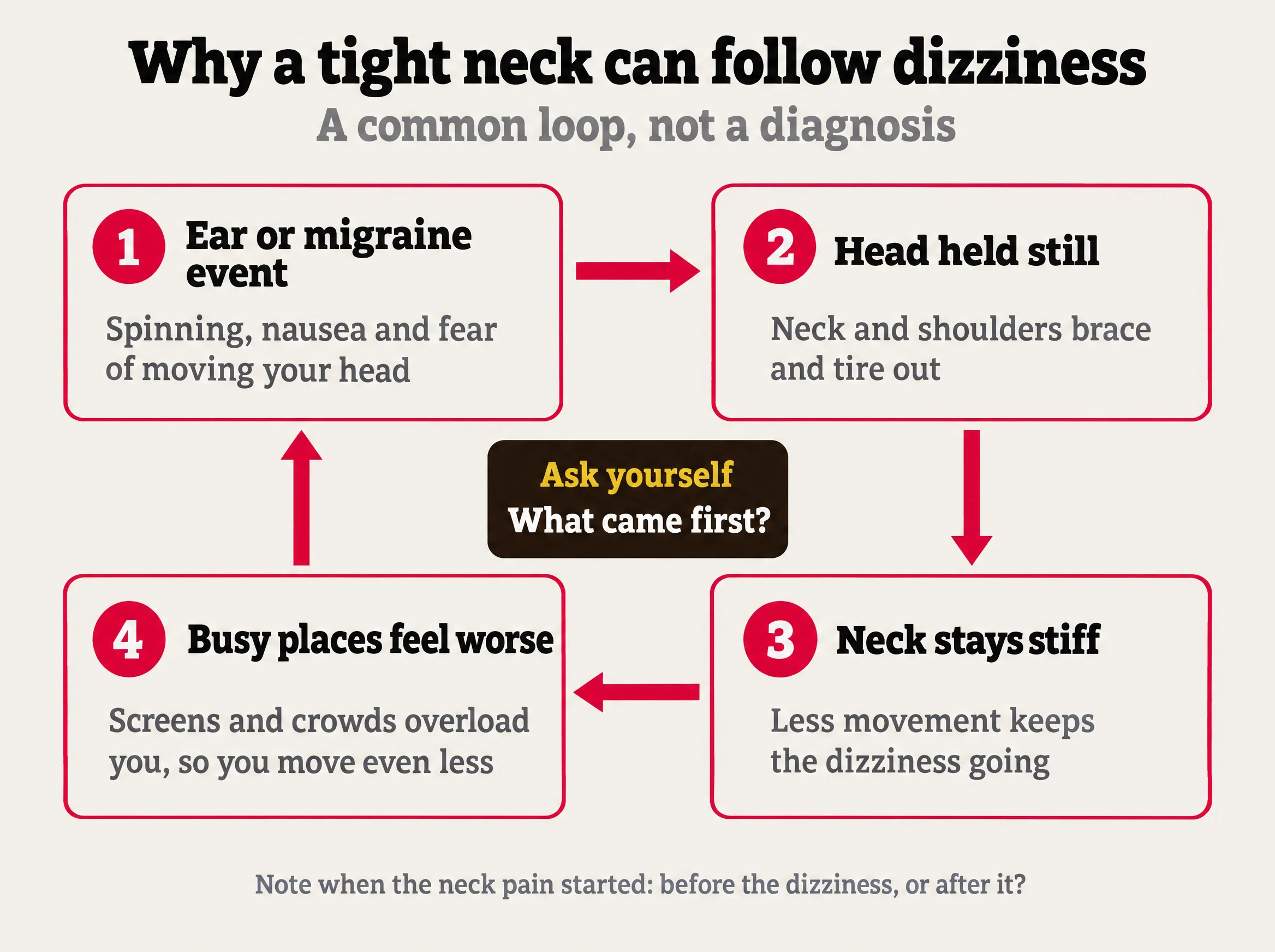
So the useful question is not “is my neck tight?” but what came first. The same review says the history should show neck pain starting before the dizziness, with the two rising and falling together, and dizziness provoked by neck movements or positions.1 If the neck only stiffened after a vertigo attack began, guarding is the better explanation.
The loop can also run the other way. A stiff, guarded neck reduces your range of motion and can keep the dizziness going, so a short ear or migraine event can leave a longer neck problem behind. That is also why the authors recommend looking at the neck and the balance system together rather than choosing one.1
The three look-alikes most articles skip
Neither condition exists in a vacuum. These three imitate one or both, and any of them can sit on top of the other.
BPPV
Brief spinning, usually under a minute, set off by changing head position such as rolling in bed. See how it differs in our guide to how BPPV differs from a neck cause.
Vestibular migraine
Can cause dizziness with no headache, plus neck or head pressure, light or sound sensitivity and nausea. Compare it in how vestibular migraine imitates both.
Persistent postural-perceptual dizziness
A constant rocking or swaying that worsens in busy visual places such as supermarkets and when scrolling, often after an earlier vestibular event.
In a 2025 specialist-centre study, neck pain was reported by 40% of 188 people with vestibular migraine and 26% of 88 people with Ménière’s disease, and another 14 patients had a mixed syndrome.2 So neck pain can point toward migraine as easily as an ear problem, and cannot diagnose either.
Four things the internet gets wrong
Patient forums mix lived experience with confident half-truths.
“Spinning is the ear. Floating is the neck.”
“My hearing test was normal, so it is not Ménière’s.”
“My neck is stiff, so my neck is causing it.”
“One adjustment of the top bone cured my Ménière’s.”
The rule-out order doctors follow
Because cervicogenic dizziness is reached by exclusion, order matters. This sequence wastes the least time and money.
- Red flags firstStroke signs, sudden hearing loss and new neurological symptoms go to urgent medical care before anything else.
- Check the earsFluctuating hearing, ringing or fullness in one ear means a formal hearing test with an ENT. If the pattern fits, that is the Ménière’s route, not the neck.
- Test for positional vertigoBrief spells triggered by lying down or turning in bed point to BPPV, which a clinician confirms with a positional test such as the Dix-Hallpike manoeuvre.
- Screen for migraine and other causesLight and sound sensitivity, nausea, a migraine history, blood pressure, heart rhythm and medication effects all come before the neck.
- Only then, look at the neckDoes the dizziness track with neck pain, neck movement and sustained postures? Reviewers note neck tests help but are not specific, so the whole picture decides.1
If you are weighing medication, we compare how betahistine and Stemetil compare in plain language.
Quick self-check: which pathway fits you?
Four questions, one at a time. It points you to the right first step. It does not diagnose.
Self-guided check
Which pathway should you start with?
When your ENT results come back clear
The hearing test is normal, the scan is clear, and you are still floating through your workday. A clear ear test does not mean “it must be the neck”. Migraine, BPPV, medication effects and the other look-alikes still need ruling out. We cover the scan side in why a clear scan can still leave you dizzy.
Debated does not mean imaginary
Researchers call cervicogenic dizziness a diagnosis of exclusion with no gold-standard test and few trials. That describes how thin the research base is, not whether patients improve. In their 2025 review, De Hertogh and colleagues report moderate evidence that neck treatment reduces symptoms when the problem lies in the neck’s position sensing, and they recommend treating the neck and the balance system together.1
Doctor of Chiropractic · 29 years, 3,000+ patients
“Dizziness is not a neck problem until the other causes have been looked at: ears, migraine, blood pressure, medication. Once those are covered and the dizziness builds with desk hours or neck movement, the neck becomes the unmeasured variable.”
“That is when I want a standing X-ray. A measured deviation in the curve, together with that symptom pattern, makes a mechanical contribution much more likely. A film on its own proves nothing. In the right order, it tells us a lot.”
Dr Will’s view comes from sequence, not from the image. Work-up first, X-ray second. That is also how Dr Neck Pain assesses cervicogenic dizziness approaches it.
If the neck is the candidate
Measure it before you commit to months of treatment
Treating a neck you only assume is muscular is a blind bet. A standing X-ray removes the blindfold. It raises or lowers the odds that your neck structure is involved, and a normal film is useful news too. If a deviation is there, correction is X-ray verified and ends when you are corrected, with no ongoing dependency.
Phase 1
RELEASE
AxisFlex Protocol™ loosens deep restrictions and stiffness.
Phase 2
RESET
AxisFlow Adjust™ resets joints at the neurological level.
Phase 3
RECALIBRATE
NeuroPosture Calibration™ trains posture to hold automatically.
You start with a free phone assessment. The $168 first consult includes 4 standing spinal X-ray films, so bring films under a year old, or the clinic can arrange them. Progress is tracked on film, not on feel. Long desk days and forward-head posture from screen hours are the usual drivers here.
Educational information, not a diagnosis or a substitute for an ENT, neurology or emergency assessment.
Who to see in Singapore, and when
This is the usual routing.
GP or polyclinic
The first stop. They can screen for red flags, check blood pressure and refer you to an ENT or neurologist.
ENT specialist
For hearing tests and the Ménière’s question. Public hospitals such as SGH and NUH have ENT and audiology services, and private ENT clinics are widely available.
Neurologist
For migraine features, or any neurological sign that needs a closer look.
Vestibular physiotherapist
For ongoing imbalance between attacks. See what vestibular physiotherapy costs in Singapore.
In Singapore, long hours in cold air-conditioned offices tend to produce a forward-head posture. Hawker and restaurant meals run salty, and your ENT may suggest limiting salt if you have Ménière’s (the NIDCD mentions 1,500 to 2,000 mg a day).3 If ringing shifts with neck or jaw movement, tell your ENT.
Ears cleared and still dizzy?
Start with a free phone assessment. If a standing X-ray makes sense, your $168 first consult includes 4 films. See the full price list for the rest.
Check suitability on WhatsApp →Bring this to your appointment
A one-page timeline beats a list of internet diagnoses.
Printable dizziness diary
One A4 page. Print it and bring it to your GP or ENT.
Spinning, floating or rocking?Start time and lengthWhich ear, any hearing changeTinnitus or fullnessLight or sound sensitivityDid neck pain come first?What you were doingWhat you tried and how it went
Add how you felt between attacks too. Many people with Ménière’s stay unsteady and tired afterwards, and gentle vestibular rehabilitation can help.
Go gently
Patients often report that aggressive deep massage, forceful stretching or big exercise jumps flared their dizziness for days. That is anecdotal, but a fair warning. Whoever treats your neck should start light and stop if symptoms jump beyond a short flare.
Frequently asked questions
Can neck problems cause dizziness?
They can contribute, but it is a diagnosis of exclusion. The upper neck holds many position sensors that report head position to the brain. Researchers think disrupted neck input may cause unsteadiness in some people. There is no single confirming test, so ear, brain, heart and medication causes are assessed first.
Can tight neck muscles cause ear fullness and ringing?
Some people notice ear symptoms that change with neck position, but hearing changes always need an ear check first. Fluctuating hearing loss, ringing and fullness in one ear are the classic pattern of Ménière’s disease, so a formal hearing test comes before anyone blames the neck. Ringing that shifts with neck or jaw movement is sometimes called somatic tinnitus.
How do doctors test for cervicogenic dizziness?
There is no single test, so doctors work by exclusion. They take a detailed history, check hearing and balance, screen for migraine, positional vertigo and neurological or cardiovascular causes, and then look for dizziness that tracks with neck pain and neck movement. Researchers note that the available neck tests are useful but not specific to this condition.
Does neck tension during vertigo mean the neck caused it?
No. Neck tension is often a reaction to the dizziness. When head movement makes you dizzy, you tend to hold your head still and tense your neck and shoulders, which leaves the muscles sore. Researchers note this can make the neck look like the cause. It helps to note whether neck pain started before the dizziness or only after it.
If my hearing test is normal, can I still have Ménière’s disease?
Possibly, but a definite diagnosis needs hearing loss documented on a test. The criteria require low-to-medium frequency hearing loss shown on a hearing test before, during or after an episode. Probable Ménière’s disease can be considered when that has not been confirmed. Hearing can fluctuate, so ask your ENT whether a repeat test makes sense.
Can a neck adjustment cure Ménière’s disease?
No. Ménière’s disease is an inner-ear disorder, and adjusting a neck joint does not treat it. If your dizziness is Ménière’s, you need an ENT-led plan. A neck assessment only becomes relevant when ear causes have been excluded, or when neck pain and neck-triggered symptoms are also part of your picture.
Which doctor should I see first in Singapore?
Start with your GP or polyclinic doctor, who can refer you to an ENT. Ask for a formal hearing test if you have any ear symptoms. A neurologist is the next step for migraine features or neurological signs. Vestibular physiotherapists help with ongoing imbalance, and a neck assessment comes once the likely causes have been worked through.
Will a neck X-ray tell me if my dizziness comes from my neck?
Not on its own. It raises or lowers the probability. In Dr Will Kalla’s clinical view, a measured deviation in the neck’s curve together with dizziness that tracks neck load makes a mechanical contribution much more likely. A film without that symptom pattern proves nothing, which is why the work-up comes first and the standing X-ray second.
References
- De Hertogh W, Micarelli A, Reid S, Malmström E-M, Vereeck L, Alessandrini M. Dizziness and neck pain: a perspective on cervicogenic dizziness exploring pathophysiology, diagnostic challenges, and therapeutic implications. Front Neurol. 2025;16:1545241. doi:10.3389/fneur.2025.1545241
- Huppert D, Grill E, Becker-Bense S, Zwergal A, et al. Diagnostic challenges in vestibular migraine: clinical differentiation from Ménière’s disease and discrepancies with current classification criteria. J Neurol. 2025;272(9):558. Springer
- National Institute on Deafness and Other Communication Disorders (NIDCD). Ménière’s disease. nidcd.nih.gov
Keep reading
Still dizzy after the ear tests?
Work-up first, X-ray second. If your neck is a candidate, we measure it before we treat anything.
Check suitability on WhatsApp →VisitNorth Bridge Centre, #02-20
420 North Bridge Road
Getting here5 min from Bugis and
City Hall MRT
HoursMon to Fri 9:30am to 7pm
Sat 9:30am to 1pm
This article is educational information only and is not medical advice, diagnosis or a treatment recommendation. Prices can change; confirm with the clinic. If you have red-flag symptoms, seek urgent medical assessment.