

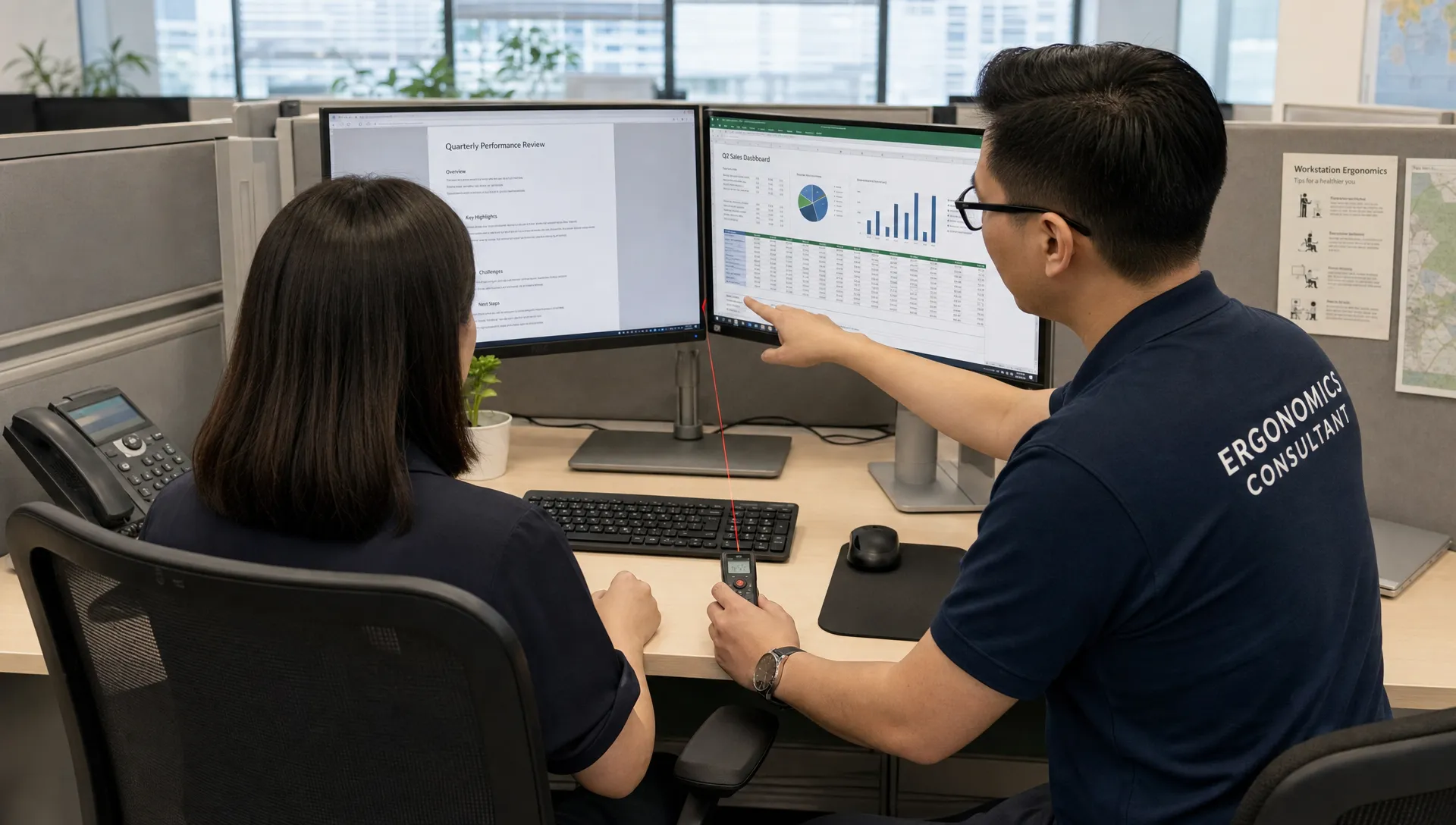
An ergonomic consultant can set your desk to the millimetre. What they cannot do is reach inside your neck and undo the pattern years of that desk have already trained into it. For a healthy team, that distinction is academic. For an executive who already has chronic tech neck, it is the whole story.
This is a guide to hiring an ergonomic office setup consultant in Singapore, and to the exact point where a better workstation stops being the answer and your neck itself becomes the question.
The short version
- An ergonomic consultant fixes your external environment: desk, chair, screen height, lighting. That is genuinely valuable, and it is the right first step for a team.
- It works best as prevention. For staff who are not yet in pain, a good setup stops new strain from starting.
- Once neck pain is chronic, hardware tweaks often under-deliver, because the problem has moved inside: muscle firing, joint loading and motor control adapt to the slump.
- A visual or photo posture check estimates how you sit. It does not measure the curve inside your neck, which is a different question with a different tool.
- The honest split: consultant for the desk and the team, clinician for a neck that keeps hurting after the desk is right.
Related reading
Consultant First, Clinician If It Persists
Most of the confusion around ergonomic consultants comes from treating one service as if it does two jobs. It does not. There are two stages, and they need different providers.
Step 1 is the external setup. An ergonomics consultant, or a furniture and space-planning partner, gets your workstation right: screen height, viewing distance, desk stability, chair adjustment, lighting and movement planning. For a company rolling this out across a floor, it is the correct first line of defence, and it prevents a large share of new strain before it starts.
Step 2 is the internal problem, and it only applies to people who already hurt. If a professional has had tech neck or cervicogenic headaches for months or years, the neck has adapted internally, and adjusting the hardware lowers the daily load without reversing the pattern that is now maintaining the pain. That is a clinical question, not a furniture one.
Get the order right and both steps add value. Confuse them, and you either buy furniture expecting it to cure pain, or you treat a neck while ignoring the desk that keeps reloading it.
What an Ergonomic Consultant Does Well
For Singapore companies, the non-clinical options fall into two useful groups. The first is human-factors and DSE consultancies (display screen equipment specialists) such as the Institute of Ergonomics and Hygiene (IEH), which run structured workstation risk assessments, use recognised tools, and can build a repeatable standard for new hires and hybrid staff. The second is furniture and space-planning providers such as Makeshift or NextChair, which are strong on the physical layout: desk width and stability, monitor arms, screen spacing and cable management. Service scope and pricing change, so confirm current details directly before booking.
The value for a company is not one adjusted desk. It is a standard: minimum desk widths, monitor-arm requirements, assessment forms and staff training, so the setup survives after the consultant leaves. A good consultant starts by asking what your staff actually do, not by selling a chair, and can explain how they handle a laptop plus monitor, two equal screens, or a single wide display without forcing anyone into a sustained neck turn. (For how to arrange the screens themselves, our workstation setup guide has the numbers.)
What a Good Assessment Should Cover
Screen position is one part of a system. A thorough assessment looks at the whole seated setup, because the monitor only helps if the rest of the posture is supported.
What a competent workstation assessment should include.
| Area | What is checked | Why it matters |
|---|---|---|
| Screen height | Top of screen at or just below eye level | Poor height drives neck extension or a forward head |
| Screen distance | Roughly an arm’s length, with readable text | Too close strains the eyes; too far invites leaning in |
| Chair and desk fit | Feet, hips, lumbar support, elbow angle | The screen position only works on a supported base |
| Keyboard and mouse | Close, elbows near the body, no reaching | Reaching drives shoulder and upper-back tension |
| Lighting and glare | Windows, reflections, brightness, task light | Glare causes squinting, leaning and headaches |
| Movement plan | Break rhythm and position changes | No fixed posture is safe if it is held for hours |
WSH Ergonomic Audits: Prevention, Not Rehabilitation
In Singapore the corporate version of this is formalised. SS 514:2016, the Code of Practice for Office Ergonomics, is an Approved Code of Practice under the Workplace Safety and Health (WSH) framework. It guides employers on workstation design, screen and chair setup, lighting, breaks and the wider work environment, and a WSH-aligned audit turns that into a repeatable, documented standard for a whole floor of staff. For preventing new strain and standardising setups, it is exactly the right instrument, and it is worth doing properly.
But read what the standard is actually for: it is a prevention and design code, not a diagnostic or treatment one. A checklist audit records the visible setup, monitor height, chair settings, obvious posture cues, and recommends better hardware and break schedules. What it does not do, and is not meant to do, is assess the things that define chronic tech neck: cervical alignment, segmental joint mobility, deep neck flexor endurance, or the proprioceptive changes that come with a neck that has adapted to years of slump.
So for an employee who is already in chronic pain, a WSH audit that raises a monitor or swaps a chair lowers the daily load without reaching the internal pattern. That is not a failure of the audit, and it is not a reason to skip one. It is a scope boundary: prevention and rehabilitation are different jobs, done by different people, and the audit only ever claimed the first.
External Desk, Internal Neck
Here is the limit no furniture brochure mentions. An ergonomic consultant changes your external environment. But chronic neck pain is increasingly an internal problem, and the two do not respond to the same fix.
Prolonged slump does not just look bad. It changes how your neck muscles fire and how accurately your neck senses its own position.
In office workers with chronic neck pain, an hour of slump typing increased pain, reduced neck proprioception in every direction, and raised activity in the deep neck extensors and upper trapezius (office-worker slump studies, 2023 to 2024). In plain terms, the neuromuscular system adapts to the slumped position. It is sensitised, not simply “out of alignment.” These are small studies, and posture is not the only driver of pain, but the direction is consistent.
This is why a better chair or monitor arm can lower the daily load and still leave the neck and shoulder pain running. The external setup reduces how much you reload the tissue each day. It does not, on its own, retrain the muscle tone, joint loading and motor control that have already adapted, or reverse a forward head posture that now holds even when you sit square. Once that internal pattern is entrenched, hardware is necessary but not sufficient.
Why a Visual Posture Check Falls Short
Most ergonomic assessments, and many posture checks, are visual: someone looks at how you sit, or measures angles from a photo, and gives feedback. That is a reasonable screen, and it is genuinely useful for setup. But it has a hard limit worth understanding before you rely on it for a painful neck.
A visual check estimates the outside: where your head and shoulders sit in space. It cannot measure the inside: the actual curve of your cervical spine, the lordosis that is supposed to sit at roughly 30 to 40 degrees and that years of screen work can flatten. Two people can look equally “forward” from the side and have very different curves underneath. So a posture photo tells you how you are holding yourself today; it does not tell you what your neck structure has become.
Worth being clear
This is the difference between an opinion about your posture and a measurement of it. When neck pain persists despite a corrected setup, the useful next step is objective measurement, not another visual opinion. A structural assessment is built on a standing X-ray that measures the cervical curve directly, under load, rather than estimating it from the outside. A change in that curve is not by itself a diagnosis, but it is information a posture photo simply cannot give you.
The Internal Reset
If the internal pattern is the problem, the fix has to be internal too. The encouraging part is that it responds. In employees with chronic neck pain, targeted neuromuscular retraining, deep neck flexor and stabilisation work, reduced pain, reduced the forward-head angle, and lowered the overactive muscle activity over about six weeks. That is the internal reset a chair cannot perform: it retrains how the neck holds itself, rather than only changing what it rests against.
For a subset of people, there is a structural layer under that. Where the cervical curve has genuinely flattened and symptoms keep returning, the aim is to restore alignment and retrain the position so it holds. At Dr Neck Pain, that runs through the R3NEW X™ protocol: release the tissue holding the pattern, reset the restricted joints, and recalibrate the nervous system so a neutral position starts to hold on its own, with progress tracked on repeat imaging.
Clinical note
Executives come in after a full corporate ergonomics rollout, a S$1,500 chair, dual monitor arms, the works, and they are still in pain. They assume something was set up wrong. Usually it was set up perfectly. The desk was Step 1, and it did its job.
What the desk cannot do is measure or change what the neck has become on the inside. That is not a criticism of ergonomics. It is just a different tool for a different layer of the problem.
Consultant or Clinician?
The choice is rarely one or the other for a whole organisation. It is which one this person needs next.
Start with a consultant when
- You are setting up a team, floor or new hires
- Staff are not yet in pain (prevention)
- The obvious issues are desk, screen and chair
- You need a repeatable workplace standard
Move to a clinician when
- Neck pain persists after the setup is corrected
- There are recurring cervicogenic headaches
- The head stays forward even when sitting square
- Pain radiates, tingles, or wakes the person at night
If you are weighing the clinical routes themselves, our guide on chiropractic vs physiotherapy for office syndrome compares them for Singapore. The one-line rule: a consultant optimises the environment; a clinician assesses the person.
What to Ask Before You Book
A short enquiry tells you whether a provider understands the difference between setup and treatment. Ask for concrete answers, not general promises about posture.
- Do you deliver a written report?A checklist or standard you can reuse for new hires, not just a verbal once-over.
- Do you assess glare, lighting and movement, not just the chair?The whole system, not a single accessory.
- Can you review photos or video for hybrid staff?Remote assessment matters for split-location teams.
- Can you create a standard workstation spec?For companies, repeatability is the real deliverable.
- What do you do when someone is already in pain?An honest provider names the limit and points to clinical care, rather than promising a chair will fix symptoms.
Red flags
Treating ergonomics as a shopping list, promising “perfect posture,” no questions about hours or symptoms, no written recommendations, and no follow-up. For a painful neck, the biggest red flag is any provider, of any kind, who claims a piece of equipment will resolve pain that has been building for years.
Setup, or Structure?
This quick self-check mirrors the logic above. It is educational, not a diagnosis. Tick anything that sounds like you.
Self-check
The “setup vs structure” checklist
Tick any that apply. A result appears as soon as one is true.
Your result will show here.
You may be past what a consultant can fix.
Pain after a professional setup: the desk has done its job; the problem is likely internal now. That is a clinical question, not a hardware one.
Recurring headaches from the skull base: a cervicogenic pattern is worth assessing, because it overlaps with, and is treated differently from, migraine.
Aching away from the desk: pain on weekends, nowhere near your workstation, is not being caused by the workstation.
A head that will not sit square: that points to an internal postural or structural pattern a setup cannot correct on its own.
Either way, if the neck persists after a corrected setup, the useful next step is measuring the neck, not re-checking the desk. If you first want to know whether to wait or act, the 14-day triage guide walks through it.
Educational self-check only, not a diagnosis. If you have arm numbness, weakness, or sudden severe headaches, seek urgent medical care.
Corporate setup done, and still in pain? That is the signal to assess the neck, not the desk. A short structural assessment shows whether alignment is the reason, and you can see how other Singapore patients progressed first.
Book a pain assessment →Frequently Asked Questions
Do I need an ergonomic consultant, or a clinician, for my neck pain?
Start with a consultant if you are setting up a workstation or a team and are not yet in pain; move to a clinician if pain persists after the setup is corrected. An ergonomic consultant fixes the external environment, which is the right first step and strong prevention. If neck pain, headaches or a forward head keep returning despite a good setup, the problem has likely moved inside the neck, and that needs clinical assessment.
Can an ergonomic setup fix office syndrome or chronic neck pain?
It can reduce strain and may relieve symptoms if the workstation was the main trigger. But if pain is chronic, research shows the neck adapts internally: muscle firing, proprioception and joint loading change with prolonged slump. A better desk lowers the daily load without reversing that internal pattern, which usually needs neuromuscular retraining and, where the curve has flattened, structural assessment.
Is a visual or photo posture check enough for neck pain?
It is a useful screen, but it estimates how you sit rather than measuring the curve inside your neck. Two people can look equally forward-headed and have very different cervical curves. A posture photo cannot see that. When pain persists despite a corrected setup, objective measurement, including a standing X-ray where clinically justified, is more informative than another visual opinion. A structural assessment of the neck is built on that objective measurement rather than a visual estimate.
What should an ergonomic workstation assessment include?
Screen height, distance and angle; chair and desk fit; keyboard and mouse position; lighting and glare; and a movement plan. For companies, it should also produce a repeatable written standard for new hires and hybrid staff. A good provider asks what you actually do before recommending equipment, and is honest about what setup can and cannot resolve.
Who are the ergonomic office setup consultants in Singapore?
They fall into non-clinical categories: human-factors and DSE consultancies (for example IEH) for corporate assessments and standards, and furniture and space-planning providers (for example Makeshift or NextChair) for desks, monitor arms and layout. These handle the external setup. If you already have persistent neck pain or headaches, that is a clinical question rather than a setup one, and it belongs with a qualified clinician. Confirm any provider’s current services directly.
Do WSH ergonomic audits or SS 514 checks treat neck pain?
No. SS 514:2016 and WSH-aligned audits are prevention-and-design tools, not treatment. They standardise desks, screens, chairs, lighting and breaks, which is excellent for stopping new strain and for compliance. They are not diagnostic standards and do not assess cervical alignment, joint mobility or deep neck flexor endurance. If an employee already has chronic tech neck or cervicogenic headaches, that needs clinical assessment rather than another audit.
The desk is set. The neck still hurts.
If a professional setup, a premium chair and dual monitor arms have not settled a recurring neck, a standing-X-ray assessment can show whether the pattern has become structural, which no consultant can measure.
References
- Ataei Cheragh Z, Degens H, Sakinepoor A. Effect of a slump posture on pain, proprioception, and electrical activity of the muscles in office workers with chronic non-specific neck pain: a retrospective study. J Bodyw Mov Ther. 2024;38:100-105. PMID 38763548. PubMed
- Sakinepoor A, Ataei Cheragh Z, Degens H, Mazidi M. Neck stabilization exercise and dynamic neuromuscular stabilization reduce pain intensity, forward head angle and muscle activity of employees with chronic non-specific neck pain: a retrospective study. J Exp Orthop. 2025;12(1):e70188. PMID 40028418. PubMed
- Christensen SWM, Palsson TS, Krebs HJ, Graven-Nielsen T, Hirata RP. Prolonged slumped sitting causes neck pain and increased axioscapular muscle activity during a computer task in healthy participants: a randomized crossover study. Appl Ergon. 2023;110:104020. PMID 36958253. PubMed
- Blanpied PR, Gross AR, Elliott JM, et al. Neck Pain: Revision 2017. Clinical Practice Guidelines. J Orthop Sports Phys Ther. 2017;47(7):A1-A83. PMID 28666405. PubMed
- Singapore Standard SS 514:2016, Code of Practice for Office Ergonomics (Enterprise Singapore / Singapore Standards Council); an Approved Code of Practice under the Workplace Safety and Health framework. WSH Council
This article is educational information only and is not medical advice, diagnosis, or a treatment recommendation for your individual situation. Third-party providers are named for context only and should be verified directly; this is not an endorsement. A change in cervical curvature is not by itself a diagnosis. Chiropractic care is not MOH-registered in Singapore and is not a substitute for medical or surgical care. If you have arm or hand numbness, weakness, dizziness, or pain that wakes you at night, seek medical assessment promptly.