

A stiff neck by 4pm is not a mystery, and it is usually not an emergency. The question that actually keeps people up is different: how long is too long? When does a stiff neck stop being something to stretch out and start being something to get looked at?
This is a triage guide, not a treatment plan. It gives your neck a clear deadline, shows you how to tell a tired muscle from a pinched nerve, and names the exact signals that mean stop waiting and see someone now.
The short version
- Recent, uncomplicated neck stiffness is worth self-managing first, on a fixed 14-day clock rather than an open-ended one.
- Most desk necks are muscular and mechanical. A smaller number are a pinched nerve or age-related arthritis, and they behave differently.
- The one line that changes everything: pain, numbness or weakness travelling down the arm is not a stiff neck to wait out.
- Arm weakness, spreading numbness, balance change, fever or pain after a fall means same-day medical assessment, not exercises and not a booking.
- Track a pain score and one function you care about. Memory hides slow progress, and it hides no progress.
- If 14 honest days change nothing, the next step is a diagnosis, not more repetitions of the same routine.
Why Home Working Loads the Neck Differently
An office does a lot of quiet work for your neck. An external monitor sits at roughly eye height. The chair adjusts. You walk to a meeting room, queue for coffee, go out for lunch. None of that is exercise, but it breaks up the hours.
Home removes most of it. In Singapore the constraint is space. A three-bedroom condo or an HDB flat rarely has a spare room for a study, so the dining table becomes the desk, the sofa becomes the afternoon office, and the laptop screen sits 20 to 30 cm below where your eyes want it. Back-to-back video calls remove the walk between meetings. Heat and humidity remove the lunchtime walk. The commute that used to force 6,000 steps disappears.

The mechanism is dull and predictable. A screen below eye level holds your head slightly forward and slightly down. The muscles along the back of your neck and across your shoulder blades hold that position for hours at low effort. Nothing tears. The tissue simply fatigues, then guards, and guarding feels like stiffness. That is what people describe as muscles working overtime, and it is the most common finding in a desk-related neck. That is the ordinary path into neck and shoulder pain for people who have never had a neck injury in their lives.
Singapore context
From 1 December 2025, the Occupational Disease lists under the Workplace Safety and Health Act and the Work Injury Compensation Act replaced “musculoskeletal disorders of the upper limb” with the broader term “work-related musculoskeletal disorder”, extending coverage to the back, spine and lower limbs. Upper-limb disorders were already reportable before this. The change widens what counts, which tells you the regulator now treats ergonomic load across the spine as an occupational health matter rather than a personal complaint.
If your setup is the obvious culprit and you want the measurements rather than the theory, our ergonomic workstation setup guide has the heights, angles and distances. This page assumes you have either fixed the desk or cannot, and the stiffness is still there. The question here is what the stiffness is, and how long to give it.
The 14-Day Rule, and Your Decision Table
Most people get this decision wrong in the same direction. They do not rush to a clinic too early. They drift for months, stretching when they remember, waiting for it to sort itself out, and only book when the pain starts affecting sleep or work.
The fix is a deadline. Give home care 14 consecutive days of consistent effort, then judge it against what you wrote down. Consistent means daily, not three times when the stiffness flares. Fourteen days is long enough for a genuine response and short enough that you have lost nothing if it fails.
Home care first is the right call when the stiffness is local (neck and upper shoulders, not travelling down an arm), mechanical (worse after sustained positions, easier when you move), and recent. Outside those three conditions, the table below applies instead.
Where to start, by what you are actually experiencing.
| Your situation | Start here | The reasoning |
|---|---|---|
| Stiff after long days, no arm symptoms, under 2 weeks old | Home programme, plus cut the static load | Recent mechanical stiffness usually settles once loading drops and the supporting muscles gain endurance |
| Stiffness returns every workday but clears overnight | Home programme, plus change how often you move | The driver is repeated daily loading rather than a single strain, so frequency of movement matters more than any one stretch |
| Nothing has changed after 14 consistent days | Book an assessment | Something is maintaining the problem that self-care has not reached, and more of the same rarely finds it |
| Stiffness with a recurring headache from the base of the skull | Assessment, sooner than 14 days if it is frequent | Neck-driven headache patterns have to be told apart from migraine before treatment makes sense |
| Pain wakes you, or you cannot find a sleeping position | Assessment within days | Disrupted sleep raises pain sensitivity, which slows recovery and makes exercise harder to tolerate |
| Pain, numbness or tingling travelling down the arm | Medical or specialist assessment promptly | Possible nerve root irritation needs proper neurological examination before any exercise or manual treatment |
| Any fall, accident or collision involving the head or neck | Medical assessment before you exercise at all | Trauma has to be screened first, because serious causes have to be excluded rather than assumed away |
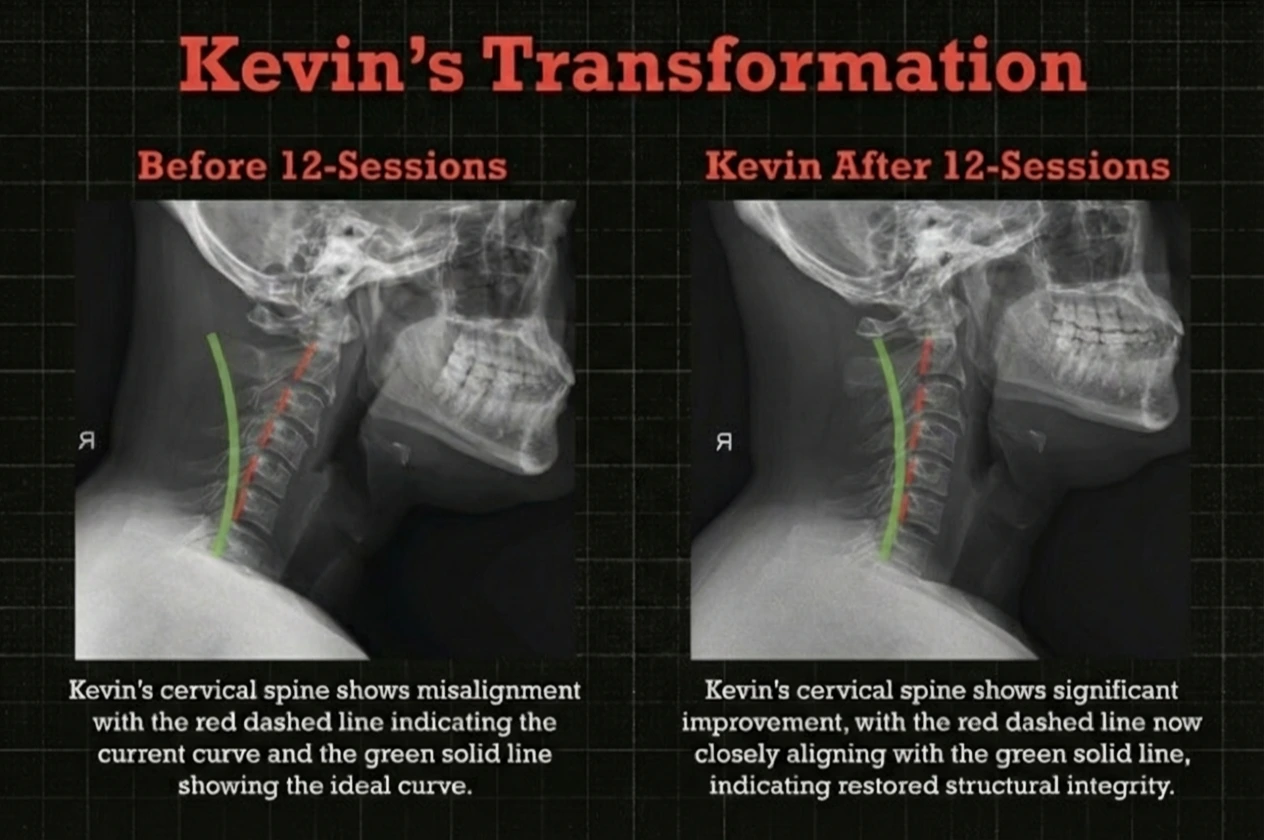
Arm symptoms are the line that matters most. Stiffness that stays in the neck and shoulders behaves differently from pain that radiates, and the second one belongs in the territory of cervical radiculopathy, or in some cases a slipped disc pressing on a nerve root. Either way, a proper examination comes before any home programme.
Symptoms That Skip the 14 Days
Seek urgent medical care, not a chiropractic or physiotherapy booking
Some symptoms move this out of self-management entirely. If any of the following are present, contact a doctor or go to an emergency department the same day.
- Weakness in an arm or handDropping mugs, a grip that gives way, or difficulty telling a key from a coin by touch.
- Numbness that is spreadingParticularly if it affects both arms, or moves into the trunk or legs.
- Balance or walking changesUnsteadiness, a wider walking base, or new clumsiness on stairs.
- Bladder or bowel changesNew difficulty controlling either, at any age.
- Fever with neck stiffnessEspecially with headache, light sensitivity or feeling generally unwell.
- Unexplained weight loss, or pain that is worse at nightPain that does not ease in any position and wakes you consistently.
- Severe pain after traumaAny fall, road accident or sporting collision.
One more that gets mistaken for a neck problem: pain in the jaw, pain on chewing, tooth pain or facial swelling belongs with a dentist rather than a neck programme. Jaw and dental problems refer pain into the temples and the side of the head convincingly enough that people treat their neck for months before anyone checks their bite.
Which Kind of Stiff Neck Is It?
“Stiff neck” is a symptom, not a diagnosis. Three very different things hide behind it, and they need different responses. Most desk necks are the first kind. The point of knowing all three is so you recognise the moment yours stops behaving like the common one.
The same stiffness, three different causes, read across the row.
| What you notice | Muscular / mechanical | Neck arthritis (spondylosis) | Pinched nerve (radiculopathy) |
|---|---|---|---|
| Where it is felt | Back of the neck and across the shoulders | Deep in the neck, often one-sided, sometimes into the shoulder | Neck plus a line of pain down one arm to the hand |
| What makes it worse | Long static positions, end of the workday | Holding one position, mornings, certain neck movements | Looking up or turning toward the painful side |
| What eases it | Moving, walking, a change of position | Gentle movement; it loosens through the day | Often resting the hand on top of the head; little else |
| Arm involvement | None | Usually none; occasional referred ache | Tingling, numbness or weakness in specific fingers |
| Typical picture | Any age, clearly tied to desk hours | More common with age; gradual onset | Can start suddenly; arm symptoms dominate |
| First step | 14-day home trial | Assessment if it persists or recurs | Examination before any exercise |
Muscle fatigue, or the start of cervical spondylosis?
Muscular stiffness eases when you move and is clearly worse after long desk sessions. Age-related wear in the neck joints, cervical spondylosis, tends to feel deeper and stiffer first thing in the morning, loosens as the day goes on, and is more likely to be one-sided or tied to specific movements rather than to hours at the screen. Spondylosis is common and often manageable, but it is worth confirming rather than assuming, because the sensible plan differs from a purely muscular case.
Mechanical stiffness, or a pinched nerve?
This is the distinction that decides urgency. A mechanical stiff neck stays in the neck and shoulders. A pinched nerve, cervical radiculopathy, sends a recognisable line of symptoms down one arm: tingling, numbness or weakness following the path of a specific nerve, often worse when you tip your head back or turn toward the sore side. If your “stiff neck” has an arm component, it is not a candidate for a 14-day wait. It needs an examination first.
The four searches people actually type
Stiff neck after sleeping. A neck that seizes overnight and is worst on waking is usually an acute muscular strain (often a “wry neck”) from position, not the pillow’s fault. It typically eases over a few days with gentle movement and heat; if it has not moved at all in a week, or comes with arm symptoms, have it looked at.
Neck pain only when turning the head. Pain tied to a specific direction points to a joint or facet restriction rather than diffuse muscle fatigue. It often responds well to hands-on assessment, and it is worth checking rather than forcing through.
Text neck or tech neck. This is the modern name for sustained forward head posture from looking down at screens. It is mechanical, and it is the classic 14-day-rule case, provided there are no arm symptoms and the setup is being addressed.
Neck pain spreading to the shoulder or arm. Pain that stays around the shoulder blade is usually still muscular or referred. Pain that travels past the shoulder and down the arm, especially with tingling, is the radiculopathy pattern above and skips the wait.
Which Pathway Might You Need?
This quick self-check follows the same logic as the table above. It is educational, not a diagnosis. If you have red-flag symptoms it will tell you to seek urgent care, not to book anything.
Interactive self-check
Wait it out, or get it looked at?