

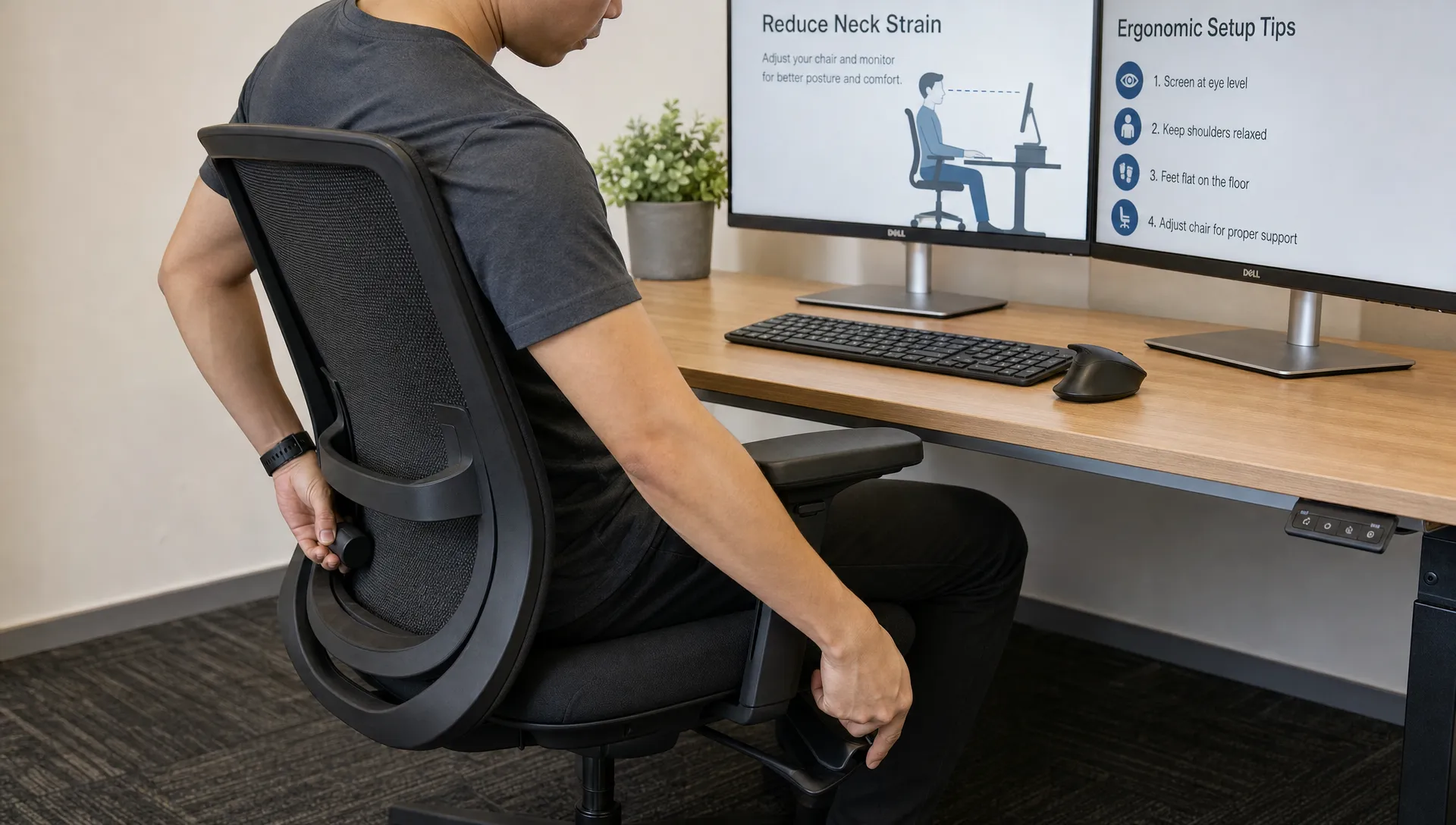
You spent S$1,500 on a Herman Miller, a Secretlab or an ErgoTune, and your neck still aches by mid-afternoon. So you start eyeing a kneeling chair. Before you buy anything else, it is worth understanding why the seat under you keeps failing the muscle at the top of your spine.
This is a clinical breakdown of ergonomic versus kneeling chairs for neck pain, built around one idea most chair reviews miss: your neck position is decided at your pelvis, not at your head.
The short version
- For a full workday, a well-adjusted ergonomic chair is the safer main seat. A kneeling chair is a short posture reset, not an all-day fix.
- The neck sits at the top of a kinetic chain that starts at the pelvis. What the chair does to your pelvis quietly decides where your head ends up.
- An ergonomic chair fails the neck when you slump into a backward pelvic tilt and the head drifts forward to keep the eyes level. The price of the chair does not prevent this.
- A kneeling chair tilts the pelvis forward, but with little back support the upper back tires, the shoulders round, and the head can fall forward again.
- A pilot study found no single chair produced an ideal posture across every region. A good lower-back position did not guarantee a good neck position.
- If your neck curve is already flattened, changing chairs alone may not settle it, and that is a question for assessment, not another purchase.
Related reading
The Quick Verdict
If you are choosing between an ergonomic chair and a kneeling chair because your neck hurts on long dual-screen days, here is the practical answer first: for most Singapore desk professionals doing long research, writing, design, coding or trading sessions, a well-adjusted ergonomic office chair is the better main seat. It supports the pelvis and lower back, gives your arms somewhere to rest, and offers the adjustability the neck needs. A kneeling chair can be a useful short posture reset, but it rarely solves neck strain on its own.
That said, the chair question and the neck question are not the same question, and confusing them is why people keep buying seats that do not fix the problem. The rest of this guide is about the part the showroom does not explain: the link between the seat and the neck.
Your Neck Starts at Your Pelvis
Here is the piece most chair reviews skip. The neck does not work in isolation. It is the top link in a chain that begins at the pelvis, and a change at the bottom travels upward.
When a chair lets the pelvis roll backward into a posterior tilt, the lower-back curve tends to flatten and the trunk rounds forward. But your eyes still have to stay level with the screen. So the upper spine and neck compensate: the head drifts forward, the lower neck flexes, and the upper neck extends to keep your gaze horizontal. Research on seated posture describes exactly these within-region links, posterior pelvic tilt with a flatter lumbar curve, and thoracic rounding with a more forward-leaning head. It is a mechanical requirement of keeping your eyes on the screen, not simply a bad habit.
Slump at the base and the head must travel forward to keep the eyes level. That forward head position is where the neck load comes from.
This is the honest version, and it matters: sustained forward-head posture may increase mechanical loading and muscle demand around the neck. It does not mean tissue is being damaged on a timer, and neck posture, symptoms and tissue strain are related but not interchangeable. The useful takeaway is directional: the chair sets the base, the base influences the head, and the head is where your pain is.
This is why a chair that helps your lower back can still leave your neck sore, and why the fix has to consider the whole chain, rather than the seat you happen to be comparing.
Why Your Neck Still Hurts in an Expensive Ergonomic Chair
“Why does my neck hurt in my Herman Miller?” is one of the most common questions from people who have already spent well on seating, and the answer is rarely the chair’s quality. It is what the chair lets your pelvis do.
A premium ergonomic chair supports sitting endurance beautifully. But adjustability is not the same as correction. If you sit back, let the pelvis roll under, and drift into a slump, the lumbar support becomes a backrest you are leaning away from, and your head slides forward to see the screen. Recline makes this trickier than the spec sheet suggests: a deep recline of 110 to 135 degrees can feel restful, but if the monitor is not raised to match, it forces the neck to flex or the chin to jut to keep the eyes level. Many people who type actively are more comfortable nearer 95 to 100 degrees, because the neck stays closer to neutral.
So neck pain despite an ergonomic chair usually is not a sign you bought the wrong brand. It is a sign the base of your posture is rolling back and dragging the head, and the shoulder-blade area, along with it, into a forward head posture the chair cannot veto for you. If that pattern is already familiar, our tech neck correction plan covers how to retrain it.
The order that fixes this
Adjust from the base up, not from the neck down. Feet supported, pelvis set against the backrest, then the screen and arms. We keep the full monitor, keyboard and armrest walkthrough in one place, our workstation setup guide, so this article can stay on the seat and the spine.
The Kneeling Chair Trap
The kneeling chair looks like the logical answer, and for the pelvis it often is. Its forward-sloping seat tilts the pelvis into an anterior tilt, opens the hip angle, and discourages the slump. For the lower back, in the short term, many people find it a relief.
But look at what it removes: there is usually no backrest, no headrest and no armrests. Your trunk has to hold itself up actively. That is fine, and even useful, for a short focused block. The trap is what happens as fatigue develops. Without support, some users gradually round through the upper back, let the shoulders protract forward, and bring the head forward again, recreating the exact upper-back and neck strain the chair was meant to relieve. In other words, a kneeling chair can fix the pelvis and still let tech neck creep back in once your endurance runs out.
This is the honest answer to “will a kneeling chair fix my forward head posture?” It can improve the base, but it does not hold the top of the chain up for you, and it is a poor primary seat if you have knee or shin sensitivity, circulation issues, or long typing stretches across two screens.
The Honest Comparison
How the two seats compare for full-day, screen-heavy work.
| Aspect | Ergonomic office chair | Kneeling chair |
|---|---|---|
| Pelvis | Neutral, but can roll back into a slump | Tilts forward, opens the hip angle |
| Lower-back support | Adjustable lumbar or contoured backrest | None; relies on active posture |
| Upper back and neck | Backrest, sometimes a headrest, to rest against | No support; the trunk works to hold the head up |
| Muscle effort | Low to moderate | Moderate to high, rises with fatigue |
| Best use | Full workday, with breaks | Short focused blocks, then change |
| For neck pain | Better default, more adjustable for a neutral gaze | Supplement only; can worsen tech neck as you tire |
The healthiest answer is often rotation rather than loyalty: an ergonomic chair as your main seat, with a kneeling chair for short blocks when you catch yourself collapsing into the backrest, then a stand or a walk. Variety of position beats any single “perfect” posture held for hours.
What Real Users Keep Finding
The communities most obsessed with chairs keep arriving at the same conclusions, through hundreds of trial-and-error experiments. Presented as anecdote, not evidence, the pattern is striking:
Recurring themes from chair and posture forums
- People who feel better usually adjust base-up: feet, then pelvis, then backrest, then monitor, rather than chasing the neck directly.
- Backward pelvic tilt gets blamed again and again for the cascade of rounded upper back and forward head, even in expensive chairs.
- Kneeling chairs are described as a clever hack that exposes the kinetic chain, then a fatigue trap: “no back support, I slouched anyway, my neck came back.”
- There is no agreed “best chair for cervical support.” Even fans of specific models stress that setup, movement and the person’s own structure matter more than the brand.
- The most thoughtful neck-pain threads move past gear entirely, toward assessment, targeted exercise and movement variety.
None of this proves anything about your neck specifically. But it is a useful reality check: the people who spend the most on chairs are the ones who most often conclude the chair was never going to be the whole answer.
Set the Chair From the Base Up
Whichever seat you use, the setup order is the same, and it starts at the floor, not the screen.
- Feet and seat height firstFeet flat on the floor or a footrest, thighs roughly horizontal, hips level with or slightly above the knees. If your feet dangle, the pelvis is pulled forward and the whole chain shifts.
- Set the pelvis against the backrestHips all the way back so the lumbar support meets your lower back. This is the single most important step for the neck, because it stops the backward roll that drags the head forward.
- Choose your recline honestlyIf you type actively, a near-upright 95 to 100 degrees often keeps the neck more neutral than a deep recline. Save the deep recline for reading and calls, and raise the screen to match if you use it.
- Then set the screen and armsOnly now bring the monitor to eye level and the keyboard and mouse close. Setting these before the base just bakes in whatever your pelvis is doing.
Clinical note
People arrive convinced the answer is one more chair. Usually the chair is a red herring. The neck is being dragged forward by a base that rolls back, and no amount of lumbar padding fixes that if you keep sliding into a slump to see the screen.
The honest line I give patients: you may be trying to solve a neck problem by changing your chair. If the neck settles when you fix the base and the screen, wonderful. If it keeps coming back regardless, the chair was never the thing to change.
Why No Chair Guarantees a Neutral Neck
There is a hard limit to what any seat can do, and it is measurable. A pilot study of four office chairs, including a kneeling chair, found that the chair producing the best lower-back position did not necessarily produce the best neck position, and that no chair consistently produced an ideal posture across every spinal region (Annetts and colleagues, European Spine Journal, 2012). With 14 participants it was a small study, but the conclusion is important: a good pelvis does not guarantee a good neck, so “buy the right chair” is not a complete answer to a neck problem.
This matters most for a specific group. If you already have persistent forward-head posture, restricted neck movement, recurrent spasm, or a cervical curve that has flattened, changing chairs alone may not reach the problem. A change in the neck’s curve is not, by itself, a diagnosis, and it does not mean something is damaged. But it does mean the cause may be sitting a layer below the furniture, and that is a question a chair cannot answer.
✓ What the right chair and setup fix
- A pelvis that rolls back into a slump
- A screen and arms that drag the head forward
- Fatigue from an unsupported base
- How comfortable a full day feels
✗ What no chair can fix
- A cervical curve that has already flattened
- Fixed forward-head posture that holds when you sit square
- Restricted neck joints or recurrent spasm
- Whether the neck itself is the maintaining problem
When It Is the Neck, Not the Chair
If the pain persists after you have set the chair from the base up, raised the screen and taken regular breaks, the useful next step is to look at the neck itself rather than buy a fourth chair. Persistent, setup-resistant neck pain, especially with recurring headaches or a head that will not sit square, can sit on a structural driver that seating cannot reach.
- History and examinationWhat the pain does and a screen for the nerve, reflex and movement signs that separate mechanical load from something needing medical review first.
- Your standing X-rayThe assessment is built on your actual cervical alignment, so it is based on a standing, weight-bearing X-ray. Bring your own films if they are less than a year old, or the clinic can help arrange them. A normal curve sits around 30 to 40 degrees.
- A plan measured over timeIf correction is appropriate, structural correction at Dr Neck Pain runs through the R3NEW X™ protocol, tracked on repeat imaging rather than on how a week happened to feel.
Assessment, not guesswork
A structural assessment is exactly that, a measurement: a standing X-ray of your neck instead of a guess from how it feels.
- Bring your films if they are less than a year old, or the clinic can help arrange them.
- Arm pain and tingling are assessed here; if you cannot tell a key from a coin by touch, that possible nerve or cord sign is referred to a spine surgeon.
- Cost: chiropractic is non-MOH and not Medisave-claimable.
Weakness, spreading numbness, unsteadiness or pain after an injury need urgent medical care first.
Imaging is not needed for every sore neck, and guidelines do not support routine imaging without red flags. If your pain keeps returning, a longer-standing neck condition is worth ruling in or out, and for those who would rather stay ahead of it, proactive neck health is the preventive version.
Third chair, same neck pain? That is the signal to check the neck, not the furniture. A short assessment shows whether structure is the reason, and you can see how other Singapore patients progressed first.
Book a pain assessment →Is It the Chair, or Your Neck?
This quick self-check mirrors the logic above. It is educational, not a diagnosis. Tick anything that sounds like you.
Self-check
The “chair vs neck” checklist
Tick any that apply. A result appears as soon as one is true.
Your result will show here.
The seat may not be the thing to change.
Pain in a well-set ergonomic chair: the chair is doing its job; the head is likely still drifting forward to see the screen. Fix the base and screen first, and if it persists, look at the neck.
Pain that follows you across chairs: when the seat changes and the symptom does not, the seat is probably not the cause. Something is maintaining it independently of the furniture.
Aching away from the desk: pain on weekends, nowhere near a chair, is not being caused by the chair. That points past ergonomics.
A head that will not sit square: if it stays forward even when you straighten up, that is a postural or structural pattern a seat cannot correct on its own.
Either way, if the neck keeps returning after a genuine setup fix, the useful next step is measuring the neck, not buying another chair. If you first want to know whether to wait or act, the 14-day triage guide walks through it.
Educational self-check only, not a diagnosis. If you have arm numbness, weakness, or sudden severe headaches, seek urgent medical care.
Frequently Asked Questions
Why does my neck still hurt in an expensive ergonomic chair?
Usually because the chair lets your pelvis roll backward, and your head drifts forward to keep your eyes on the screen. The price and brand do not prevent that; adjustability is not the same as correction. Set the chair from the base up, raise the screen to eye level, and avoid deep reclining while typing. If the neck pain persists after all that, the cause may be in the neck itself rather than the chair.
Is an ergonomic chair or a kneeling chair better for neck pain?
For a full workday, the ergonomic chair is the better main seat. Neck comfort depends heavily on screen height, head position and arm support, and an ergonomic chair gives more adjustability for all three. A kneeling chair opens the hip angle and can help the lower back for short blocks, but with no back or head support it tends to let the head fall forward again as you tire.
Will a kneeling chair fix forward head posture or tech neck?
Not reliably. A kneeling chair tilts the pelvis forward, which can improve the base, but it does not hold your upper back and head up for you. As fatigue develops, many users round the upper back, protract the shoulders and bring the head forward again, which can make tech neck worse over a long session rather than better. Treat it as a short reset, not a cure.
Can a kneeling chair cause upper back pain?
It can, over longer sessions. Because there is no backrest, the muscles of the upper back and trunk work continuously to hold you upright. That is manageable for short focused blocks, but as endurance runs out the upper back fatigues and rounds, which is uncomfortable and pulls the head forward. If you have existing upper-back or neck strain, a kneeling chair is better used briefly than all day.
What is the best chair for office syndrome in Singapore?
A well-adjusted ergonomic chair, set from the base up, is the best default, but no chair alone resolves office syndrome. Office syndrome is a whole-chain problem: it starts at the pelvis and shows up in the neck and shoulders. The chair sets the foundation, but screen height, movement breaks and, where symptoms persist, the state of your cervical spine matter more than the brand on the seat. On choosing a provider for it, see our guide on office syndrome: chiro or physio.
Will buying a better chair permanently solve my neck pain?
Not always. A good chair reduces mechanical load, but recurring neck pain can also involve forward head posture, reduced neck mobility, weak neck and shoulder-blade muscles, or a flattened cervical curve. A pilot study found no chair produced an ideal posture across every spinal region. If your pain keeps returning despite better seating, it is worth assessing the neck rather than buying again.
Stop buying chairs. Check the chain.
If a well-set ergonomic chair, a raised screen and regular breaks have not settled a recurring neck, a standing-X-ray assessment can show whether your cervical curve is the ceiling you keep hitting.
References
- Annetts S, Coales P, Colville R, Mistry D, Moles K, Thomas B, van Deursen R. A pilot investigation into the effects of different office chairs on spinal angles. Eur Spine J. 2012;21(Suppl 2):S165-S170. doi:10.1007/s00586-012-2189-z. PMID 22349969. PubMed
- Canadian Centre for Occupational Health and Safety (CCOHS). Office ergonomics: monitor positioning and working postures. ccohs.ca
- Blanpied PR, Gross AR, Elliott JM, et al. Neck Pain: Revision 2017. Clinical Practice Guidelines. J Orthop Sports Phys Ther. 2017;47(7):A1-A83. PMID 28666405. PubMed
This article is educational information only and is not medical advice, diagnosis, or a treatment recommendation for your individual situation. A change in cervical curvature is not by itself a diagnosis. Forum descriptions are anecdotal and do not establish cause. Chiropractic care is not MOH-registered in Singapore and is not a substitute for medical or surgical care. If you have arm or hand numbness, weakness, dizziness, or pain that wakes you at night, seek medical assessment promptly.