

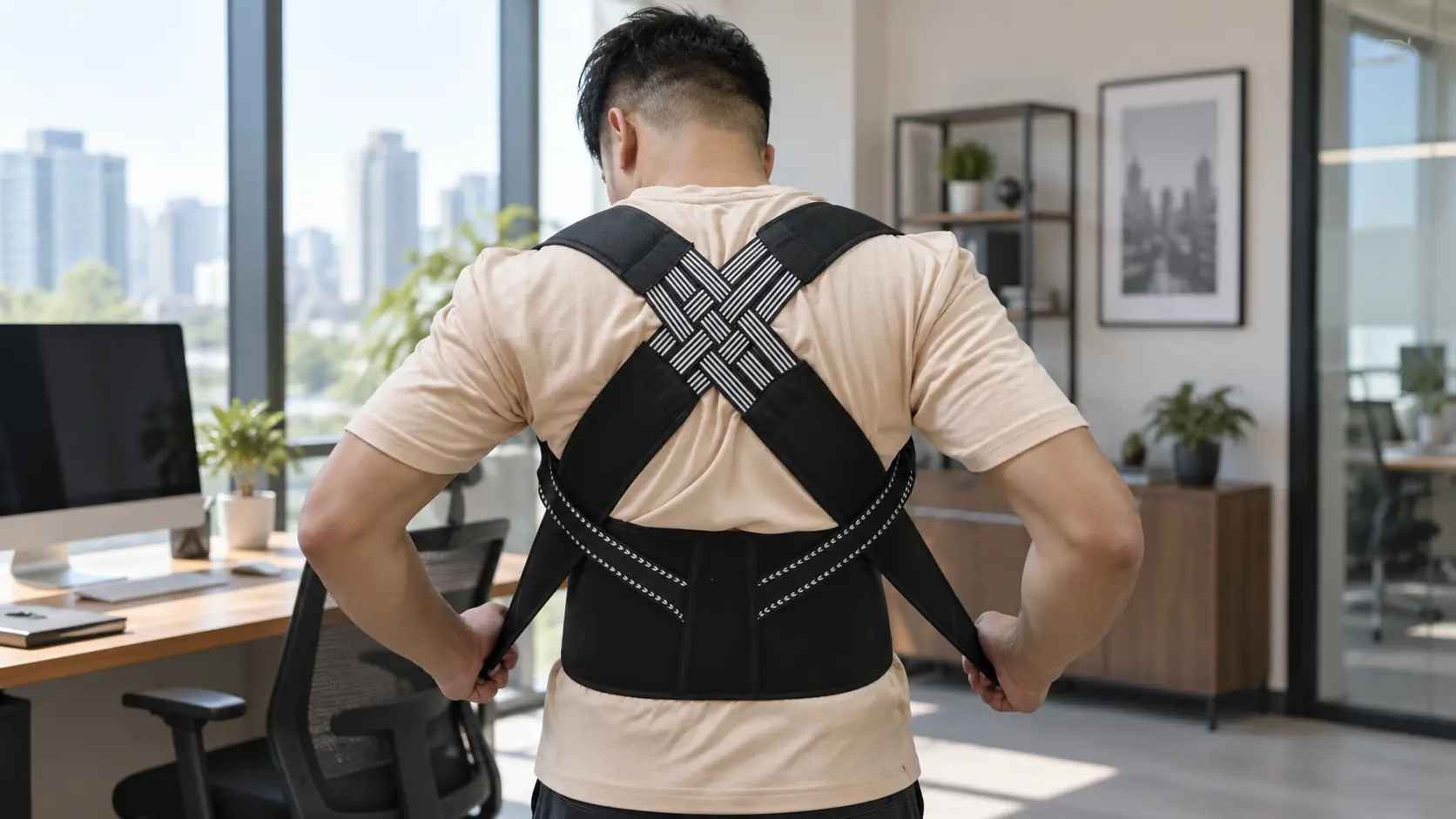
A posture corrector does one thing well: it holds your shoulders back while you wear it. The problem is what that teaches your body, and what it quietly ignores underneath.
Here is the honest, evidence-based read on posture braces and smart wearables for Singapore desk workers, what they actually do, where they backfire, and the one thing a strap can never reach.
The short version
- Posture correctors work while you wear them. In studies, posture reverts within minutes to an hour of taking the device off.
- They are an external prop for an internal problem: worn for hours, they let your own postural muscles do less, which is the opposite of what you want.
- They do nothing to the bones of your neck. A strap cannot change a flattened cervical curve or a fixed forward head.
- Used briefly and deliberately, they are a useful awareness cue, best paired with strengthening and a proper workstation, then weaned off.
- If your neck pain keeps returning, the driver is usually structure and habit, not a missing gadget, and that is a question for assessment, not another purchase.
Related reading
Do Posture Correctors Work?
Yes, and no, and the distinction is the whole point. Braces and smart wearables reliably improve how you sit or stand while they are on. Multiple studies show measurable posture improvement during use. The catch is consistent across the research: posture reverts to baseline within about 15 to 60 minutes of taking the device off. A 2025 systematic review found these devices can change thoracic posture in the short term, but there is no solid evidence the change lasts once the device is removed, and reviewers rated most of the studies as low quality.
So a posture corrector is not a fraud, and it is not a fix. It is a temporary awareness tool. Treated that way, it can help. Treated as a cure you strap on and forget, it does very little, and can quietly make things worse.
The External-vs-Internal Problem
A brace works by applying external tension across your shoulders, physically pulling them back. That is exactly where the trouble starts, because if the strap is doing the holding, your muscles are not.
When a brace holds you up, your own postural muscles work less, measurably.
In a randomised crossover trial during a 30-minute typing task, wearing a scapular brace significantly reduced trapezius muscle activity, including the lower trapezius, even though alignment looked better on the outside. That is the mechanism in one sentence: external support lowers the demand on the muscles that are supposed to hold you up. It is why physiotherapists warn that wearing a passive brace for long hours, day after day, can let the stabilising muscles switch off, and why the honest goal is the reverse: build the muscles, do not outsource them.
To be fair, this is a short-term study in healthy people, and it does not prove that a brace causes lasting weakness. But the direction is clear, and it lines up with what clinicians see: an external device can stack you up better for an afternoon while leaving the real drivers, weak shoulder-blade muscles, a tight chest, poor load through the neck, completely untouched, and sometimes worse for the disuse.
What a Strap Can Never Reach
Here is the part the marketing skips entirely. A posture corrector acts on soft tissue, pulling the shoulders. It does nothing to the bones and joints of the cervical spine. It cannot remodel vertebrae, it cannot reverse a flattened neck curve, and it cannot undo a forward head posture that has set into the structure.
That matters because the very thing people buy a brace to fix, the rounded, head-forward "tech neck" look, is often driven by exactly those structural and muscular changes. A strap can temporarily hold you in a better shape. It can also mask the discomfort just enough that you stop looking for the real cause while the underlying mechanics carry on. The relief is real; so is the delay.
✓ What a corrector can do
- Cue you to sit taller while it is worn
- Give a short-term reminder during a slump
- Reduce strain on overworked tissue briefly
- Act as training wheels early in a plan
✗ What it cannot do
- Strengthen the muscles that hold you up
- Change a flattened cervical curve or the bones
- Create posture that lasts once it is off
- Fix structural or nerve problems
Braces vs Smart Wearables
The market splits into passive braces (straps and vests that physically pull) and smart wearables (sensors that buzz when you slouch). They fail in different ways, but they share the same ceiling.
How the main types compare for a desk worker.
| Type | How it works | Best for | Key limitation |
|---|---|---|---|
| Smart wearables (Upright GO 2, Lumo Lift) | Sensor detects slouching and vibrates as a reminder | People who want a nudge and tracking, less restrictive than a strap | Only works while worn; no support; can misread posture |
| Corrective braces (straps, vests) | Elastic tension physically pulls the shoulders back | Short-term mechanical reminder during desk work | Muscle dependency with long wear; chafes in the heat |
| Posture shirts | Built-in elastic panels nudge underused muscles | Discreet wear under office clothes | Reviews find weak evidence of real effect |
| Smart cushions | Sensor cushion monitors how you sit | People who will not wear a device | Works at one desk only; nothing in meetings or commute |
Whichever you pick, notice the shared limitation in every row: the benefit is a reminder, and it stops when the device does. None of them builds capacity, and none of them touches structure.
The Singapore Reality
A few local realities matter more here than the brochures admit.
- The humidity problemA neoprene strap against your back in a Singapore commute or a warm office means sweat and chafing within the hour. Breathable mesh helps, but a clip-on sensor avoids the sweat trap entirely. Comfort decides whether you actually keep using it.
- Buggy tech is the norm, not the exceptionOwner reviews are full of crashing apps, weak or over-sensitive buzzing, fiddly setup, and connectivity drops. If a device nags you at the wrong moments, you stop wearing it, and a device in a drawer corrects nothing.
- The employer-monitoring questionPosture wearables deployed by an employer raise real privacy concerns: who sees the data, and does "posture compliance" become one more thing you are measured on. In a high-pressure office, that is worth thinking about before you opt in.
- The "half-lying in a chair" blind spotAngle-based sensors read your back relative to the device, so you can slump down into a chair with your neck bent and still be told your posture is "good." The gadget measures the sensor, not your neck.
Five Myths Worth Clearing Up
These come up again and again from real users, and each one is worth correcting before you spend.
“The device will fix my posture by itself.”
“Wearing it all day is good for me.”
“If it doesn’t work immediately, it’s a scam.”
“It’s safe for any pain or back issue.”
“The sensor catches every posture problem.”
How to Use One the Right Way
If you do want a corrector, use it as training wheels, not a wheelchair. The pattern that works, drawn from clinical guidance, is short bursts plus real strengthening, then weaning off.
- Weeks 1 to 2: short cuesWear the device during your worst slump, often the mid-afternoon, for 30 to 60 minutes (up to about two hours a day, no more). Do a quick posture reset twice daily and take a 30-second walk break every 30 minutes.
- Weeks 3 to 4: cut the device, add strengthReduce wear time by a quarter to a half, and add the real work: thoracic extensions, band pull-aparts (scapular retractions), chin tucks, and core stability, a few times a week.
- Week 5 onward: wean offAs the strengthening takes over, phase the device out. The goal is a neck and upper back that hold themselves, with the gadget as a memory of what "tall" feels like.
- Fix the desk in parallelA supportive chair and a screen at eye level address the cause of the slump. A brace is an awareness tool while you sort the workstation, not a substitute for it.
Clinical note
Patients bring me a drawer's worth of straps and clips and ask why nothing held. The honest answer is that a strap can pull your shoulders back for an afternoon, but it cannot build the muscles that should do that job, and it cannot touch the bones underneath.
If a corrector helps you notice when you slump, good, use it that way for a few weeks. Just do not expect the strap to be the thing that changes.
When It Is Structural, Not a Strap
For a healthy desk worker who slouches from habit, a corrector plus strengthening plus a better setup is a reasonable plan. But if your neck pain keeps returning no matter what you wear, the driver is usually the two things a strap cannot reach: the muscles that need building, and the structure underneath, a flattened cervical curve or a head that sits forward even when you sit square. That is a different problem, and no wearable measures or fixes it.
How assessment works here
Because the approach is structural, an assessment with Dr Kalla is based on a standing X-ray of your neck, not on how it looks or feels: bring your own films if they are under six months old, or you will be referred for one first. Radiating arm pain and tingling are assessed here; signs of possible nerve or spinal-cord damage, like losing the ability to tell a key from a coin by touch, are referred to a spine surgeon. Chiropractic is non-MOH and not Medisave-claimable. Seek urgent medical care for weakness, spreading numbness, unsteadiness, or pain after an injury.
Tried the braces and the apps, still slouching back into pain? That is usually structure and strength, not a missing gadget. A standing-X-ray assessment shows what is driving it, and you can see how other Singapore patients progressed first.
Book a pain assessment →One honest money note: a corrector costs S$30 to S$250, and for many people that money does more as a few physiotherapy sessions, a better chair, or an assessment that tells you what is actually wrong. Related desk-worker reading: neck and shoulder pain and upper back pain.
Frequently Asked Questions
Do posture correctors actually work?
They work while you wear them, but the effect does not last on its own. Studies show posture improves during use and reverts to baseline within about 15 to 60 minutes of taking the device off. There is no strong evidence that a corrector alone produces lasting postural change. Used as a short-term awareness cue alongside strengthening and better ergonomics, it can help; used as a standalone fix, it does very little.
Can wearing a posture brace weaken my muscles?
Overuse can, yes. When a brace holds your shoulders back, your own postural muscles work less, EMG studies show reduced trapezius activity while braced. Worn for long hours over weeks, physiotherapists warn this can let the stabilising muscles switch off, which is why the advice is short, deliberate use (around an hour a day), paired with strengthening, rather than all-day wear.
Is the Upright GO worth it for neck pain?
As an awareness cue, it can help; as a cure, no. Smart wearables like the Upright GO buzz when you slouch, which some people find genuinely useful during long desk sessions. But they only work while worn, provide no structural support, and cannot change a flattened neck curve. If your neck pain is persistent or radiating, a device is not the answer, and an assessment is.
How do I fix slouching at my desk?
Fix the setup, build the muscles, and move often, with a corrector only as an optional short-term cue. Raise your screen to eye level, support your lower back, keep the keyboard and mouse close, and take a short movement break every 30 to 60 minutes. Add thoracic extensions, band pull-aparts and chin tucks a few times a week. A brace can remind you to sit tall while you build these habits, then you wean off it.
How long should I wear a posture corrector each day?
Short sessions, not all day. Clinical guidance is roughly 30 to 60 minutes, up to about two hours at most, during your worst slouching period, then off. Wearing it longer risks letting your own muscles do less. Think of it as training wheels: use it briefly, strengthen in parallel, and phase it out over a few weeks.
Will a posture corrector fix a neck hump or forward head posture?
No. A strap acts on soft tissue and cannot remodel bone or reverse a structural change. It may temporarily hold you in a better shape, but it will not fix a neck hump or a flattened cervical curve on its own. Those need targeted strengthening and, where the change is structural and persistent, a proper assessment of the neck rather than a wearable.
The strap comes off. The slouch comes back.
If braces and apps have not settled a recurring neck, a standing-X-ray assessment can show whether the driver is structure and strength, which no wearable can reach.
Related reading
References
- Leung M, Kan MMP, Cheng HMH, De Carvalho DE, Anwer S, Li H, Wong AYL. Effects of using a shoulder/scapular brace on the posture and muscle activity of healthy university students during prolonged typing: a randomized controlled cross-over trial. Healthcare (Basel). 2023;11(11):1555. doi:10.3390/healthcare11111555. PMC
- Occupational Safety and Health Administration (OSHA). Computer workstations eTool: working postures. osha.gov
- Blanpied PR, Gross AR, Elliott JM, et al. Neck Pain: Revision 2017. Clinical Practice Guidelines. J Orthop Sports Phys Ther. 2017;47(7):A1-A83. PMID 28666405. PubMed
This article is educational information only and is not medical advice, diagnosis, or a treatment recommendation for your individual situation. Product names are examples for context, not endorsements; specifications and pricing change. Forum descriptions are anecdotal. Chiropractic care is not MOH-registered in Singapore and is not a substitute for medical or surgical care. If you have arm or hand numbness, weakness, dizziness, or pain that wakes you at night, seek medical assessment promptly.