

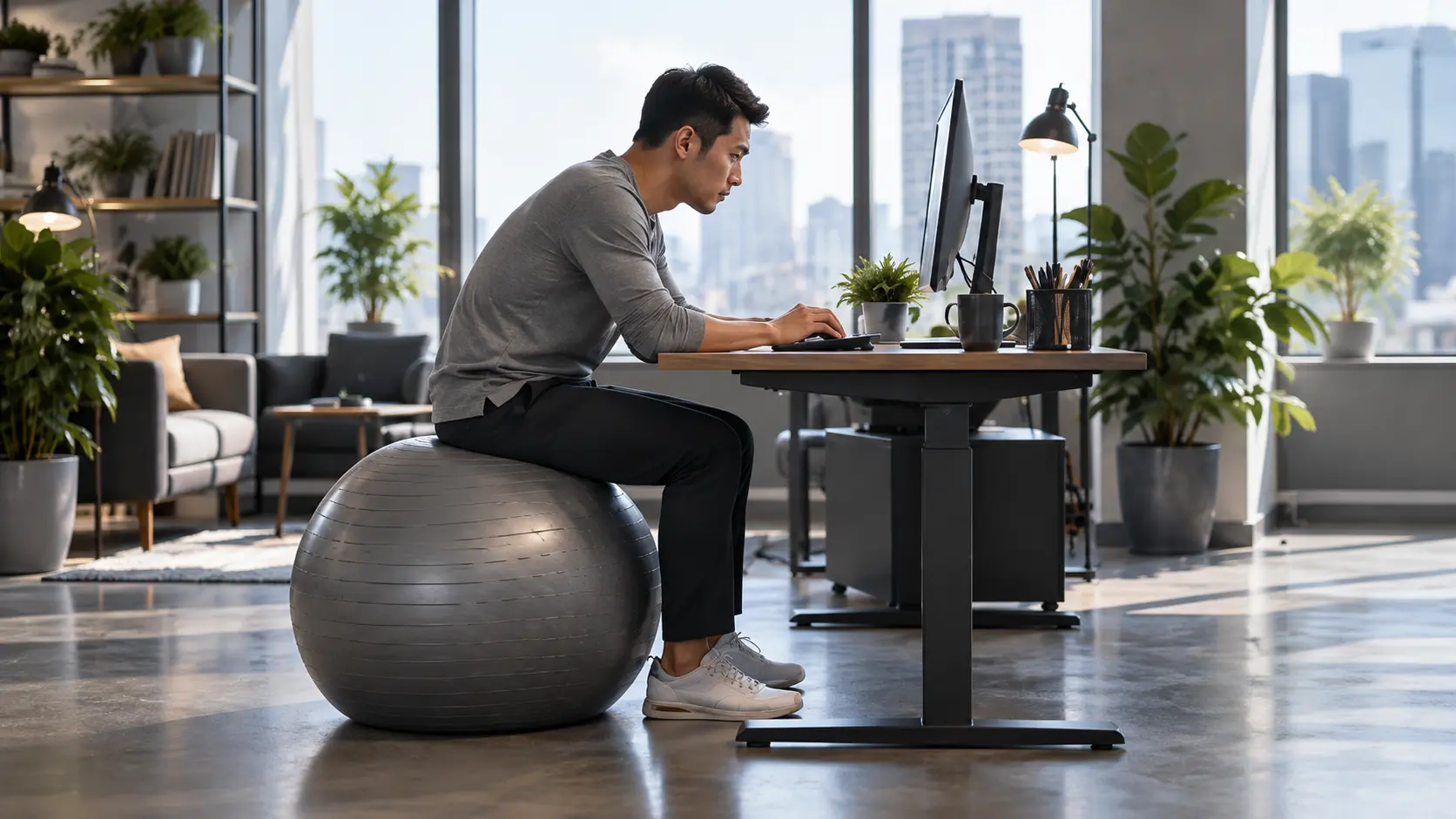
“Active sitting” on a balance ball promises a core workout while you work. The biomechanics say the opposite: over a full day it fatigues the very muscles meant to hold you up, and then quietly pushes your head forward.
Here is the honest, evidence-based read for Singapore desk workers, what the research actually found, why a ball accelerates tech neck as an all-day chair, and the narrow window where it genuinely helps.
The short version
- Over an hour, a balance ball gives no worthwhile core-activation benefit versus a chair, and measurably more discomfort and spinal disc compression.
- The “core engagement” is real only in short bursts. Across a workday, postural muscles fatigue, and you slump.
- Once the base collapses, the neck becomes the shock absorber: the head juts forward to keep your eyes on the screen, which is exactly what drives tech neck.
- A ball is a good 10 to 20 minute movement tool, and a poor 8-hour chair. Those are not the same thing.
- If you have used a ball to “fix your posture” and now get daily tension headaches, you have hit the ergonomic ceiling, and the question moves from hardware to structure.
Related reading
The Quick Verdict
A balance ball is not useless, and it is not a chair. As a short, intentional movement break it has a place. As a primary seat for an eight-hour knowledge-work day, it accelerates tech neck rather than preventing it. The reason is simple: the promised benefit (constant core engagement) is exactly the thing that fails you, muscles cannot hold a low-level contraction for eight hours, and when they tire on a seat with no backrest, the only way left to stay upright is to slump.
What the Research Actually Found
The “exercise while you sit” claim has been tested directly, and it does not hold up over a realistic sitting period.
Over an hour, a ball gave no worthwhile posture or muscle benefit, but more discomfort and more disc compression.
In a University of Waterloo study (Gregory, Dunk & Callaghan, 2006), 14 people sat for an hour on a stability ball and an hour in an office chair. The ball produced no meaningful advantage in posture or trunk-muscle activation, and significantly more low-back discomfort. A second study (Kingma & van Dieën, 2009) found that over a one-hour typing task the ball drove higher lumbar muscle load and greater spinal shrinkage, a measure of disc compression, than an office chair with armrests. The small increase in movement the ball allows does not offset those costs. In short: the core-workout effect is minor and short-lived; the fatigue and compression are not.
This matters because the marketing rests entirely on the muscle-activation claim. Once that benefit turns out to be small, brief, and outweighed by discomfort and disc load, the case for using a ball as your everyday chair collapses, and so, over the day, does your posture.
The Fatigue-Collapse Mechanism
Here is the chain, step by step, and why the neck is where it ends up. Postural muscles are built for intermittent work with regular rest, not continuous low-grade contraction. On a ball, they get the opposite.
- The core fatigues, earlyHolding an unstable seat upright is constant low-level work for the deep trunk stabilisers. Over the first part of the workday they tire, well before you consciously notice.
- With no backrest, the base collapsesA chair’s backrest lets your spine offload and rest between tasks. A ball has none, so when the stabilisers fatigue, the pelvis tilts back, the lower back flattens, and the upper back rounds into a C-shape.
- The neck becomes the shock absorberYour eyes still need to face the screen. So as the trunk collapses, the cervical spine compensates: the head translates forward and the chin pokes up to keep your gaze horizontal. The neck absorbs the postural failure happening below it.
- Forward head posture, held for hoursThat forward-head position loads the muscles at the back of the neck and shifts the head’s weight in front of the shoulders, the exact mechanics behind tech neck, upper-trap tension and tension headaches. Repeated day after day, it is associated with a gradual loss of the neck’s natural curve.
The important insight: the ball does not cause tech neck by being “bad” in itself. It causes it by removing the support that would otherwise stop a fatigued body from collapsing, and by making that collapse arrive faster than it would in a supportive chair.
Feeling Active Is Not Being Ergonomic
There is a second, quieter reason a ball fails during real work, and it is worth stating with appropriate caution, because the evidence here is softer than the biomechanics above. Research on cognitive load and posture suggests that when a task gets demanding, a complex spreadsheet, a difficult email, the brain deprioritises fine postural control and lets the body drift to its lowest-effort position.
On a supportive chair, that lowest-effort position is at least partly held by the backrest and seat. On a ball, there is nothing to catch you, so “locked in” on the work often means slumped on the seat, without noticing. The unstable surface that was supposed to keep you active instead competes for attention you are spending on the task. For deep-focus roles, the honest framing is that a chair should reduce the number of things your body has to manage, not add one.
The 20-Minute Tool vs the 8-Hour Trap
None of this makes the ball worthless. Used correctly, it is a genuinely useful movement accessory, the problem is only the all-day rebrand as a chair. Discs are nourished by movement, and short bursts of position change help; an eight-hour static load, microscopic wobbling included, does the opposite.
✓ The 20-minute tool
- 10 to 20 minutes, one to three times a day
- Gentle pelvic tilts, thoracic extensions, seated marches
- A break from a proper chair, not a replacement
- Stop at the first sign of lower-back or shoulder fatigue
✗ The 8-hour trap
- Replacing your desk chair for the whole day
- Expecting “core engagement” to replace lumbar support
- Never truly offloading the spine
- A repetitive cycle of fatigue, slump and neck compensation
A useful rule of thumb: if you need willpower to hold neutral posture on a seat, it is not a primary work chair. A good ergonomic chair makes neutral posture the default even when your attention drifts. A ball makes neutral posture a continuous task you will eventually lose.
For employers & safety leads
For an ergonomics programme, the defensible position is clear: do not endorse balance balls as primary desk chairs for full-day screen roles. Classify them as optional movement tools for limited use (10 to 20 minutes, one to three times a day), and prioritise investment in adjustable ergonomic chairs, lumbar support, backrest recline and armrests, for every seated role. An eight-hour ball-chair policy runs against basic load-management and recovery principles and raises neck, shoulder and back-pain risk rather than lowering it.
Ball vs Chair: The Support Deficit
Set side by side, the gap is not about “movement” versus “static.” It is about what happens when your muscles inevitably tire.
What a ball lacks that a good chair provides, and why it matters for the neck.
| Feature | Balance ball | Adjustable ergonomic chair |
|---|---|---|
| Lumbar support | None; curve held only by fatigable muscle | Contoured support keeps the low-back curve as muscles rest |
| Backrest / recline | None; no way to offload the spine | Lets the spine rest between tasks, lowering cumulative load |
| Armrests | None; arms hang, loading neck and upper traps | Support forearms, keeping shoulders relaxed |
| Height adjustment | Coarse; often forces neck or shoulder compensation | Fine control to match desk and screen height |
| Effect over 8 hours | Fatigue, slump, forward head, disc compression | Neutral posture sustainable with far less effort |
For the actual desk, chair and screen numbers that make a chair work, our workstation setup guide has them. The headline here: the ball’s missing features are exactly the ones that protect the neck once you stop paying attention to your posture.
When It Is Structural, Not the Seat
Here is the ceiling. If you have been using a ball to “train” your posture for months and you are now getting daily neck and shoulder tension or tension headaches, the message is not “try harder on the ball.” It is that the muscles have been losing this battle for a while, and when a forward-head pattern is held long enough, the structure underneath, the neck’s curve and the way it sits over the shoulders, can shift with it. At that point, a different seat lowers the daily load but does not reverse what has already changed.
How assessment works here
Because the approach is structural, an assessment with Dr Kalla is based on a standing X-ray of your neck, not on how it looks or feels: bring your own films if they are under six months old, or you will be referred for one first. Radiating arm pain and tingling are assessed here; signs of possible nerve or spinal-cord damage, like losing the ability to tell a key from a coin by touch, are referred to a spine surgeon. Chiropractic is non-MOH and not Medisave-claimable. Seek urgent medical care for weakness, spreading numbness, unsteadiness, or pain after an injury.
Swapped the chair, the ball, the standing desk, and still stiff by 3pm? That is usually the ergonomic ceiling, not a missing accessory. A standing-X-ray assessment shows whether structure is the reason, and you can see how other Singapore patients progressed first.
Book a pain assessment →The sensible plan: keep a good ergonomic chair as your main seat, use the ball for short, deliberate movement breaks, and move often. If the neck keeps flaring no matter what you sit on, that is the signal it was never really the seat. Related desk-worker reading: upper back pain.
Frequently Asked Questions
Is sitting on a balance ball good for your posture?
Not as an all-day chair. Over a realistic sitting period, studies show a ball gives no worthwhile posture or core benefit versus a chair, and produces more discomfort and greater spinal disc compression. Any “core engagement” is small and short-lived; once the muscles fatigue you slump, and without a backrest that means a rounded back and a forward head, which worsens tech neck. As a short movement break it is fine; as your main seat it is not.
Does a balance ball cause neck pain?
Used all day, it can contribute to it. A ball has no backrest, lumbar support or armrests, so when your trunk muscles tire, the base of your spine collapses and the neck compensates by pushing the head forward to keep your eyes on the screen. That sustained forward-head posture loads the neck and upper traps and is a key driver of tech neck and tension headaches. The problem is the duration and lack of support, not a single sitting session.
Balance ball or ergonomic chair, which is better for a desk job?
For a full workday, an adjustable ergonomic chair is clearly better. It provides lumbar support, a backrest to offload the spine, armrests, and fine height adjustment, so neutral posture is sustainable even when your attention is on the task. A ball lacks all of these, so posture depends entirely on muscles that fatigue. Use the chair as your primary seat and the ball only for short, intentional movement breaks.
How long should I sit on an exercise ball?
Short, timed blocks, not all day. Around 10 to 20 minutes, one to three times a day, used as a movement break from a proper chair, is a sensible ceiling. Stop at the first sign of lower-back fatigue or your shoulders creeping up. Beyond that, the stabilising muscles tire and posture drifts into a slump, which is when the ball starts working against your neck rather than for it.
Does active sitting strengthen your core?
Barely, and not enough to matter for posture. Sitting on an unstable surface raises muscle activity only slightly and briefly; it is nothing like a real core workout, and the effect fades as the muscles fatigue. Studies comparing a ball with a chair over an hour found the muscle-activation difference minor and outweighed by increased discomfort. If you want a stronger core, dedicated exercise does far more than an unstable seat.
I use a ball and now get daily tension headaches. What does that mean?
It usually means you have hit the ergonomic ceiling. Daily tension headaches alongside neck and shoulder tightness suggest a sustained forward-head pattern that hardware changes are no longer resolving. When that pattern has been held for a long time, the structure of the neck can shift with it, and a different seat lowers the load without reversing the change. That is the point to get the neck assessed rather than buy another accessory. Persistent or worsening headaches should also be reviewed by a doctor.
Tried every seat. Still stiff by 3pm?
If a chair, a ball and a standing desk have not settled a recurring neck, a standing-X-ray assessment can show whether the ceiling you keep hitting is structural.
Related reading
References
- Gregory DE, Dunk NM, Callaghan JP. Stability ball versus office chair: comparison of muscle activation and lumbar spine posture during prolonged sitting. Hum Factors. 2006;48(1):142-153. PMID 16696264. PubMed
- Kingma I, van Dieën JH. Static and dynamic postural loadings during computer work in females: sitting on an office chair versus sitting on an exercise ball. Appl Ergon. 2009;40(2):199-205. PMID 18508028. PubMed
- Occupational Safety and Health Administration (OSHA). Computer workstations eTool: seating and working postures. osha.gov
- Blanpied PR, Gross AR, Elliott JM, et al. Neck Pain: Revision 2017. Clinical Practice Guidelines. J Orthop Sports Phys Ther. 2017;47(7):A1-A83. PMID 28666405. PubMed
This article is educational information only and is not medical advice, diagnosis, or a treatment recommendation for your individual situation. Product examples are for context, not endorsements. Chiropractic care is not MOH-registered in Singapore and is not a substitute for medical or surgical care. If you have arm or hand numbness, weakness, dizziness, or pain that wakes you at night, seek medical assessment promptly.